
US Strikes Iranian Launchers On Larak Island In First Military Action In Weeks, Tehran Vows Revenge
US forces struck 2 Iranian rocket launchers on Larak Island in Strait of Hormuz after spotting sea mine preparations, first attack in a month, triggering an IRGC retaliation as Trump maintains zero tolerance policy amid reduced oil traffic.
- Global News
- 5 min read

;'%3e%3cpath%20d='m8,15.99c4.41,0,7.99-3.58,7.99-7.99S12.41,0,8,0,0,3.59,0,8s3.58,7.99,7.99,7.99Z'%20style='stroke:%23fff;%20stroke-miterlimit:10;%20stroke-width:.02px;'/%3e%3cpath%20d='m3.08,3.37l3.82,5.11-3.84,4.15h.87l3.37-3.64,2.72,3.64h2.94l-4.04-5.39,3.58-3.87h-.86l-3.1,3.35-2.5-3.35h-2.94Zm1.27.64h1.35l5.97,7.99h-1.35l-5.97-7.99Z'%20style='fill:%23fff;'/%3e%3c/g%3e%3c/svg%3e)


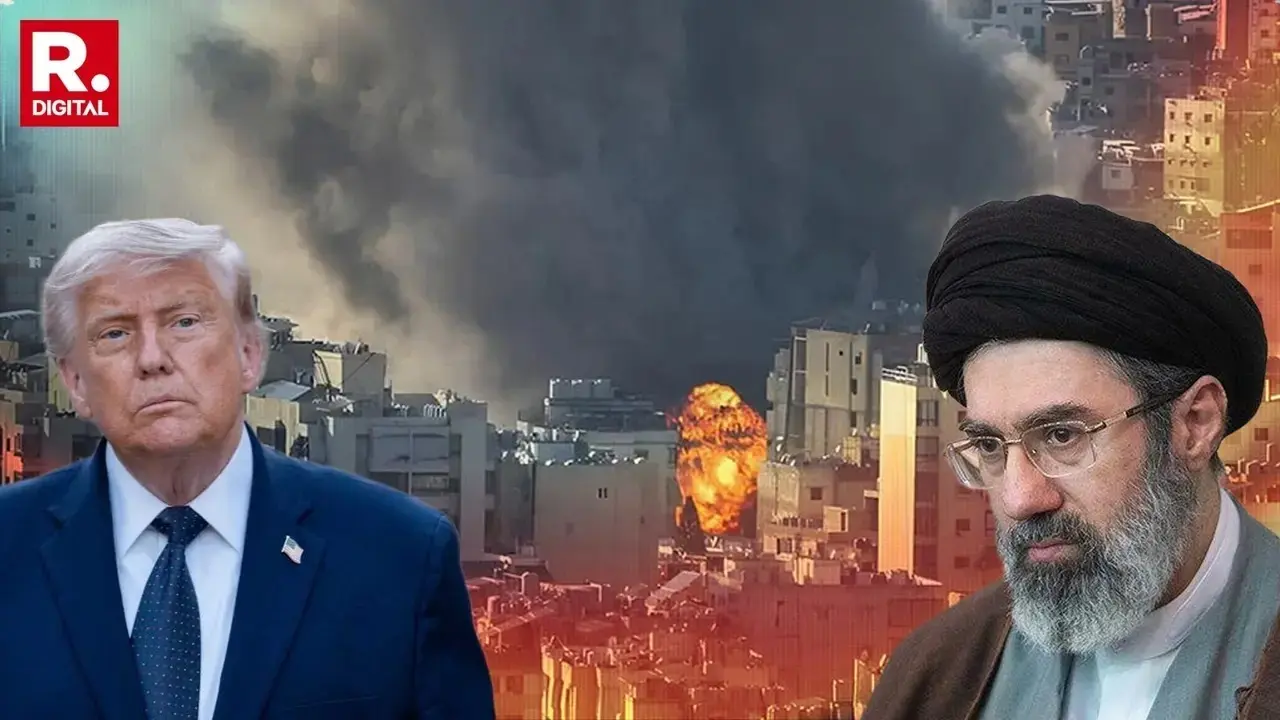
Tehran: The US military has struck Iranian rocket launchers positioned on the Strait of Hormuz in the first military action in a month, ending a brief gap in an intermittent conflict that has now stretched beyond 6 months. The operation, carried out on Sunday, targeted installations on Larak Island after American surveillance detected preparations for a sea mine deployment.
The fresh escalation has once again raised tensions around one of the world's most critical shipping lanes. According to Washington, the strike was a pre-emptive measure after Islamic Revolutionary Guard Corps (IRGC) personnel were observed readying rockets armed with sea mines to be launched into the waterway. The fresh attack is understood to be the first known American attack inside Iranian territory since late July, when President Donald Trump paused a 2-week military campaign linked to the strait.
A US official confirmed the operation to Reuters, stating that American forces had destroyed 2 Iranian launchers on Larak Island. The official stated that the IRGC forces were seen preparing to launch rockets carrying sea mines into the Strait of Hormuz and added that the US forces remained prepared to protect the free flow of commerce. US Central Command (US CENTCOM) spokesperson Tim Hawkins stated that IRGC forces had been observed preparing the launch, while the US military noted it had completed clearing sea mines from the strait's international shipping routes just last week.
US Declares Zero Tolerance, Iran Vows Punishment
Following the US strikes, the IRGC responded, saying that the attack would be answered by the sons of Iran and would result in the punishment of the aggressor, a statement carried by Iran's state broadcaster. The semi-official news outlets in Iran reported sounds of explosions near Larak Island, with the IRGC acknowledging the martyrdom and injury of several of the fighters and compatriots.
Advertisement
IRGC spokesperson General Hossein Mohebi termed Sunday's attack a fatal mistake by the Trump administration during the economic war, warning that the enemy would pay the consequences militarily and economically. The Iranian state broadcaster IRIB reported that several Iranian personnel and civilians were killed and wounded, while Tasnim News Agency, which is affiliated with the IRGC, separately reported that a drone carried out the strike, killing 2 people and wounding 2 others. The IRGC's spokesperson also asserted that the United States would pay for the attack on both economic and military fronts.
Donald Trump had issued a serious warning to Tehran after the mine-clearing operation, writing on Truth Social that any ship or boat involved in placing new mines would be immediately and systematically destroyed and that there is a Zero Tolerance policy on mine placement in full force and effect.
Advertisement
Economic Pressure Replaces Military Focus
The US forces carried out strikes just days after the Trump administration signalled a shift in strategy from military action to increasing economic pressure to try to end the war with Iran, which began on February 28. The new approach centres on threatening to punish any country or entity that continues to conduct business with Tehran. Last week the Trump administration announced so-called D-Day sanctions to squeeze Iran financially, with threats of secondary sanctions.
The change of strategy is crucial as Washington weighs diminished munitions stockpiles after months of war, raising concerns that the prolonged conflict could undermine US military readiness elsewhere. Trump has stressed that he is not in a hurry to get Iran back to the negotiating table, while continuing to stress that the Islamic Republic's leadership is on the ropes. However, recent appointments to Iran's senior security leadership have signalled defiance after decades of sanctions and little tolerance for dissent.
As per reports, Tehran has continued to lean on the strait for leverage as Iran retains enough drones and missiles to target vessels transiting the waterway, through which 20% of the world's oil normally flows, and maintains that even after working out a management plan with Oman, the US cannot use it until it fulfils the obligations under a memorandum of understanding (MoU) signed in mid-June. Trump has repeatedly declared that the Strait of Hormuz is open, saying 24 vessels passed through last week, a fraction of the around 130 vessels that transited daily before the war.
A multinational coalition overseen by the US Navy said that commercial traffic remained at reduced levels. On Saturday, the United Kingdom Maritime Trade Organisation (UKMTO) asserted that an unknown projectile struck a tanker north of Khasab, Oman, with no casualties or environmental impact reported. The US military emphasised on Sunday that it had redirected 83 commercial vessels and disabled 3 under the blockade of Iranian ports. Washington has also asserted that sanctions and the blockade are pushing Iran towards economic collapse, while Tehran insisted that it is prepared for a prolonged conflict and points to 270 billion dollars in direct and indirect damage.
Why Larak Island Matters
Larak is a small Iranian island in the Strait of Hormuz, located off the coast of Bandar Abbas, east of Qeshm Island and south of Hormuz Island. Covering around 49 square km, the location gives the island outsized strategic importance as it sits close to one of the world's most important maritime choke points linking the Persian Gulf with the Gulf of Oman.
The island is home to an Iranian Islamic Revolutionary Guard Corps Navy base and has long had military importance because of the position overlooking shipping routes, with historical accounts recording missile sites and military installations there. The role is tied directly to the strait, through which about one-fifth of the world's oil and liquefied natural gas shipments passed before the current conflict disrupted traffic.