
White House Hits Back With Ban On Canadian Dairy, Booze And Bikes After Ottawa Slaps $20 Billion Tariffs
White House bans Canadian dairy, alcohol and motorcycles from the US as Canada slaps tariffs on $20 billion of US goods and PM Mark Carney vows to cut US dependence and pursue closer EU ties amid escalating trade war with Trump now.
- Global News
- 5 min read

;'%3e%3cpath%20d='m8,15.99c4.41,0,7.99-3.58,7.99-7.99S12.41,0,8,0,0,3.59,0,8s3.58,7.99,7.99,7.99Z'%20style='stroke:%23fff;%20stroke-miterlimit:10;%20stroke-width:.02px;'/%3e%3cpath%20d='m3.08,3.37l3.82,5.11-3.84,4.15h.87l3.37-3.64,2.72,3.64h2.94l-4.04-5.39,3.58-3.87h-.86l-3.1,3.35-2.5-3.35h-2.94Zm1.27.64h1.35l5.97,7.99h-1.35l-5.97-7.99Z'%20style='fill:%23fff;'/%3e%3c/g%3e%3c/svg%3e)


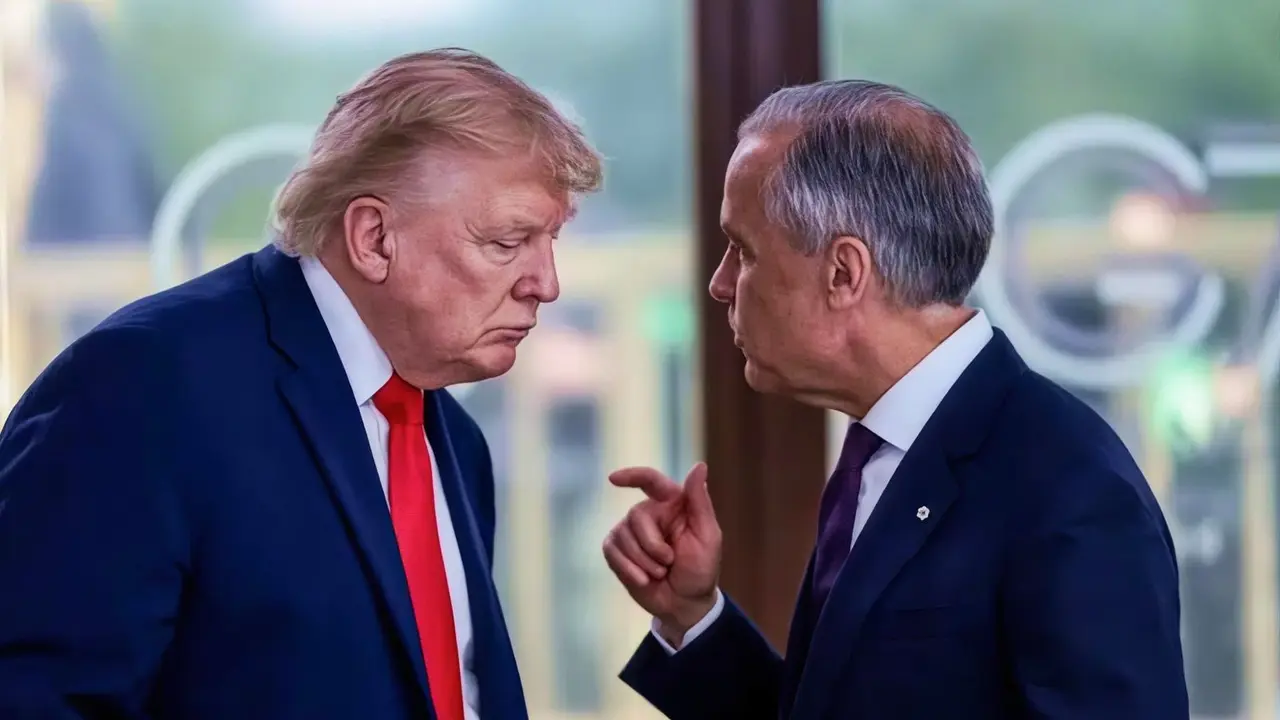
Washington: The White House has announced a ban on dairy products, most alcoholic drinks and motorcycles from Canada, intensifying an already bitter trade conflict between the two longstanding allies. According to reports, the measure will come into force in 3 weeks.
The Trump administration imposed a ban on the same day that Ottawa imposed retaliatory duties on around $20 billion worth of American imports. The event also followed a separate directive from US President Donald Trump instructing the General Services Administration (GSA) to make Canadian goods ineligible for large, long-term federal procurement contracts until Canada grants “full and fair reciprocity” for the US products.
Canadian Prime Minister Mark Carney asserted on Tuesday that Canada's response was part of an effort to secure greater self-reliance. “It’s about ensuring that no country can hold us hostage. And that we can live how we want to live,” he said.
Canada Explores European Option
According to a Canadian official familiar with the discussions, behind the tariff exchange, Ottawa is quietly examining a far closer relationship with the European Union (EU), one that could fall just short of full membership. The official, who spoke on condition of anonymity because he was not authorised to discuss the matter publicly, stated that the options under review range from existing accords to negotiating an entirely new treaty or building other forms of cooperation.
Advertisement
The provinces, territories and labour groups are already being consulted on what a deeper EU partnership might entail, though no specific model has been chosen. The disclosure is deemed crucial as Carney prepares to travel to Strasbourg next week, where he is scheduled to attend European Commission President Ursula von der Leyen’s State of the European Union address on September 16 and to address the European Parliament the following day.
The US-Canada fallout has capsized one of the closest bilateral relationships in the world. Canada and the United States share deeply integrated economies and blended defence and security links, though Trump has rolled out a succession of duties on Canadian goods despite negotiating and repeatedly praising the North American trade agreement during his first term. The latest ban and duties on many products are considered to breach the pact between the two neighbours.
Advertisement
Push To Cut Reliance On US
Mark Carney acknowledged that the trade measures would bring short-term pain but stressed that they would accelerate investment, infrastructure development and diversification. “It was easy business, but it meant we relied too much on one economic partner……That time is over,” he said.
However, the scale of the challenge remains intense, with over 70% of Canadian exports still destined for the US. Canadian PM Carney emphasised that shipments to other markets were climbing rapidly and were on course to double within a decade.
Ottawa defended the Canadian retaliation as unavoidable, saying it could not allow American goods to enter tariff-free while Canadian firms face US levies. The government insisted that it does not want to escalate, but that the duties are needed to protect Canadian workers.
According to Carney, the deeper problem emerged during the failed negotiations, which collapsed on August 21. “The most fundamental issue is that the cumulative US demands revealed that they wanted us to become even more reliant on them, not less,” he said.
The Canadian PM stated, “In too many areas, they wanted dependency, not a true economic partnership.” He said that Washington had sought curbs on French-language and cultural protections, influence over Canada's future trade deals and conditions that would weaken the automotive, steel and forestry sectors.
No Rush Back To Talks
The experts suggested that how the dispute is resolved could resonate well beyond Ottawa and Washington, testing whether a smaller US ally can withstand economic pressure from Trump without being compelled to capitulate. Earlier on Tuesday, a Canadian official asserted that Ottawa would not alter course whether Trump did nothing or unleashed a “nuclear response". He said that the focus would stay on building domestic capacity and broadening trade abroad.
Canada’s new tariffs cover hundreds of US products, including steel, aluminium, cheese, household appliances, clothing, cosmetics and farm machinery, at rates of 15%, 25% or 50%. They apply to around $20 billion in goods, about 6% of the $333.6 billion the US exported to Canada last year.
Since the collapse of talks, Trump and his administration have added further tariffs and issued a series of jibes portraying Canada as weak and dependent, alongside repeated suggestions that Canada should become the 51st state. The rhetoric has triggered massive anger in Canada, with Canadians sharply reducing travel to the US and boycotting US products, a response Carney has praised as a sign of national resolve.
British Columbia Premier David Eby outlined that his province would erect new signs at US border crossings stating, “Welcome to British Columbia, Canada. Strong, proud and will NEVER be the 51st state. Sorry!”
He added, “While our kindness is one of our greatest strengths, you should never, ever mistake that kindness for weakness.”
At present, neither side appears eager to return to the negotiating table, with Gabriel Brunet, a spokesman for Canada-US Trade Minister Dominic LeBlanc, stating that the officials remain in contact even though formal discussions have not resumed. Former US trade official Wendy Cutler said that Carney’s approval rating, now above 70%, gives him little incentive to restart talks. “Clearly, at this point each side does not want to look too anxious to reengage in fear of looking weak,” she said.
Now, the dispute over tariffs has become a defining test of sovereignty and economic identity for both neighbours. With dairy, alcohol and motorcycles now caught in the ban, steelworkers and farmers facing fresh duties, and border towns bracing for fewer crossings, the cost is no longer abstract. In the present moment, the old assumption that Canada and the US would always find a way to compromise has given way to something far less predictable, as two countries are now learning to live apart.