
Delhi's AQI dips to 'very poor' category due to stubble burning, says SAFAR
Delhi's air quality slipped even deeper into the 'poor' category on Friday, with the share of stubble burning in the capital's PM2.5 pollution hitting 20%.
- India News
- 2 min read

;'%3e%3cpath%20d='m8,15.99c4.41,0,7.99-3.58,7.99-7.99S12.41,0,8,0,0,3.59,0,8s3.58,7.99,7.99,7.99Z'%20style='stroke:%23fff;%20stroke-miterlimit:10;%20stroke-width:.02px;'/%3e%3cpath%20d='m3.08,3.37l3.82,5.11-3.84,4.15h.87l3.37-3.64,2.72,3.64h2.94l-4.04-5.39,3.58-3.87h-.86l-3.1,3.35-2.5-3.35h-2.94Zm1.27.64h1.35l5.97,7.99h-1.35l-5.97-7.99Z'%20style='fill:%23fff;'/%3e%3c/g%3e%3c/svg%3e)


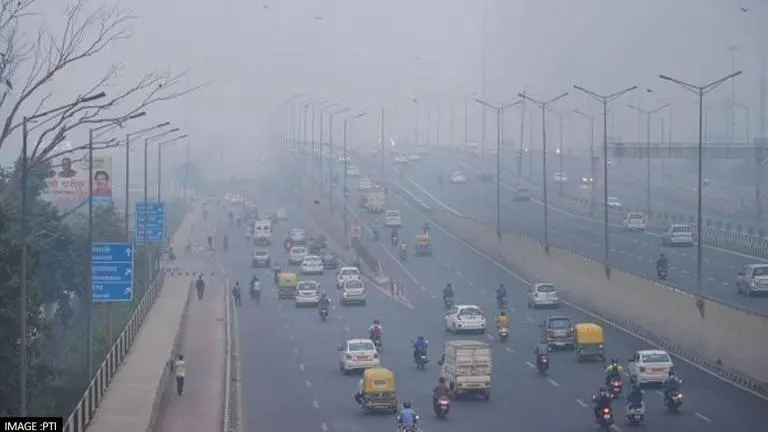
On Friday, Delhi's air quality slipped even deeper into the 'poor' category, with the share of stubble burning in the capital's PM2.5 pollution hitting 20%, the highest level so far this season. SAFAR, the air quality forecasting office of the Ministry of Earth Sciences, reported 1,112 farm fires in Delhi's northwest region on Thursday.
According to data from the Central Pollution Control Board (CPCB), the national capital had an AQI of 283, Faridabad 289, Ghaziabad 321, Greater Noida 284, Gurugram 262, and Noida 282. An AQI of zero to fifty is deemed "good," fifty-one to one hundred "satisfactory," 101 to 200 "moderate," 201 to 300 "poor," 301 to 400 "very poor," and 401 to 500 "severe."
On Thursday, the Sub-Committee on Graded Response Action Plan (GRAP) instructed authorities in Delhi and the NCR states to stop utilizing diesel generator sets and improve bus and metro service frequency. The panel was warned by Dr V K Soni of the India Meteorological Department (IMD) that north-westerly winds will persist until the morning of November 1 and may push air quality into the "very poor" category.
AQI in Delhi stands in the very poor category
With increased moisture, the minimum temperature is predicted to drop to 14-15 degrees Celsius, which is unfavourable for pollution dispersion. In light of this, the sub-committee requested that Delhi and the NCR states implement measures in the "very poor" category in addition to the GRAP's "poor" and "moderate" AQI categories. The GRAP, a collection of anti-pollution measures implemented in Delhi and its surrounding cities based on the severity of the problem, goes into effect in mid-October, when air pollution levels in the region begin to worsen.
Advertisement
The GRAP, which was announced by the Ministry of Environment and Forests in 2017, includes increasing bus and metro services, raising parking costs, and prohibiting the use of diesel generator sets when air quality becomes "very poor." When the situation becomes "severe," the GRAP suggests closing brick kilns, stone crushers, and hot-mix plants, spraying water, frequent mechanised road cleaning, and maximising natural gas power generation. Stopping trucks from entering Delhi, banning construction operations, and implementing an odd-even car-rationing scheme are among the measures to be implemented in the "emergency" situation.