
Amid Strait Of Hormuz Crisis, QUAD Unveils Big Indo-Pacific Surveillance Plan; What Is Marco Rubio’s New Maritime Initiative? | Explained
The QUAD nations, India, the US, Japan and Australia, have announced a new Indo-Pacific Maritime Surveillance initiative amid growing tensions over the Strait of Hormuz and rising concerns around maritime security. US Secretary of State Marco Rubio said the initiative aims to boost real-time information sharing and protect critical shipping routes across the Indo-Pacific.
- India News
- 3 min read

;'%3e%3cpath%20d='m8,15.99c4.41,0,7.99-3.58,7.99-7.99S12.41,0,8,0,0,3.59,0,8s3.58,7.99,7.99,7.99Z'%20style='stroke:%23fff;%20stroke-miterlimit:10;%20stroke-width:.02px;'/%3e%3cpath%20d='m3.08,3.37l3.82,5.11-3.84,4.15h.87l3.37-3.64,2.72,3.64h2.94l-4.04-5.39,3.58-3.87h-.86l-3.1,3.35-2.5-3.35h-2.94Zm1.27.64h1.35l5.97,7.99h-1.35l-5.97-7.99Z'%20style='fill:%23fff;'/%3e%3c/g%3e%3c/svg%3e)


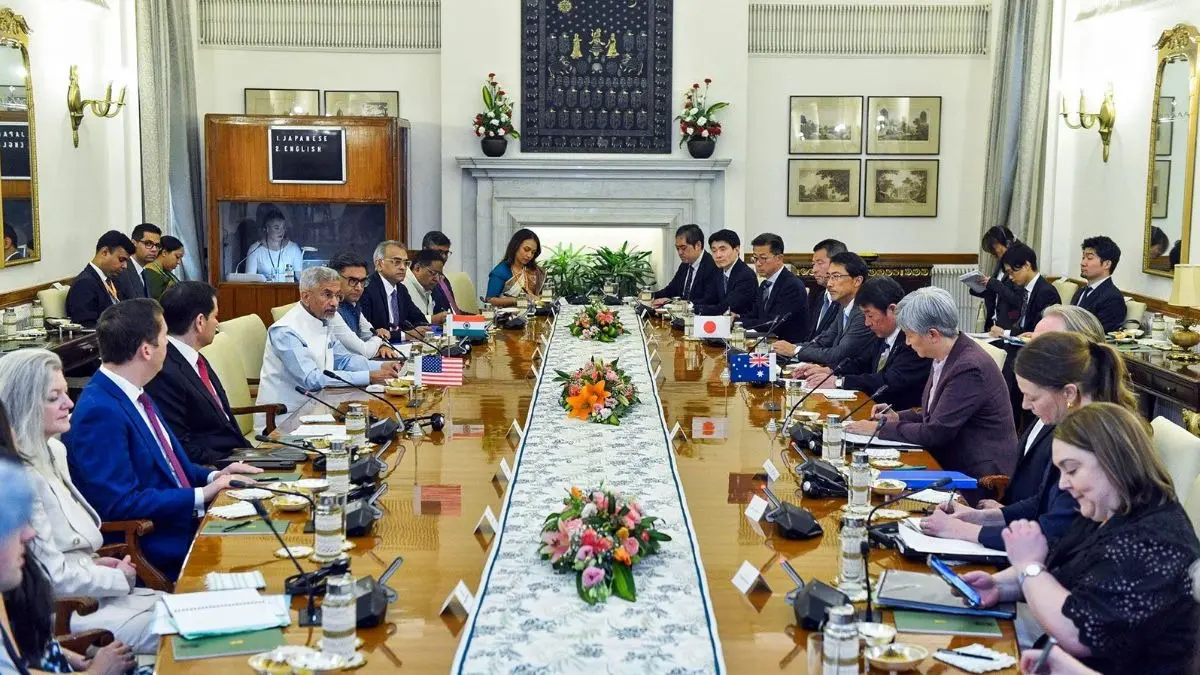
Against the backdrop of escalating tensions in the Strait of Hormuz and growing geopolitical uncertainty in the Indo-Pacific, the QUAD nations on Tuesday announced a major new maritime surveillance initiative aimed at securing key global trade routes and strengthening regional coordination.
The announcement came during the QUAD Foreign Ministers’ Meeting in New Delhi, attended by External Affairs Minister S Jaishankar, US Secretary of State Marco Rubio, Australian Foreign Minister Penny Wong and Japanese Foreign Minister Toshimitsu Motegi.
Rubio announced the launch of the Indo-Pacific Maritime Surveillance Cooperation initiative, describing it as one of the QUAD’s key “real achievements” as the grouping shifts from being a “talk shop” to a “partnership of action”.
What Is The Indo-Pacific Maritime Surveillance Initiative?
The initiative is designed to integrate and leverage the maritime surveillance capabilities of India, US, Japan and Australia to create a stronger regional monitoring network across the Indo-Pacific.
Advertisement
Its primary aim is to establish a Common Operating Picture, allowing member countries to share near real-time maritime data and track developments across strategic sea lanes through which nearly 60 per cent of global maritime trade passes.
The initiative is expected to help regional authorities monitor commercial shipping activity, improve maritime domain awareness, and respond faster to threats such as piracy, illicit trafficking and illegal, unreported and unregulated (IUU) fishing.
Advertisement
Officials said the surveillance cooperation would also strengthen coordination against coercive manoeuvres and attempts to alter the regional status quo through force or intimidation.
Why Has The Initiative Been Launched Now?
The announcement comes at a time of heightened global concern over maritime security following the Iran conflict and the ongoing crisis surrounding the Strait of Hormuz.
Speaking after the meeting, Australian Foreign Minister Penny Wong warned that disruptions in the Strait of Hormuz directly impact energy security and economies across the Indo-Pacific region.
Rubio reiterated that the Strait “needs to be open without tolls” and called any attempt to impose a tolling regime “unlawful, illegal, unsustainable and unacceptable”.
The QUAD ministers also reaffirmed the importance of “safe and unimpeded maritime commerce” and adherence to international law.
Other Major QUAD Announcements
Apart from the surveillance initiative, Rubio also announced:
- A joint QUAD port infrastructure project in Fiji under the “Ports of the Future Partnership”
- A new Indo-Pacific energy security initiative
- A future QUAD Fuel Security Forum to be hosted by the US
- Expansion of maritime domain awareness cooperation
- India hosting the next “QUAD at Sea” mission involving the four Coast Guards
For the first time, the QUAD countries will jointly fund and develop port infrastructure in Fiji, a move being viewed as strategically significant amid increasing competition for influence in the Indo-Pacific.
Japanese Foreign Minister Toshimitsu Motegi said the QUAD strongly opposes any unilateral attempts to change the status quo by force or coercion.
Rubio underlined the growing importance of the grouping, noting that QUAD nations together account for nearly one-third of the world’s GDP and represent around two billion people.
Get Current Updates on India News, Entertainment News, Cricket News along with Latest News and Web Stories from India and around the world.