
Amit Shah Hits Out at INDI Bloc for Opposing Women’s Reservation Bill; Assures Delimitation Will Benefit SC/ST, Women & South
Amid protests that created a huge furore in the Lok Sabha, Union Home Minister Amit Shah asserted that no one had openly objected to the principle of women's reservation. However, he said a closer look revealed that members of the INDI Alliance were raising "ifs and buts" to undermine it.
- India News
- 5 min read

;'%3e%3cpath%20d='m8,15.99c4.41,0,7.99-3.58,7.99-7.99S12.41,0,8,0,0,3.59,0,8s3.58,7.99,7.99,7.99Z'%20style='stroke:%23fff;%20stroke-miterlimit:10;%20stroke-width:.02px;'/%3e%3cpath%20d='m3.08,3.37l3.82,5.11-3.84,4.15h.87l3.37-3.64,2.72,3.64h2.94l-4.04-5.39,3.58-3.87h-.86l-3.1,3.35-2.5-3.35h-2.94Zm1.27.64h1.35l5.97,7.99h-1.35l-5.97-7.99Z'%20style='fill:%23fff;'/%3e%3c/g%3e%3c/svg%3e)


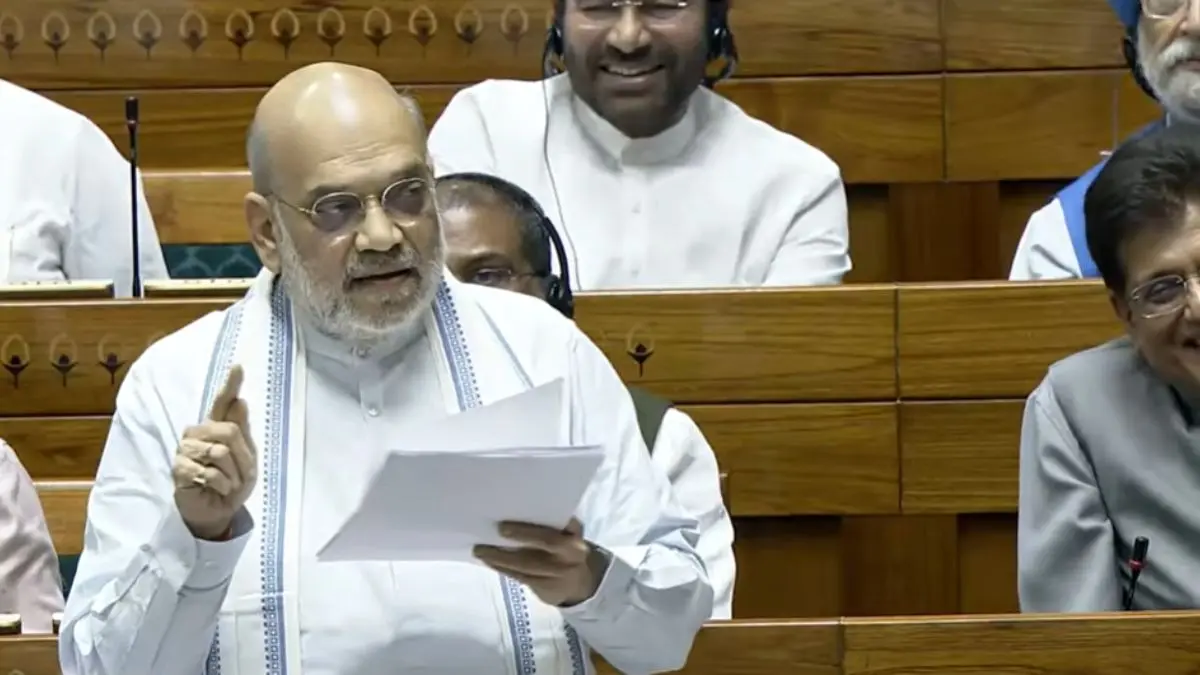
New Delhi: Union Home Minister Amit Shah launched a sharp rebuttal in the Lok Sabha on Thursday while replying to the debate on the Women's Reservation Bill and associated Delimitation Bills, accusing the INDI Alliance of opposing women's empowerment through indirect tactics despite public claims of support.
Amid protests and repeated interruptions that created a huge furore in the House, Shah asserted that no one had openly objected to the principle of women's reservation. However, he said a closer look revealed that members of the INDI Alliance were raising "ifs and buts" to undermine it.
"Everyone has stated that they are with the Bill. But if we get into the bottom of it, the INDI Alliance is against it," he said.
Shah emphasised that the three Bills are designed to enable high women inclusivity in the 2029 Lok Sabha elections, in line with Prime Minister Narendra Modi's vision. He argued that opposing delimitation effectively means limiting seats and opportunities for SC/ST communities.
Advertisement
"By opposing this, they are trying to limit SC/ST seats and votes," he said. Delimitation, he added, is essential to unfreeze seats in certain constituencies and ensure balanced representation.
Addressing concerns over numbers raised by Samajwadi Party leader Akhilesh Yadav, Shah clarified that seats and population figures would be readjusted post-delimitation for fairness. He assured the House that no state would lose out, stating,
Advertisement
"I assure them that if they support us for delimitation, then the value of each vote will have equal value across constituencies."
On the historical context, Shah pointed out that Congress had previously stalled delimitation. He recalled that in 1972, Indira Gandhi's government increased seats from 525 to 545 and froze them. In 1976, during the Emergency, the 42nd Amendment imposed a ban on further delimitation.
"Even at that time, it was the Congress party that deprived the country's people of delimitation, and today too, it is the Congress party that is depriving them," he said.
Responding to southern states' apprehensions about a North-South divide, Shah rejected the narrative as false and politically motivated. He provided specific projections: the five southern states currently hold 129 seats (23.76% of the 543-member House). Post-delimitation and expansion, this would rise to 195 seats (approximately 23.87% share in the larger House). He detailed state-wise increases, for instance, Tamil Nadu from 39 to 59, Karnataka from 28 to 42, while maintaining proportional balance.
"No state is going to lose out in delimitation," he stressed.
"I never want the North-South divide. Every single UT is as important as the North. All states and UTs are equal," he said.
Shah explained the rationale behind expanding the Lok Sabha (with a cap at 850 seats, actual projected strength around 816) to accommodate the 33% women's quota without reducing general seats. He illustrated that a 50% increase in seats would ensure that after reserving one-third for women, the remaining open seats roughly match the current 543.
"We are increasing seats by 50% for every state," he noted, adding that implementing reservation on the existing 543 seats or outdated 2011 census figures would shrink representation in states like Tamil Nadu.
On the census, Shah said the process originally due in 2021 was delayed by COVID-19 and the subsequent national recovery. He clarified that a comprehensive citizen count naturally includes caste data, countering demands for a separate caste census.
"When a citizen’s counting takes place, his caste automatically becomes part of it," he said.
The debate saw sharp exchanges, with Congress leader KC Venugopal calling for constitutional protection for southern states. Shah responded firmly, offering to adjourn the House briefly to bring an official amendment ensuring at least 50% seats if needed.
"We are not scared. We do not steal votes," he asserted. In a lighter moment referencing Atal Bihari Vajpayee, he remarked that the former PM "understood Congress better."
Akhilesh Yadav questioned Shah's figures and remarked that even a written assurance of a woman PM candidate from BJP would not earn their trust.
Shah highlighted the significance of the discussion, noting that nearly 133 members spoke on the constitutional amendment, including a record 56 women MPs. He reiterated that the Bills aim to strengthen democracy through greater women's participation and equitable delimitation, without affecting ongoing elections.
The session witnessed multiple adjournments due to ruckus, with Shah warning, "If you say a lie out loudly, it shall not become the truth."
The government maintained that the measures would empower women while safeguarding federal balance and proportional representation for all regions.
Get Current Updates on India News, Entertainment News, Cricket News along with Latest News and Web Stories from India and around the world.