
Are Some Farmers Fooling NASA, Korean Satellites to Dodge Stubble Burning Detection?
Delhi-NCR woke up to hazardous air quality this morning, with the Air Quality Index (AQI) nearing the 500 mark.
- India News
- 4 min read

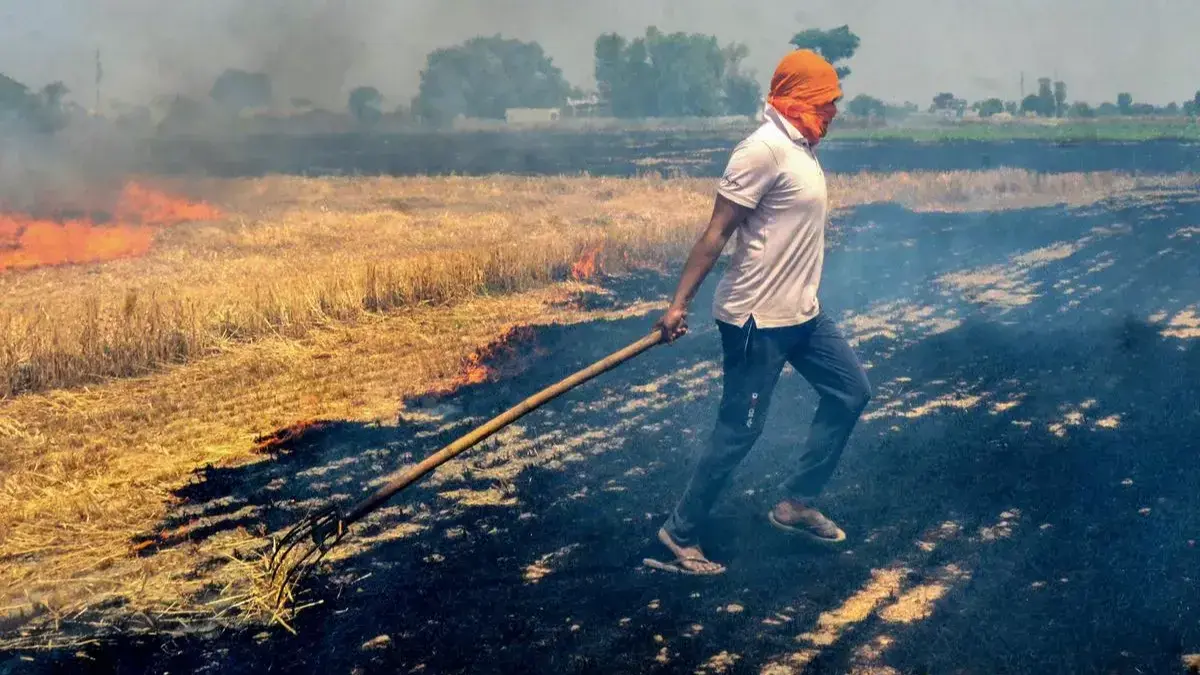
New Delhi: The Supreme Court on Monday raised concerns over discrepancies in data related to stubble burning in Delhi and neighbouring regions, which is a major contributor to worsening air quality. The court stressed the need for comprehensive and accurate reporting of all farm fire incidents and directed compliance updates by Friday.
During the hearing, Senior Advocate Aparajita Singh, the amicus curiae in the MC Mehta case, informed a bench comprising Justice Abhay S Oka and Justice Augustine George Masih about discrepancies in satellite data.
She explained that the Indian Space Research Organisation ( ISRO ) receives data from a NASA satellite, which passes over the National Capital Region between 10:30 am and 1:30 pm daily. Consequently, the reported farm fires are limited to these timeframes.
In contrast, data from a stationary Korean satellite captured stubble-burning incidents at 4:20 pm, revealing gaps in the coverage provided by NASA's polar-orbiting satellite.
Advertisement
‘Farmers Might Be Avoiding Satellite Monitoring Times’
Hiren Jethva, a senior research scientist at NASA, raised concerns about the possibility that farmers in northwest India and Pakistan might be deliberately avoiding satellite monitoring times. On October 25, Jethva posted on X (formerly Twitter), stating, "Are farmers in NW India and Pakistan avoiding satellite overpass time for stubble burning?
A close eyeballing of GEO-KOMPSAT 2A (launched by South Korea) geostationary satellite images shows localized puffs/clouds of smoke in the late afternoon. Needs ground checking." His observation suggests that farmers may be timing their stubble burning activities to avoid satellite overpasses, thus evading detection.
Advertisement
NASA’s Aqua and Suomi-NPP satellites, part of a collaboration between NASA and NOAA, pass over India and Pakistan between 1:30 pm and 2:00 pm IST, capturing images that can identify stubble burning. In contrast, the GEO-KOMPSAT-2A satellite, positioned in a geostationary orbit, offers continuous monitoring every 10 minutes. Jethva's analysis of this satellite's data revealed that fire activity seemed to shift to the late afternoon, after the NASA satellites had already passed.
Discrepancies in Government Data
Data from the Indian Agricultural Research Institute (IARI) and other governmental bodies suggests a notable reduction in stubble burning incidents in Punjab and Haryana . From September 15 to November 17, 2024, Punjab recorded 8,404 cases of stubble burning, a significant drop from 33,082 during the same period in 2023. Similarly, Haryana saw a reduction from 2,031 in 2023 to 1,082 in 2024.
However, despite these reported declines, the concentration of aerosol particles contributing to air pollution in the region has remained largely unchanged over the past six to seven years. This ongoing pattern raises doubts about the true impact of the reported reductions in stubble burning.
SC Takes Note of Differences
Taking note of these differences, the bench directed the government as well as the Commission for Air Quality Management (CAQM) to make immediate arrangements for getting data either from Korean stationary satellites or any other stationary satellites so that data of farm fires throughout the day can be made available to the states to enable them to take immediate actions.
The bench further said that the Commission and the Centre will also involve ISRO in taking this step. “The ultimate object should be to show that all instances of farm fire burning throughout the day are reported to the concerned states, so that prompt action be taken.
"Compliance on this aspect shall be reported by this Friday,” the bench ordered and added that the Centre and the CAQM will procure data from stationary satellites from October 1, 2024.
Delhi-NCR AQI Turn ‘Hazardous’
Delhi-NCR woke up to hazardous air quality this morning, with the Air Quality Index (AQI) nearing the 500 mark—nearly ten times the healthy range of 0-50, leaving residents gasping for breath.
The Supreme Court today expressed frustration with the delay in enforcing stringent measures under the Graded Response Action Plan (GRAP) to combat the city’s worsening air pollution. Flagging what it described as the “wrong approach” to implementing restrictions, the bench asserted that authorities should not wait for the AQI to improve but should take proactive measures in anticipation of further deterioration.
"The commission cannot wait for improvement in AQI. It should take steps in anticipation," the bench stated.
The court further directed all states in the National Capital Region (NCR) to immediately enforce GRAP 4 restrictions and establish committees to ensure strict adherence to the curbs. It also made it clear that the GRAP 4 restrictions will remain in effect even if the AQI drops below the 450 mark.
"We make it clear that till further orders of this court, implementation of stage 4 shall continue even if AQI falls below 450. All state and central governments to file compliance affidavit by Thursday," the court ruled.
Get Current Updates on India News, Entertainment News, Cricket News along with Latest News and Web Stories from India and around the world.