
BlueBird Satellite Placed Into Low Earth Orbit: All About The 'Baahubali' Rocket That Carried It
This mission was the sixth operational flight of LMV-3, having played a key part in landmark missions like Chandrayaan-2 and Chandrayaan-3, India's lunar missions. LMV-3 has also several OneWeb satellites (India-1 and India-2), and communication satellites GSAT-19/29.
- India News
- 4 min read

;'%3e%3cpath%20d='m8,15.99c4.41,0,7.99-3.58,7.99-7.99S12.41,0,8,0,0,3.59,0,8s3.58,7.99,7.99,7.99Z'%20style='stroke:%23fff;%20stroke-miterlimit:10;%20stroke-width:.02px;'/%3e%3cpath%20d='m3.08,3.37l3.82,5.11-3.84,4.15h.87l3.37-3.64,2.72,3.64h2.94l-4.04-5.39,3.58-3.87h-.86l-3.1,3.35-2.5-3.35h-2.94Zm1.27.64h1.35l5.97,7.99h-1.35l-5.97-7.99Z'%20style='fill:%23fff;'/%3e%3c/g%3e%3c/svg%3e)


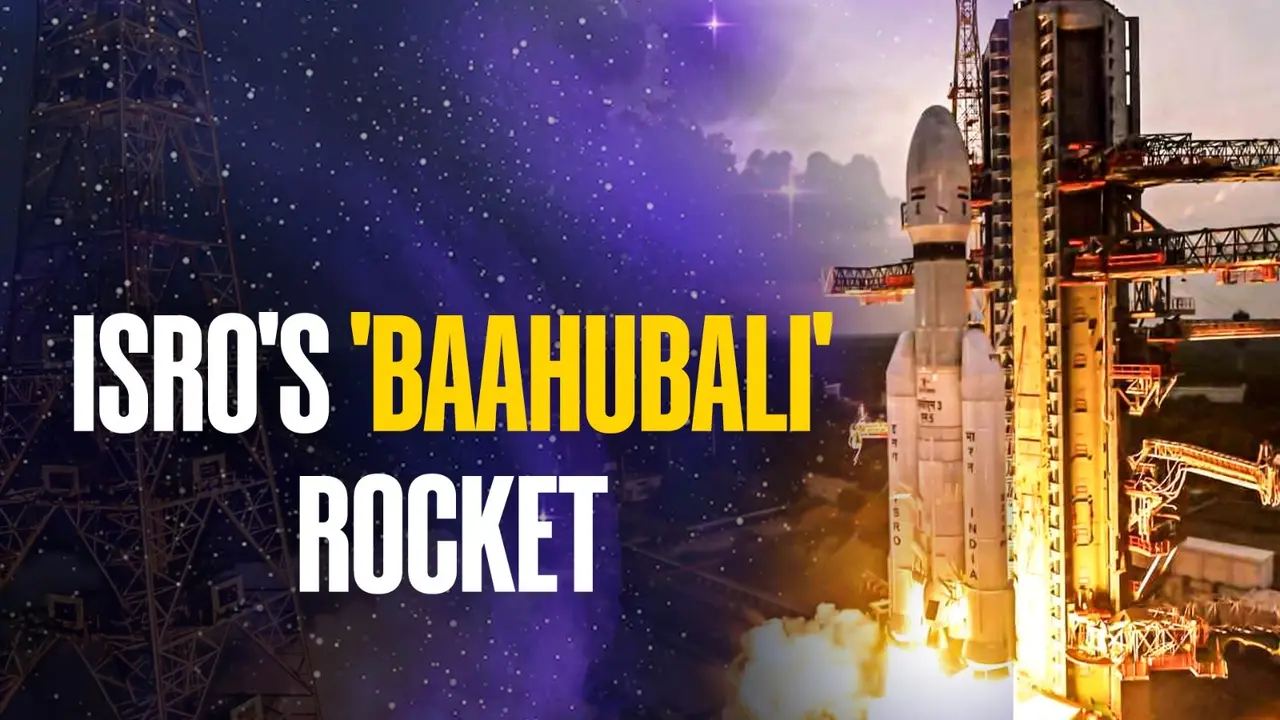
New Delhi: India launched the BlueBird Block-2 communication satellite of the United States' AST SpaceMobile on Wednesday at 8:57 AM IST from Sriharikota, Andhra Pradesh. This was the largest commercial communications satellite to be on board ISRO's heavyweight rocket Launch Vehicle Mark-3 (LVM-3) which is also popularly dubbed as India's ‘Baahubali’ rocket.
The mission was the sixth operational flight of LMV-3, having played a key part in landmark missions like Chandrayaan-2 and Chandrayaan-3, India's lunar missions. LMV-3 has also several OneWeb satellites (India-1 and India-2), and communication satellites GSAT-19/29. It's most recent operational flight (LVM3-M5) launching the heavy CMS-03 communication satellite was on November 2025.
Let us explore, some of the key specialities of India's ‘Baahubali’ launch vehicle, which has now successfully earned the trust of being a reliable commercial launch vehicles for the US, after its two initial OneWeb missions in 2022-23, which launched 36 satellites each.
Largest Solid Boosters
The 'Baahubali' or LVM3 is a three stage vehicle with two solid strap-on motors (S200), one liquid core stage (L110) and a high thrust cryogenic upper stage (C25). Notably, the S200 solid motor is among the largest solid boosters in the world with 204 tonnes of solid propellant. The S200 was developed at Vikram Sarabhai Space Centre. The Booster Height is 25 metre, booster diameter is 3.2 metre and fuel of 205 tonnes of Hydroxyl-Terminated Polybutadiene.
Advertisement
Twin Liquid Engine
The liquid L110 stage uses a twin liquid engine configuration with 115 tonnes of liquid propellant, while the C25 Cryogenic upper stage is configured with the fully indigenous high thrust cryogenic engine (CE20) with a propellant loading of 28 tons.
Lift-off Weight Of 640 Tonnes
The overall length of the vehicle is 43.5 m with a gross lift-off weight of 640 tonnes and a 5m-diameter payload fairing.
Advertisement
Payload Capability
LVM3 will be capable of placing the 4 tonne class satellites of the GSAT series into Geosynchronous Transfer Orbits in a cost effective manner. The powerful cryogenic stage of LVM3 enables it to place heavy payloads into Low Earth Orbits of 600 km altitude.
Cryogenic Upper Stage
The C25 is powered by CE-20, India's largest cryogenic engine, designed and developed by the Liquid Propulsion Systems Centre. It has a Cryo Stage Height of 13.5 metre, cryo state diameter of 4 metre, a CE-20 engine, and 28 tonnes of LOX + LH2 fuel.
Encapsulated Assembly
The Encapsulated assembly comprises of the spacecraft, Payload Adaptor (PLA) and the Payload fairing (PF).
Flight Time
The 'Baahubali' launch vehicle usually takes off with the simultaneous ignition of the two S200 boosters. The core stage (L110) is ignited at about 113s through the flight, during the firing of the S200 stages. Both S200 motors burn for about 134s and the separation occur at 137s. The payload fairing is separated at an altitude of 115 km and at about 217s during L110 firing. The L110 burnout and separation and C25 ignition occur at 313s. The spacecraft is injected into a GTO (Geosynchronous Transfer Orbit) orbit of 180x36000 km at a nominal time of 974s.
Get Current Updates on India News, Entertainment News, Cricket News along with Latest News and Web Stories from India and around the world.