
CAG Audit Warns of Ecological Collapse: 74% of Kashmir’s Lakes Vanished or Shrinking, 2,851 Hectares Lost
Comptroller and Auditor General of India warns over 74% of lakes in Jammu & Kashmir have shrunk or vanished since 1967, citing climate change, deforestation and poor conservation.
- India News
- 3 min read

;'%3e%3cpath%20d='m8,15.99c4.41,0,7.99-3.58,7.99-7.99S12.41,0,8,0,0,3.59,0,8s3.58,7.99,7.99,7.99Z'%20style='stroke:%23fff;%20stroke-miterlimit:10;%20stroke-width:.02px;'/%3e%3cpath%20d='m3.08,3.37l3.82,5.11-3.84,4.15h.87l3.37-3.64,2.72,3.64h2.94l-4.04-5.39,3.58-3.87h-.86l-3.1,3.35-2.5-3.35h-2.94Zm1.27.64h1.35l5.97,7.99h-1.35l-5.97-7.99Z'%20style='fill:%23fff;'/%3e%3c/g%3e%3c/svg%3e)


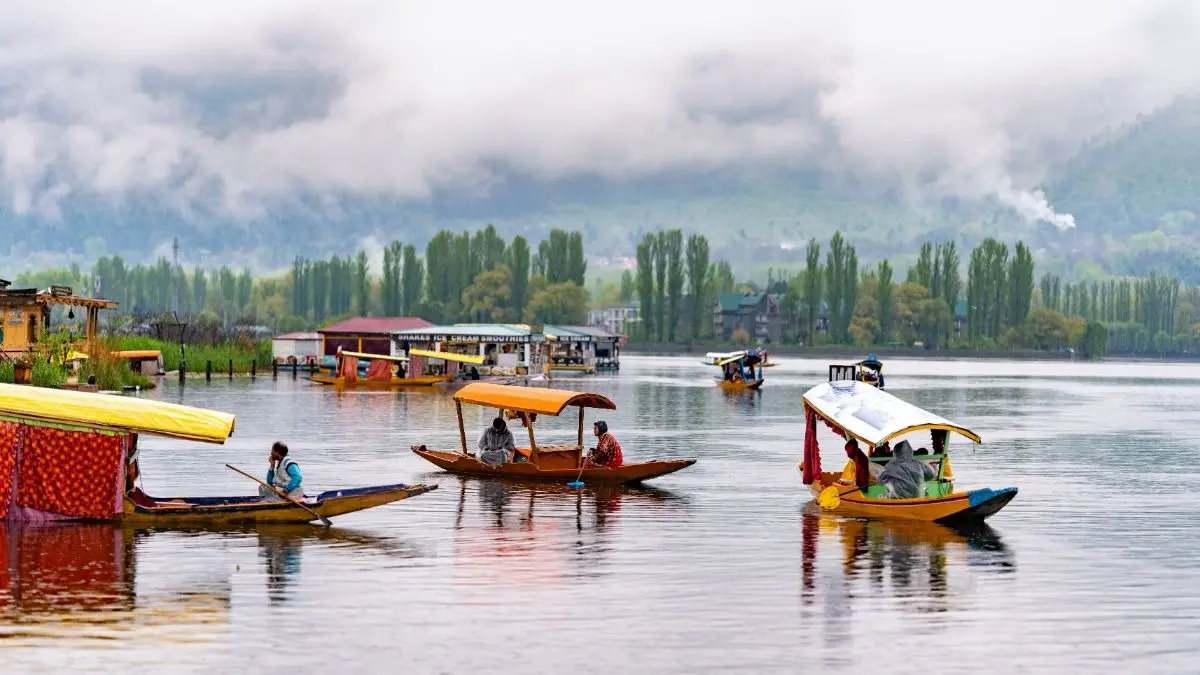
Srinagar: Comptroller and Auditor General (CAG) has sounded an alarm over the rapid degradation of natural lakes in Jammu and Kashmir, indicating that more than 74 per cent of them have either disappeared or shrunk dramatically since 1967; a crisis with grave ecological and socio-economic consequences.
According to the audit report for the year ending March 31, 2024, out of 697 lakes covering 28,990 hectares, 315 lakes spanning 1,537.07 hectares have completely vanished, while 203 lakes shrank by 1,314.19 hectares.
“There was a total decrease and disappearance of area of 2,851.26 hectares in 518 lakes,” the report stated.
CAG attributed this large-scale decline to deforestation, unregulated human activity, land-use changes in catchment areas, and climate change. It warned that the loss of these water bodies has disrupted ecological services, diminished biodiversity, and weakened natural flood buffers; a factor behind the devastating 2014 floods in Jammu and Kashmir.
Advertisement
While 150 lakes showed an increase in area by 538.22 hectares and 29 remained unchanged, the report revealed that the reasons for expansion were neither studied nor monitored.
Among the shrinking lakes, 63 have lost more than half their area, placing them at high risk of extinction.
Advertisement
The audit, which examined 63 lakes through satellite imagery, remote sensing, and field verification, found severe degradation in water bodies such as Khushal Sar and Anchar.
It also highlighted institutional lapses: despite a mandate since 1989, the forest department has not prepared conservation plans for 255 lakes under its jurisdiction. Conservation efforts remain confined to just six lakes; Dal, Wular, Hokersar, Manasbal, Surinsar, and Mansar, leaving 691 lakes without structured programmes.
“A questionnaire-based survey on 63 test-checked lakes was also undertaken by audit. Further, the audit utilised the satellite images of the lakes provided by ecology, environment and remote sensing department (EE&RSD) to analyse the spatio-temporal changes in lakes,” the report said.
CAG stressed the absence of a dedicated legal framework, noting that fragmented provisions under multiple laws have led to poor coordination and accountability.
It recommended urgent enactment of a comprehensive law, creation of a specialised authority, and deployment of experts including hydrologists, ecologists, and GIS specialists.
Other key recommendations included strengthening sewage treatment, preventing encroachments, regulating construction around lakes, and launching public awareness campaigns.
“Generic lake management activities such as survey, categorisation, sewage treatment, flushing etc need to be planned and carried out in a time bound manner,” the report emphasised.
Meanwhile, the CAG urged the Jammu and Kashmir government to increase budgetary allocations for lake conservation.
Get Current Updates on India News, Entertainment News, Cricket News along with Latest News and Web Stories from India and around the world.