
CAQM Lifts GRAP Stage-I Curbs in Delhi-NCR as AQI Improves to 119
CAQM revokes GRAP Stage-I restrictions in Delhi-NCR after AQI improves to 119. Authorities urge continued dust control and pollution mitigation measures to prevent air quality from worsening again.
- India News
- 2 min read

;'%3e%3cpath%20d='m8,15.99c4.41,0,7.99-3.58,7.99-7.99S12.41,0,8,0,0,3.59,0,8s3.58,7.99,7.99,7.99Z'%20style='stroke:%23fff;%20stroke-miterlimit:10;%20stroke-width:.02px;'/%3e%3cpath%20d='m3.08,3.37l3.82,5.11-3.84,4.15h.87l3.37-3.64,2.72,3.64h2.94l-4.04-5.39,3.58-3.87h-.86l-3.1,3.35-2.5-3.35h-2.94Zm1.27.64h1.35l5.97,7.99h-1.35l-5.97-7.99Z'%20style='fill:%23fff;'/%3e%3c/g%3e%3c/svg%3e)


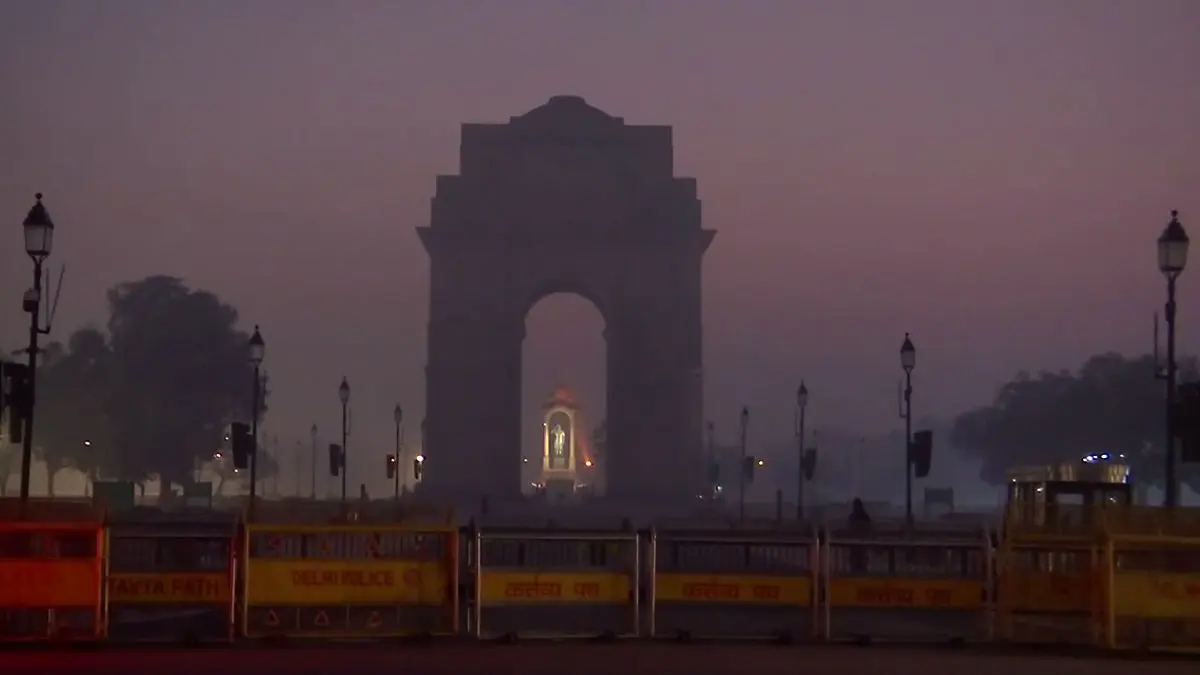
New Delhi: The Commission for Air Quality Management (CAQM) in NCR and adjoining areas on Monday revoked Stage-I actions under the Graded Response Action Plan (GRAP) with immediate effect, citing improved air quality.
According to a release, the CAQM said that Delhi's AQI was recorded at 119 at 4:00 PM on Monday, which reflected moderate air quality, with IMD and IITM forecasts indicating similar conditions in the coming days.
However, the CAQM has urged all agencies of the State Governments and GNCTD to continue implementing statutory directions, guidelines, and dust mitigation measures to maintain the current improvement and prevent air quality from slipping back to the 'Poor' category.
According to the Ministry of Environment, Forest and Climate Change, GRAP is an emergency response mechanism for entire NCR, based on Average AQI levels and forecasts for meteorological/ weather conditions in Delhi that brings together multiple stakeholders, implementing agencies and authorities in NCR to respond to situations of deteriorating air quality in the region.
Advertisement
GRAP for NCR has been formulated after careful consideration of scientific data, stakeholder consultations, expert recommendations along with field experience and learnings in the past years.
Earlier this month, the CAQM issued a framework directing NCR States and the Government of the National Capital Territory of Delhi (GNCTD) to roll out targeted Information, Education and Communication (IEC) campaigns aimed at tackling region-specific sources of air pollution.
Advertisement
The move seeks to institutionalise sustained public engagement as a core pillar of pollution control strategy across Delhi-NCR, shifting focus from seasonal firefighting to year-round behavioural change and awareness.
In its latest advisory, the Commission said, "The Commission advises all NCR States and GNCTD to direct the concerned agencies in the region to plan, implement and intensify targeted IEC campaign, aligned with the dominant sources of air pollution." It stressed that outreach efforts must be tailored to key contributors such as vehicular emissions, construction dust, biomass burning and industrial pollution.
The CAQM emphasised that IEC activities should adopt a multi-channel approach, including print, electronic and digital media, social media platforms, and community-level programmes. Engagements with Resident Welfare Associations (RWAs), farmers' groups, transport unions, market associations and other stakeholders have been specifically recommended to ensure wider participation. States have also been encouraged to adopt innovative outreach models to maximise impact.
Get Current Updates on India News, Entertainment News, Cricket News along with Latest News and Web Stories from India and around the world.