
'Catch-22 Situation': Arvind Kejriwal's Recusal Plea Rejected By Justice Sharma Of Delhi High Court
Justice Sharma observed that the applicant, Arvind Kejriwal had created a “win-win” or catch-22 situation for himself - if the Court recused, it would validate his claims, and if it did not, he could still question the outcome.
- India News
- 4 min read

;'%3e%3cpath%20d='m8,15.99c4.41,0,7.99-3.58,7.99-7.99S12.41,0,8,0,0,3.59,0,8s3.58,7.99,7.99,7.99Z'%20style='stroke:%23fff;%20stroke-miterlimit:10;%20stroke-width:.02px;'/%3e%3cpath%20d='m3.08,3.37l3.82,5.11-3.84,4.15h.87l3.37-3.64,2.72,3.64h2.94l-4.04-5.39,3.58-3.87h-.86l-3.1,3.35-2.5-3.35h-2.94Zm1.27.64h1.35l5.97,7.99h-1.35l-5.97-7.99Z'%20style='fill:%23fff;'/%3e%3c/g%3e%3c/svg%3e)


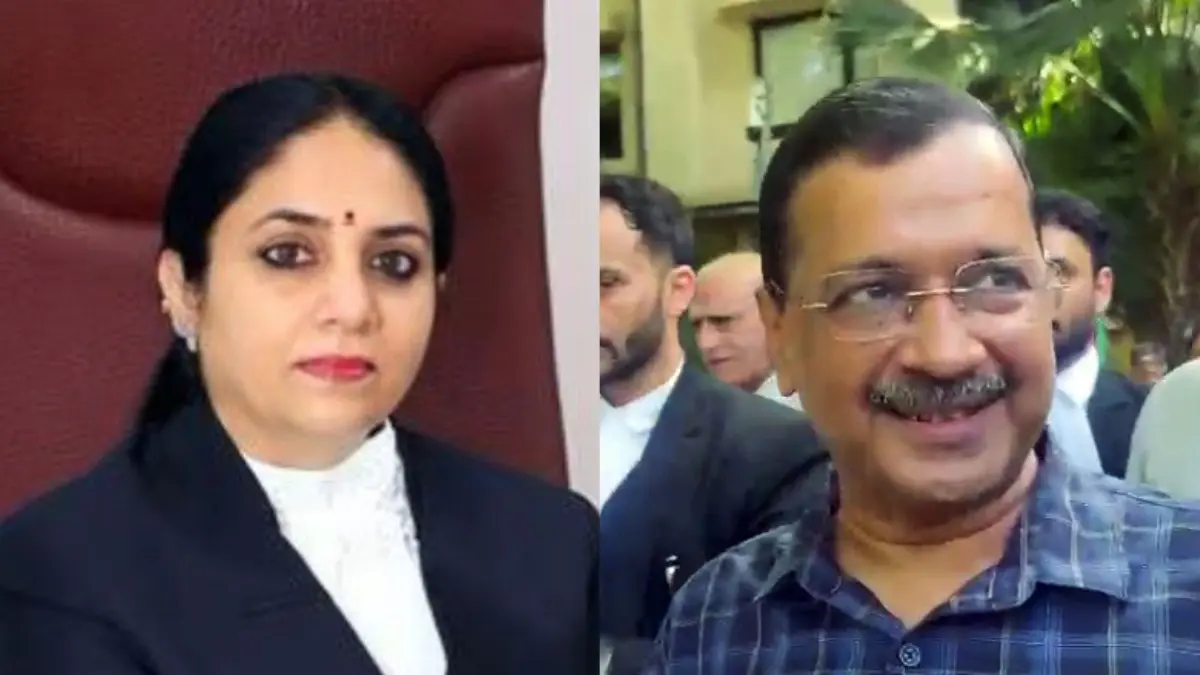
New Delhi: Former Delhi Chief Minister Arvind Kejriwal's plea has been rejected by Justice Swarna Kanta Sharma of the Delhi High Court. While delivering the verdict, the judge described the situation as a "Catch-22" for herself, but a "win-win" for the AAP supremo.
The case came up before the court after Kejriwal, his former Deputy Manish Sisodia, and some others, urged Justice Sharma to recuse herself from the hearing. The case pertained to the Central Bureau of Investigation's (CBI) plea that challenged Kejriwal's discharge in the alleged liquor policy case.
“A recusal would lead the public to believe that judges are aligned with a particular political party or ideology. This court, by penning a recusal, cannot allow this,” Justice Sharma said while delivering the verdict.
Justice Sharma observed that the applicant, Kejriwal had created a “win-win” or catch-22 situation for himself - if the Court recused, it would validate his claims, and if it did not, he could still question the outcome.
Advertisement
The Court noted that such tactics cannot be permitted, as they risk undermining not just an individual judge but the institution itself, and could set a precedent affecting courts at all levels. It cautioned that yielding to such pressure may create a public perception that judges can be influenced or are aligned with political interests.
Justice Swarana Kanta Sharma, while pronouncing the order, observed that as she began writing the judgment, “the courtroom had fallen silent,” leaving behind the solemn weight of her oath to the Constitution of India. She stated that her silence as a judge itself had come under scrutiny, and that the issue at hand concerned not just her personal fairness, but the integrity of the judicial institution as a whole.
Advertisement
The judge remarked that the easier course would have been to step aside without adjudicating the application, but she chose to decide the matter, as it involved the larger question of the institution.
The Court noted that the task was made more difficult by the contradictory stands taken during arguments while it was asserted that there was no doubt on the judge’s integrity, a request was still made to transfer the case on the basis of a perceived apprehension of bias rather than any actual bias. The judge further observed that such a plea, in effect, places the judicial institution itself under scrutiny.
Hinting at Arvind Kejriwal, the Court observed that a politician cannot be permitted to cross permissible limits or sit in judgment over the competence of the judiciary. The Court noted that when Arvind Kejriwal was granted interim bail by the Supreme Court, the issue was referred to a larger Bench, and the High Court’s order was not set aside. Justice Swarana Kanta Sharma emphasised that the competence of a judge is to be assessed by a higher court, not by a litigant.
The judge added that many judges attend such events, and mere participation as a speaker or chief guest cannot be construed as ideological bias or give rise to any reasonable apprehension of prejudice.
Justice Sharma observed that it is difficult to understand how merely participating as a chief guest or speaker could give rise to any apprehension of bias or suggest that a judge’s ability to decide a case has been compromised.
Justice Swarana Kanta Sharma observed that no litigant can be allowed to weaken the relationship between the Bar and the Bench, emphasising that even if some lawyers represent political parties, cases before the Court are decided purely on merits, not political affiliations.
She cautioned that permitting such allegations would open floodgates and erode trust in the judicial system, adding that judges would be forced to withdraw from public engagement if such grounds were entertained. The Court also noted that Kejriwal failed to point out any political statement made by her, reiterating that there exists a presumption of judicial impartiality which must be rebutted by the litigant seeking recusal.
Justice Sharma then proceeded to examine the allegations of conflict of interest arising from the empanelment of her children as government counsel. The Court noted that Kejriwal had repeatedly stated he did not doubt the judge’s integrity, yet expressed a personal apprehension of possible bias. It observed that granting recusal on such grounds would have deeper and far-reaching ramifications.
The Court noted Senior Advocate Hegde’s “agnipariksha” argument, but questioned why a judge should undergo such a test merely at the asking of an accused who fears an unfavourable outcome. It said that while an accused can prove that he is innocent, he cannot be permitted to attempt to prove that judge is tainted.
“The same fairness must apply when allegations are made against a sitting judge. Even a politician, however powerful, cannot be permitted to damage the institution without any material to prove allegations against a judge. The courtroom cannot be a theatre of perception,” the verdict read. (With ANI inputs)
Get Current Updates on India News, Entertainment News, Cricket News along with Latest News and Web Stories from India and around the world.