
Deep State Is Silent But Not Inactive: The Chakravyuh Around India
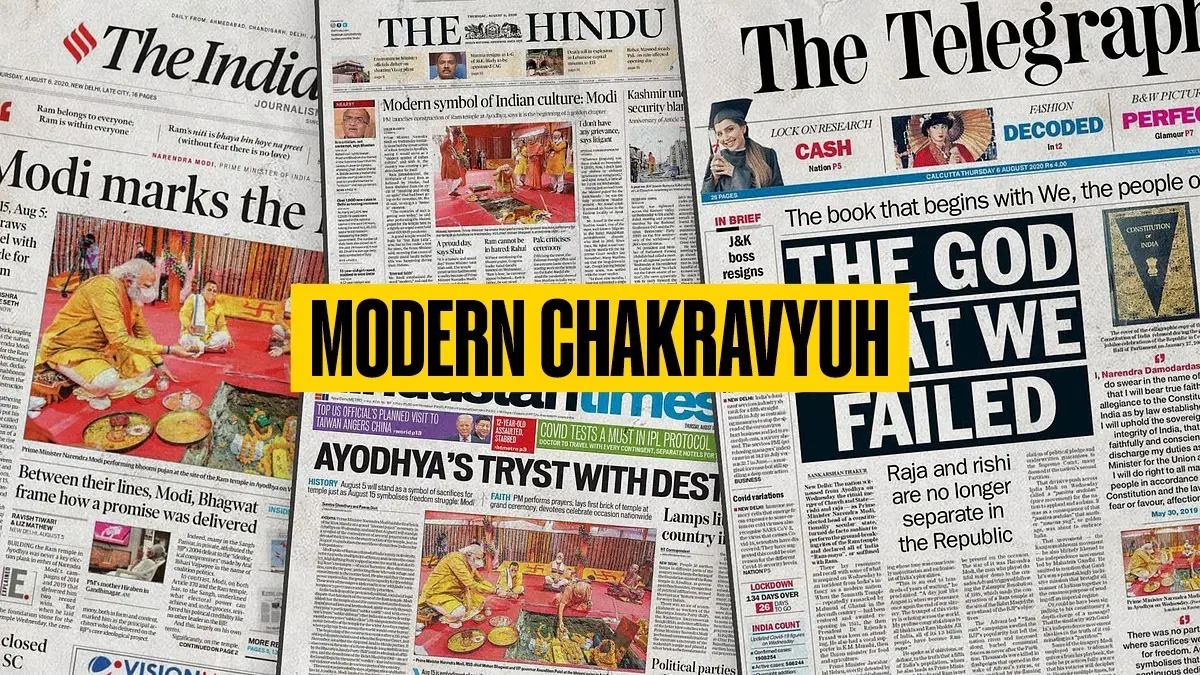
This encirclement resembles a modern Chakravyuh - multi-layered, sophisticated, and designed to entrap rather than attack. Unlike smaller or economically dependent states that can be coerced through sanctions or regime manipulation, India’s scale and resilience demand a subtler approach. Facts and data reveal how each ring of this Chakravyuh is being constructed.
- India News
- 7 min read

;'%3e%3cpath%20d='m8,15.99c4.41,0,7.99-3.58,7.99-7.99S12.41,0,8,0,0,3.59,0,8s3.58,7.99,7.99,7.99Z'%20style='stroke:%23fff;%20stroke-miterlimit:10;%20stroke-width:.02px;'/%3e%3cpath%20d='m3.08,3.37l3.82,5.11-3.84,4.15h.87l3.37-3.64,2.72,3.64h2.94l-4.04-5.39,3.58-3.87h-.86l-3.1,3.35-2.5-3.35h-2.94Zm1.27.64h1.35l5.97,7.99h-1.35l-5.97-7.99Z'%20style='fill:%23fff;'/%3e%3c/g%3e%3c/svg%3e)


In geopolitics, silence is rarely peace. More often, it is recalibration. The so-called Deep State - an entrenched network of bureaucratic power centres, intelligence establishments, military-industrial interests, financial lobbies, global media ecosystems, and ideological pressure groups - does not announce itself with flags or declarations. It operates through systems, incentives, narratives, and controlled disruptions. When it goes quiet, it is usually repositioning.
India today is not being confronted head-on. It is being encircled.
This encirclement resembles a modern Chakravyuh - multi-layered, sophisticated, and designed to entrap rather than attack. Unlike smaller or economically dependent states that can be coerced through sanctions or regime manipulation, India’s scale and resilience demand a subtler approach. Facts and data reveal how each ring of this Chakravyuh is being constructed.
1. Narrative Warfare: Manufacturing Perception as Power
Narrative control is the first and most visible ring.
Advertisement
Control the story, and you control perception. India’s rise is rarely reported as a civilisational resurgence or an economic correction of historical injustice. Instead, it is framed selectively - democracy under threat, minorities in danger, institutions weakening, freedoms shrinking. The aim is not criticism; criticism is healthy in a democracy. The aim is delegitimisation. When a nation’s moral authority is eroded internationally, coercive diplomacy becomes easier. Sanctions feel justified. Interference feels noble. Pressure feels principled.
The Deep State understands that modern wars are not fought only with tanks and missiles but with headlines, reports, think-tank papers, social media trends, and courtrooms of global opinion. India is constantly put on trial - not for what it does differently, but for daring to do things independently.
Advertisement
Between 2019 and 2024, India featured among the top five most criticised democracies in reports by Western NGOs and think tanks, despite being the world’s largest democracy with over 900 million voters participating in general elections. According to the V-Dem Institute, India was labelled an “electoral autocracy,” even as voter turnout in 2019 crossed 67%, higher than the United States’ 2020 turnout of 66%.
Data from global media monitoring agencies shows that the negative framing of India in major Western publications increased sharply after India asserted independent positions on:
- Energy purchases from Russia (2022 onwards)
- Digital sovereignty and data localisation
- Defence indigenisation and arms diversification
Narratives focusing on “democratic backsliding” intensified precisely when India’s GDP crossed USD 3.5 trillion, making it the 5th largest economy globally. Criticism did not rise when India was weak - it rose when India became consequential.
This is not a coincidence. It is conditioning global opinion to justify pressure.
2. Economic Entanglement: Growth With Strings Attached
India’s economy is encouraged to grow - but on carefully defined terms and within controlled parameters.
Supply chains are welcomed as long as they remain externally dependent. Capital flows are applauded as long as strategic sectors remain vulnerable to pressure. Trade agreements are framed as opportunities while embedding asymmetries that favour established powers.
The message is subtle: grow, but don’t outgrow the system; integrate, but don’t assert; participate, but don’t challenge. Any attempt by India to protect domestic industry, assert technological sovereignty, or regulate predatory capital is instantly labelled as protectionist, authoritarian, or anti-market. Economic nationalism, when practised by the West, is a strategy. When practised by India, it is heresy.
Foreign Direct Investment into India crossed USD 70 billion annually post-2021. However, data from the Reserve Bank of India shows that over 60% of FDI inflows are concentrated in services, fintech, and digital platforms - sectors vulnerable to regulatory and capital pressure - while strategic manufacturing still faces external dependency for:
- Semiconductors (over 90% imported)
- Defence components (despite reforms, nearly 35% still imported)
- Rare earth processing (China controls 70% of global processing)
When India introduced Production Linked Incentive (PLI) schemes worth ₹1.97 lakh crore to reduce dependency, Western trade bodies labelled it “market-distorting.” Yet the same countries subsidised domestic industries with trillions during COVID-19.
The message is clear: India may grow, but not disrupt established hierarchies.
3. Strategic Overstretch: Encouraging Responsibility Without Relief
India is encouraged - sometimes nudged, sometimes pressured - to play a larger global role. Be the net security provider. Be the balancing power. Be the voice of the Global South. All noble aspirations. But the hidden risk lies in simultaneous pressure points: unresolved borders, hostile neighbours, internal security challenges, energy vulnerabilities, and global expectations that stretch resources thin.
A nation constantly fighting fires has little time to consolidate. The Chakravyuh thrives on fatigue. When strategic bandwidth is consumed managing crises, long-term autonomy becomes harder to sustain.
India is increasingly projected as a “net security provider” in the Indo-Pacific. Defence data shows:
- India patrols over 7,500 km of coastline
- Manages two active hostile borders
- Maintains presence across Andaman Sea, Indian Ocean, and Arabian Sea
At the same time, India’s defence budget remains around 2% of GDP, far lower than:
- United States: 3.4%
- China: 1.7% officially, widely estimated above 2.5%
India is expected to balance China, stabilise the Indian Ocean, contribute to global peacekeeping (India remains among the top UN troop contributors), and manage regional crises - without commensurate strategic support.
This overstretch is structural. It drains focus, resources, and political bandwidth - exactly what a Chakravyuh is designed to do.
4. Internal Fracture Amplification: Weaponising Diversity
India’s diversity is a strength - but also a target.
No society is without fault lines. The Deep State does not create them - it weaponises them. Caste, religion, language, region, ideology - every difference is a potential lever. Domestic debates are internationalised. Local grievances are globalised. Social media ecosystems magnify outrage while muting nuance. Activism morphs into agitation. Dissent quietly slides into destabilisation.
This is not about silencing criticism. It is about recognising when organic democratic debate is hijacked by external interests that benefit from perpetual internal churn. A nation busy fighting itself is easier to manage.
Studies by cybersecurity firms show that India is among the top three targets of coordinated disinformation campaigns globally. During election cycles, social media platforms reported:
- Millions of bot-driven engagements
- Foreign-origin narratives amplifying caste, religious, and regional fault lines
- Algorithmic boosting of polarising content
Between 2020 and 2023, Meta and Twitter disclosures confirmed repeated takedowns of coordinated inauthentic behaviour networks linked to foreign locations targeting Indian discourse.
The objective is not debate - it is perpetual instability. A nation distracted internally is less capable externally.
5. Elite Capture: Influence Without Occupation
This is perhaps the most dangerous layer of the Chakravyuh. When sections of a nation’s elite - bureaucratic, corporate, intellectual, or cultural - begin to see external approval as more valuable than domestic accountability, sovereignty erodes from within. Awards, fellowships, global platforms, consulting contracts, and moral validation become tools of alignment.
The Deep State does not need to control governments if it can influence mindsets. It only needs enough influential voices to shape policy hesitation, strategic doubt, and narrative confusion
Data from global policy forums shows disproportionate representation of Indian-origin elites in Western think tanks advocating policies misaligned with India’s strategic interests. Funding trails reveal:
- Research grants linked to defence lobbies
- Climate funding tied to policy conditionalities
- Academic fellowships influencing regulatory discourse
When domestic policy debates increasingly echo external talking points rather than ground realities, sovereignty erodes subtly - not by force, but by persuasion.
Why India Has Not Fallen - Yet
India has resisted being boxed into military alliances that compromise autonomy. It has refused to be a permanent proxy in great power rivalries. It has diversified partnerships without surrendering decision-making. It has spoken of civilisational confidence in a world that prefers post-national compliance. It has chosen reform over rupture, continuity over chaos.
Most importantly, India has refused to apologise for existing. Despite this multi-layered Chakravyuh, India has resisted.
- India refused military alliances, compromising autonomy.
- India diversified defence imports, reducing single-country dependency from 70% (2010) to below 45% (2024).
- India maintained independent foreign policy positions despite pressure during the Ukraine conflict.
- India expanded digital public infrastructure (UPI, Aadhaar) now being studied by over 50 countries.
This resistance explains the Deep State’s silence. The loud confrontation failed. Subtle encirclement continues.
Breaking the Chakravyuh
India’s exit lies in a facts-backed strategy:
- Internal cohesion backed by inclusive growth - poverty reduced from 21% (2011) to under 10% (2023).
- Narrative sovereignty - India now operates over 180 diplomatic missions, but must invest equally in global media and academia.
- Strategic patience - not every provocation requires a response; data shows that restraint often yields leverage.
The Deep State is silent, but not inactive. This is why the silence is deceptive. The Deep State is regrouping, not retreating. It is shifting from overt pressure to long-term positioning. From loud condemnation to quiet calibration. From visible confrontation to invisible encirclement.
India must be neither paranoid nor complacent - only prepared.
Because, unlike Abhimanyu, India understands the Chakravyuh. And that understanding may be its greatest strategic weapon.
Get Current Updates on India News, Entertainment News, Cricket News along with Latest News and Web Stories from India and around the world.