
Delhi-NCR Chokes In Toxic Air, But Minister Says AQI Not 'Directly' Tied To Lung Diseases
Kirti Vardhan Singh, in a written reply in the Rajya Sabha on Thursday, however acknowledged that air pollution is one of the factors for respiratory issues and associated diseases.
- India News
- 5 min read

;'%3e%3cpath%20d='m8,15.99c4.41,0,7.99-3.58,7.99-7.99S12.41,0,8,0,0,3.59,0,8s3.58,7.99,7.99,7.99Z'%20style='stroke:%23fff;%20stroke-miterlimit:10;%20stroke-width:.02px;'/%3e%3cpath%20d='m3.08,3.37l3.82,5.11-3.84,4.15h.87l3.37-3.64,2.72,3.64h2.94l-4.04-5.39,3.58-3.87h-.86l-3.1,3.35-2.5-3.35h-2.94Zm1.27.64h1.35l5.97,7.99h-1.35l-5.97-7.99Z'%20style='fill:%23fff;'/%3e%3c/g%3e%3c/svg%3e)


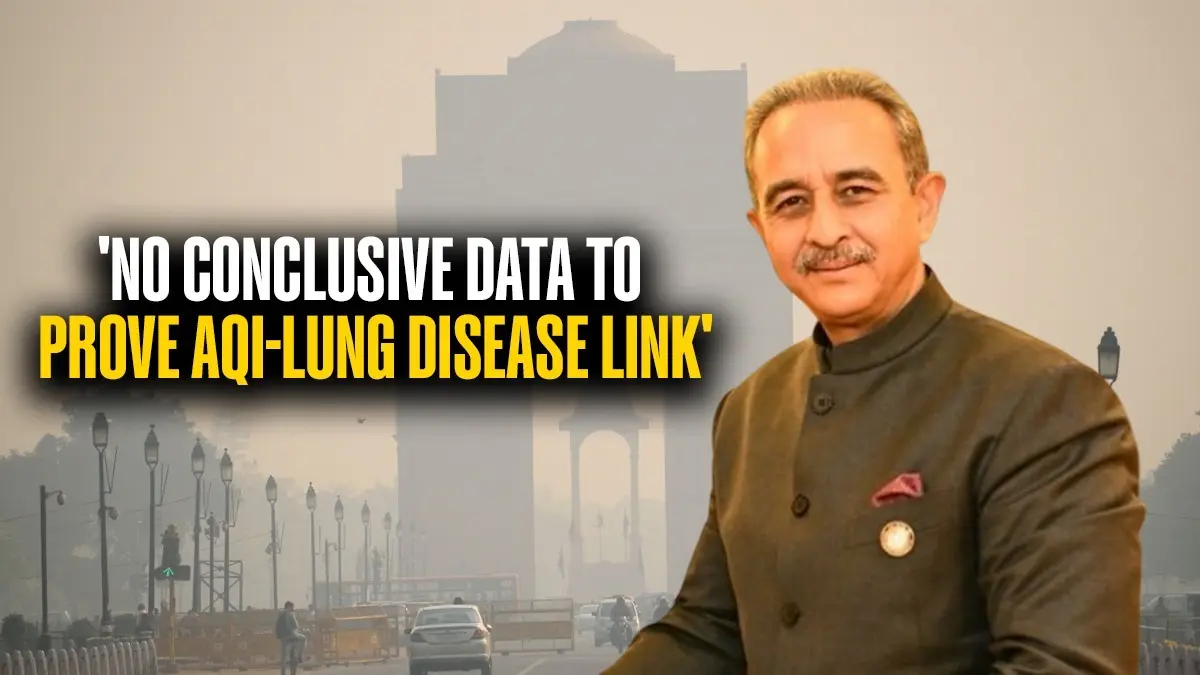
New Delhi: As Delhi-NCR continues to grapple with hazardous air quality, Union Minister of State for Environment Kirti Vardhan Singh sparked nationwide concern after he informed the Parliament that there is no conclusive data establishing a direct correlation between higher air quality index (AQI) levels and lung diseases.
Singh on Thursday, in a written reply in the Rajya Sabha on Thursday, however acknowledged that air pollution is one of the factors for respiratory issues and associated diseases.
The minister's remark came in after BJP MP Laxmikant Bajpayee questioned if the government was aware that studies and medical tests have confirmed that prolonged exposure to hazardous AQI levels in Delhi-NCR is leading to lung fibrosis, an irreversible reduction in lung capacity.
BJP parliamentarian also wanted to enquire whether lung elasticity among citizens of Delhi-NCR has drastically reduced to almost 50 per cent compared to people living in cities with good AQI levels and further asked if the government has any solution to save millions of residents of Delhi-NCR from deadly diseases following the air pollution.
Advertisement
Specialised training programs
Singh, in his defence, stated that specialised training programs have been created on air pollution for a wide range of stakeholders, including programme managers, medical officers, nurses, nodal officers, staff at sentinel sites, frontline workers such as ASHAs, vulnerable populations like women and children, and occupationally exposed groups such as traffic police and municipal workers.
He added that information, education, and communication (IEC) materials addressing illnesses related to air pollution have been prepared in English, Hindi, and various regional languages. The National Programme on Climate Change and Human Health (NPCCHH) has also developed tailored IEC content for different vulnerable groups, Singh noted.
Advertisement
Singh further mentioned that the India Meteorological Department provides early warning systems, alerts, and air quality forecasts to states and cities, assisting the health sector and communities—including vulnerable populations—in preparing for air pollution events.
Highlighting government initiatives, Singh said the Pradhan Mantri Ujjwala Yojana promotes the health of women and children by supplying clean cooking fuel in the form of liquefied petroleum gas. He also pointed out that the Swachh Bharat Mission, which focuses on improving cleanliness in urban and rural areas, incorporates the concept of “Swachh Hawa” (clean air) as a key component.
Delhi Chokes, People Suffocate
As winter sets in across northern India, dense fog continues to envelop Delhi and other states, reducing visiblity in the early morning hours. The national capital experienced poor air quality on Friday morning, with the overall Air Quality Index (AQI) recorded at 387 at around 8 am, placing it in the 'very poor' category, according to data from the Central Pollution Control Board (CPCB).
Air quality in the city deteriorated further compared to Thursday, when the AQI stood at 373 at 4 pm. Large parts of the city remained enveloped in toxic smog.
According to CPCB data, several areas, including Vivek Vihar (436), Punjabi Bagh (412), R.K. Puram (436) and Nehru Nagar (425), saw further deterioration in air quality and fell into the 'severe' category. Wazirpur also recorded 'severe' air quality with an AQI of 406.
Earlier, Delhi Environment Minister Manjinder Singh Sirsa conducted surprise inspections at several petrol pumps, including those at the Delhi-Gurugram border and Janpath, to review compliance with the 'No PUC, No Fuel' directive.
He interacted with pump staff and instructed them to enforce the rules while remaining calm and courteous.
Bhupendra Yadav AQI Claim
Earlier, Union Environment Minister Bhupendra Yadav claimed that Delhi-NCR did not experience any “severe+” air pollution days in 2025, according to his statement in the Rajya Sabha. He attributed this to the Graded Response Action Plan (GRAP) and strengthened policy measures, asserting that focused interventions and improved on-ground implementation have helped enhance air quality over the years.
Yadav highlighted that the number of days with an Air Quality Index (AQI) below 200 increased to 200 in 2025, up from 110 in 2016. He also mentioned that the average AQI in Delhi from January to November 2025 was 187, compared to 213 in 2018, and emphasized that the city did not record a single “severe+” AQI day during the year.
However, official air quality data from NCR monitoring stations indicates that parts of the region, including Delhi, did witness extremely poor air conditions, contrasting with the minister’s claims.
Get Current Updates on India News, Entertainment News, Cricket News along with Latest News and Web Stories from India and around the world.