
Donald Trump’s 50% India Tariff Is Just ‘Personal Pique’ After Nobel Dream Fizzles On Pakistan Mediation: Jefferies
The steep 50 per cent tariffs imposed by the United States on Indian goods are largely a result of President Donald Trump's "personal pique" at not being allowed to mediate in the India-Pakistan conflict.
- India News
- 3 min read

;'%3e%3cpath%20d='m8,15.99c4.41,0,7.99-3.58,7.99-7.99S12.41,0,8,0,0,3.59,0,8s3.58,7.99,7.99,7.99Z'%20style='stroke:%23fff;%20stroke-miterlimit:10;%20stroke-width:.02px;'/%3e%3cpath%20d='m3.08,3.37l3.82,5.11-3.84,4.15h.87l3.37-3.64,2.72,3.64h2.94l-4.04-5.39,3.58-3.87h-.86l-3.1,3.35-2.5-3.35h-2.94Zm1.27.64h1.35l5.97,7.99h-1.35l-5.97-7.99Z'%20style='fill:%23fff;'/%3e%3c/g%3e%3c/svg%3e)


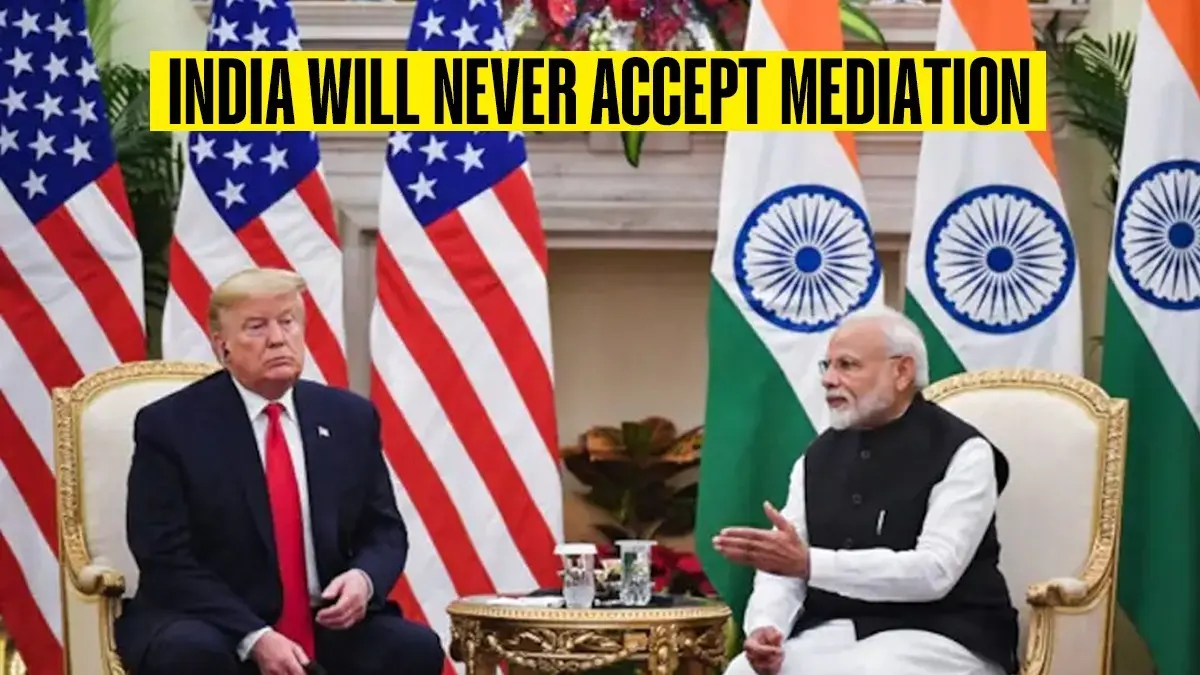
New Delhi: The steep 50 per cent tariffs imposed by the United States on Indian goods are not just about trade but also about politics and ego, according to a report by American multinational investment bank and financial services company Jefferies.
The report argues that President Donald Trump’s move is driven largely by his “personal pique” at being denied the opportunity to mediate in the long-running conflict between India and Pakistan.
A Nobel Dream Denied
Jefferies noted that Trump reportedly hoped to step in as a mediator following the brief four-day military conflict between India and Pakistan in May. However, India has consistently upheld its “red line” of rejecting third-party intervention in disputes with Pakistan.
The investment bank said this refusal carried significant diplomatic and economic consequences. By holding its ground, New Delhi effectively denied the 47th American president a chance to boost his global standing and perhaps even position himself for recognition such as the Nobel Peace Prize.
Advertisement
“Tariffs are primarily the consequence of the American president’s ‘personal pique’ that he was not allowed to play a role in seeking to end the long-running acrimony between India and Pakistan,” the report stated.
Advertisement
Trump’s Claim of Ceasefire Role
Trump first declared on May 10 that Washington had negotiated a “full and immediate” ceasefire between India and Pakistan after an intense night of discussions. He has since repeated this claim over 40 times, insisting he “helped resolve” the standoff.
India, however, has firmly maintained that the ceasefire was achieved through direct DGMO-level talks between the two armies. Prime Minister Narendra Modi told Parliament that no foreign leader played a role in halting Operation Sindoor, emphasising that the decision was India’s alone.
On the broader impact of Trump’s tariff announcement, External Affairs Minister S. Jaishankar said trade talks were continuing despite tensions. “We are two big countries, as I say, the lines are not cut, people are talking to each other, and we will see where it goes,” he remarked.
Agriculture and Wider Issues
The Jefferies report also highlighted agriculture as a key sticking point. “No Indian government is willing to open up the agriculture sector to imports because of the severe consequences it would have on millions of people,” it said. Nearly 250 million farmers and related workers depend on agriculture, which employs nearly 40 per cent of India’s workforce.
Beyond trade, Trump’s failure to end the Ukraine conflict and India’s continued Russian oil purchases have further strained ties. Still, Jefferies concluded that the root cause of the tariff escalation lies in India’s refusal to let Trump mediate on Pakistan, a move the report called a “classic example” of Washington’s “conceptual vacuum.”
(With inputs from ANI)
Get Current Updates on India News, Entertainment News, Cricket News along with Latest News and Web Stories from India and around the world.