
DY Chandrachud BBC Interview: Harish Salve Tears Into Ex-CJI for 'Explanations' On SC Verdicts
Top Jurist Harish Salve criticised former CJI DY Chandrachud for explaining Supreme Court verdicts in his recent BBC interview.
- India News
- 6 min read

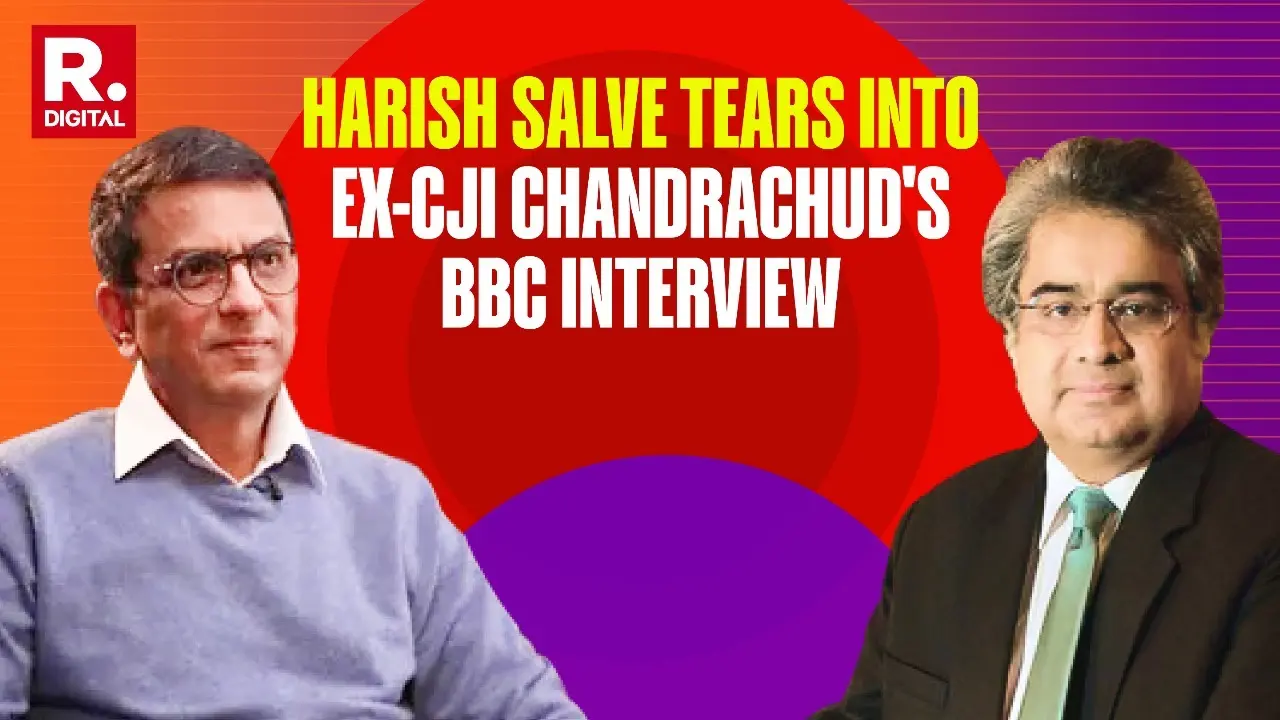
Former Chief Justice of India (CJI) DY Chandrachud has faced strong criticism from Harish Salve, Senior Advocate Supreme Court of India and King's Counsel, UK, for explaining Supreme Court verdicts in his recent BBC interview. In an exclusive interview with Republic Media Network, Salve expressed his disapproval of Chandrachud's explanations on Supreme Court verdicts, stating that judges should only speak through their judgments.
Harish Salve, in a conversation with Republic TV, posed critical questions regarding Justice Chandrachud's statements on a foreign media platform. He expressed concerns that the former CJI’s actions could be perceived as putting the Supreme Court of India "on trial".
Salve questions the example set by Justice Chandrachud, who has been forthcoming with explanations on judicial verdicts to a foreign media outlet. He explained the importance of maintaining the Supreme Court's impartiality and upholding the noble sanctity of India's judicial system.
Why Open Judiciary To Such Questions?
Speaking exclusively to Republic TV’s Rhythm Anand Bhardwaj, Executive Editor - Law and Governance, Salve expressed his concerns about the ethics of judges speaking publicly about their decisions and discussing judicial decisions outside the courtroom. He asserted that the CJI represents the Supreme Court of India and should not comment on the court's decisions outside the judgment.
Advertisement
Stressing the importance of maintaining the integrity of the judiciary, Salve argued, "The Chief Justice of India is a part of the Supreme Court of India and I don’t think he should be speaking of what the court does because it’s not him, it’s the Supreme Court which is actually on trial."
He cited the example of Article 370, where the judgment gave reasons why it was upheld.
Advertisement
However, when Chandrachud discussed it in a private interview, his motives for the judgment were questioned, and aspersions were cast in such scenarios.
Salve stressed that judges should only speak through their judgments. “We always say judges should only speak through their judgements. Take Article 370- the judgement gave reasons why it was upheld,” he explained, criticising the former CJI for discussing the ruling in an interview. “When You bring this up in a private interview, your motives for the judgement are questioned. All sorts of aspersions were cast,” Salve asserted.
The Senior Advocate Supreme Court of India and King's Counsel, UK also stressed that while judgments can be discussed, debated, and criticised, judges should not defend their decisions publicly, as it puts them on trial. “Judges should speak through their judgments, and then we follow the discipline,” he said, explaining the importance of maintaining the integrity of the judiciary.

Why Allow BBC?
Harish Salve, a renowned legal luminary, also blew the lid off the BBC's sinister agenda, which seeks to undermine the credibility of India's judicial system, with the sequence of questions posed to Justice Chandrachud. He exposed the foreign media's deliberate attempt to weave a narrative that undermines the integrity of India's judicial system.
Salve unleashed a barrage of piercing questions over BBC journalist Stephen Sackur’s question on why former CJI Chandrachud didn't hear the Citizenship Amendment Act case.
"Who is a journalist to ask why a Supreme Court hears a case and why a Supreme Court doesn’t hear a case? What was the underlying suggestion? That the Supreme Court has lost its duty to the constitution in holding the balance between different castes and communities?" he asked, suggesting that such questions undermine the Supreme Court's duty to the Constitution.
During the conversation, Harish Salve made it clear that judges should refrain from publicly explaining or justifying their judgments. He argued that by doing so, they risk inviting public scrutiny of the judiciary as a whole. “You get a BBC journalist, you should know you are heading for trouble,” Salve remarked, referring to the interview with Justice Chandrachud. He pointed out that when a judge speaks on court decisions, it leads to questions and criticisms of the entire Supreme Court, not just the individual judge.
What Former CJI DY Chandrachud Was Asked In The BBC Interview
In the BBC interview, former Chief Justice DY Chandrachud replied on several critical issues, including the abrogation of Article 370, the Citizenship Amendment Act (CAA), and the relationship between the judiciary and politics in India.
When asked about the decision to abrogate Article 370, Justice Chandrachud explained that the provision was originally included in the Constitution as a transitional measure. According to him, it was always expected to fade away over time. “At the birth of the constitution, the assumption was this, that what was transitional would have to fade away and have to merge with the overall text,” the former CJI said.
He defended the decision, explaining that it was made in the context of a 75-year-old provision and reflected the government's view.
The interviewer also questioned Justice Chandrachud on the decision to change Jammu and Kashmir from a state to a Union Territory, a move that many saw as a major change in the region's political status. The ex-Chief Justice of India explained that the move was in line with the transitional nature of Article 370. “The democratic process in Jammu and Kashmir must be restored,” he said, referring to the timeline set by the Supreme Court for holding elections and restoring democratic governance in the region.
The Citizenship Amendment Act (CAA) was another topic discussed. During the interview, the interviewer raised concerns that the law discriminates against Muslims, as it provides a path to citizenship for non-Muslim refugees from neighbouring countries, which critics argue contradicts the principle of equality enshrined in the Indian Constitution.
In response, Justice DY Chandrachud clarified that the case related to the CAA was still pending before the Supreme Court and that the court had not yet passed a final judgment on the law. He disagreed with the assertion that the court had allowed the law to pass through unchallenged, stating that the matter remained under judicial review.
Harish Salve’s critique of former CJI D.Y. Chandrachud’s BBC interview underscores a fundamental principle: judicial verdicts must speak for themselves, without external justification. His strong rebuke highlights the risks of engaging with foreign media on sensitive legal matters, especially when such discussions could invite undue scrutiny or misinterpretation.
Get Current Updates on India News, Entertainment News, Cricket News along with Latest News and Web Stories from India and around the world.