
EC Counters On Rahul Gandhi's Allegations: Clarifies On Duplicate Voter IDs, Draft List, And Machine-Readable Rolls
The Election Commission of India (ECI) has issued a detailed clarification in response to allegations raised by Congress leader Rahul Gandhi and several opposition parties regarding the accuracy of the electoral rolls and functioning of the poll body.
- India News
- 6 min read

;'%3e%3cpath%20d='m8,15.99c4.41,0,7.99-3.58,7.99-7.99S12.41,0,8,0,0,3.59,0,8s3.58,7.99,7.99,7.99Z'%20style='stroke:%23fff;%20stroke-miterlimit:10;%20stroke-width:.02px;'/%3e%3cpath%20d='m3.08,3.37l3.82,5.11-3.84,4.15h.87l3.37-3.64,2.72,3.64h2.94l-4.04-5.39,3.58-3.87h-.86l-3.1,3.35-2.5-3.35h-2.94Zm1.27.64h1.35l5.97,7.99h-1.35l-5.97-7.99Z'%20style='fill:%23fff;'/%3e%3c/g%3e%3c/svg%3e)


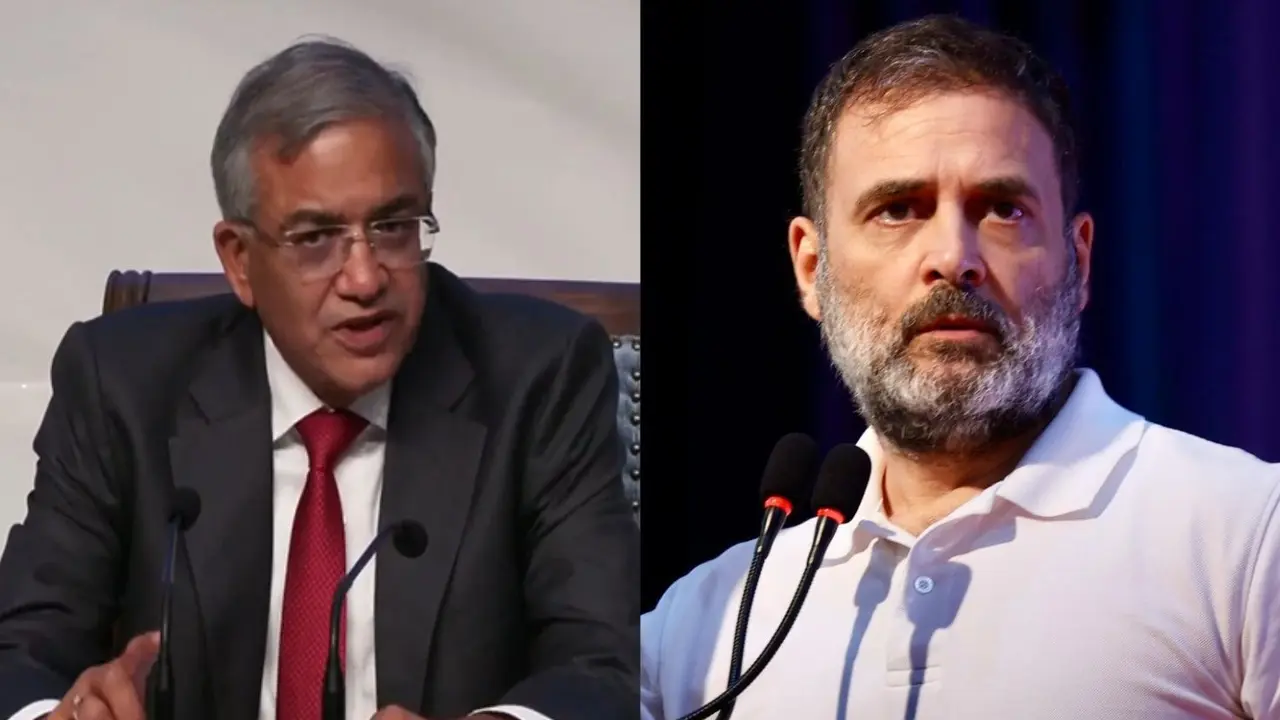
The Election Commission of India (ECI) on Saturday issued a detailed clarification in response to allegations raised by Congress leader Rahul Gandhi and several opposition parties regarding the accuracy of the electoral rolls and functioning of the poll body.
Chief Election Commissioner (CEC) Gyanesh Kumar addressed the media in Delhi and outlined key points to counter the claims, stressing that the Commission “stands like a rock with the voters” and is committed to transparency.
On Duplicate Voter ID Concerns
One of the main allegations raised by opposition leaders was the presence of duplicate voter IDs across states. Addressing this, CEC Kumar explained that duplication can occur in two different ways.
First, when two different individuals living in different states end up having the same Electoral Photo Identity Card (EPIC) number. “When this question came up around March 2025, we discussed it and solved it across the country. About three lakh such people were found whose EPIC numbers were the same, so their EPIC numbers were changed,” Kumar said.
Advertisement
The second type of duplication, he added, arises when the same individual has more than one voter ID due to migration. Before 2003, when technical facilities like a unified website were unavailable, names often remained on voter lists in multiple constituencies.
“Today, we have the technical means to identify and delete them. But if we rush into it, there is a risk of deleting the wrong voter’s name. That is why the Commission is moving with caution,” Kumar stressed.
Advertisement
Draft Electoral Rolls and Political Parties’ Role
Responding to charges that the draft voter list was flawed, Kumar highlighted that no political party has officially objected since the daily bulletins began on August 1.
“After the 1st of August, when our daily bulletins started coming, no political party has lodged a single objection till now. This can only mean two things. Either the draft list is completely correct or political parties have not done their job of scrutinising it,” he said.
The Chief Election Commissioner reminded parties that they have until September 1 to raise objections.
“Every recognised party still has fifteen days left. I appeal to all twelve political parties, whether national or state-level, to point out mistakes before September 1. The Election Commission is ready to correct them,” he added.
Machine-Readable Voter List Prohibition
Another controversy has centred around the issue of voter list accessibility. The opposition accused the Commission of not providing a machine-readable version of the electoral rolls. Kumar explained that this was not an arbitrary decision but was based on a Supreme Court judgement.
“We have to understand the difference between a machine-readable voter list and a searchable voter list,” Kumar clarified. “You can search the voter list available on the Election Commission website by entering the EPIC number, and you can also download it. But this is not called machine-readable”.
He pointed out that in 2019, the Supreme Court studied the issue and concluded that machine-readable rolls could violate voter privacy. “The machine-readable voter list is prohibited. This decision of the Election Commission is after the judgement of the Supreme Court and is from 2019,” he said.
On Election Petitions and Baseless Allegations
Addressing Rahul Gandhi’s comments on alleged manipulation in the electoral process, Kumar noted that the law provides 45 days after results are declared for filing election petitions in the Supreme Court. “Even after the returning officer declares the results, parties can go to the Supreme Court within 45 days to challenge them.
If no candidate or party finds irregularities during that period, then making allegations months later only raises questions about intent,” he remarked.
Privacy Concerns of Voters
Kumar also criticised the circulation of voters’ photos in the media. “We saw a few days ago that photos of many voters were presented to the media without their permission. Should the Election Commission share CCTV videos of voters, including their mothers, daughters-in-law, or daughters? Only those whose names are in the voter list cast their votes. Their privacy must be respected,” he stated firmly.
On Duplicate Votes
The CEC clarified that having names at two places does not mean double voting. “Even if a person has votes in two places, he goes to vote at only one place. Voting at two places is a legal crime, and if any person says so, then proof is required. Proof was asked for but was not given,” Kumar said.
He reminded us that wild allegations without evidence only create confusion. “The public understands everything,” he added.
On ‘Zero’ House Numbers
Kumar also addressed criticism about voters having “zero” house numbers in their addresses. He said, “Many people do not have a home, but their name is also on the voter list. The address is given at the place where that person comes to sleep at night, sometimes on the roadside, sometimes under the bridge."
"If someone calls such voters fake, it is a big joke with our poor voters, sisters, brothers and elders,” he explained.
He said crores of people live in unauthorised colonies or villages where municipalities and panchayats do not assign house numbers.
“In such cases, the Election Commission provides a notional number. Just because ‘zero’ appears on a form does not mean the voter is fake. Citizenship, age above 18 years, and residence near the booth are what matter,” Kumar clarified.
Rahul Gandhi's Claims Of ‘Vote Chori’
Lok Sabha Leader of the Opposition Rahul Gandhi held a press conference on August 7, where he presented Congress’s research on voting in the Mahadevapura Assembly constituency in Karnataka, alleging that “vote chori” (vote theft) of 100,250 votes took place.
He accused the BJP and the Election Commission of “collusion”, claiming that this manipulation helped Prime Minister Narendra Modi secure a third term. Gandhi further alleged that the 2024 Lok Sabha elections were “choreographed”.
In the elections, the BJP won 240 out of 543 seats, falling short of a majority on its own, but the National Democratic Alliance (NDA), led by Modi, crossed the majority mark with 293 seats and formed the government.
Get Current Updates on India News, Entertainment News, Cricket News along with Latest News and Web Stories from India and around the world.