
From Rural Haryana to Raisina Hill’s Supreme Court: The Inspiring Rise of Justice Surya Kant
Set to Take Over as the 53rd Chief Justice of India, Justice Surya Kant specialises in constitutional, service and civil matters. Currently the Executive Chairman of NALSA, he was appointed as Haryana’s youngest Advocate General in 2000 at the age of 38. He will retire on February 9, 2027.
- India News
- 3 min read

;'%3e%3cpath%20d='m8,15.99c4.41,0,7.99-3.58,7.99-7.99S12.41,0,8,0,0,3.59,0,8s3.58,7.99,7.99,7.99Z'%20style='stroke:%23fff;%20stroke-miterlimit:10;%20stroke-width:.02px;'/%3e%3cpath%20d='m3.08,3.37l3.82,5.11-3.84,4.15h.87l3.37-3.64,2.72,3.64h2.94l-4.04-5.39,3.58-3.87h-.86l-3.1,3.35-2.5-3.35h-2.94Zm1.27.64h1.35l5.97,7.99h-1.35l-5.97-7.99Z'%20style='fill:%23fff;'/%3e%3c/g%3e%3c/svg%3e)


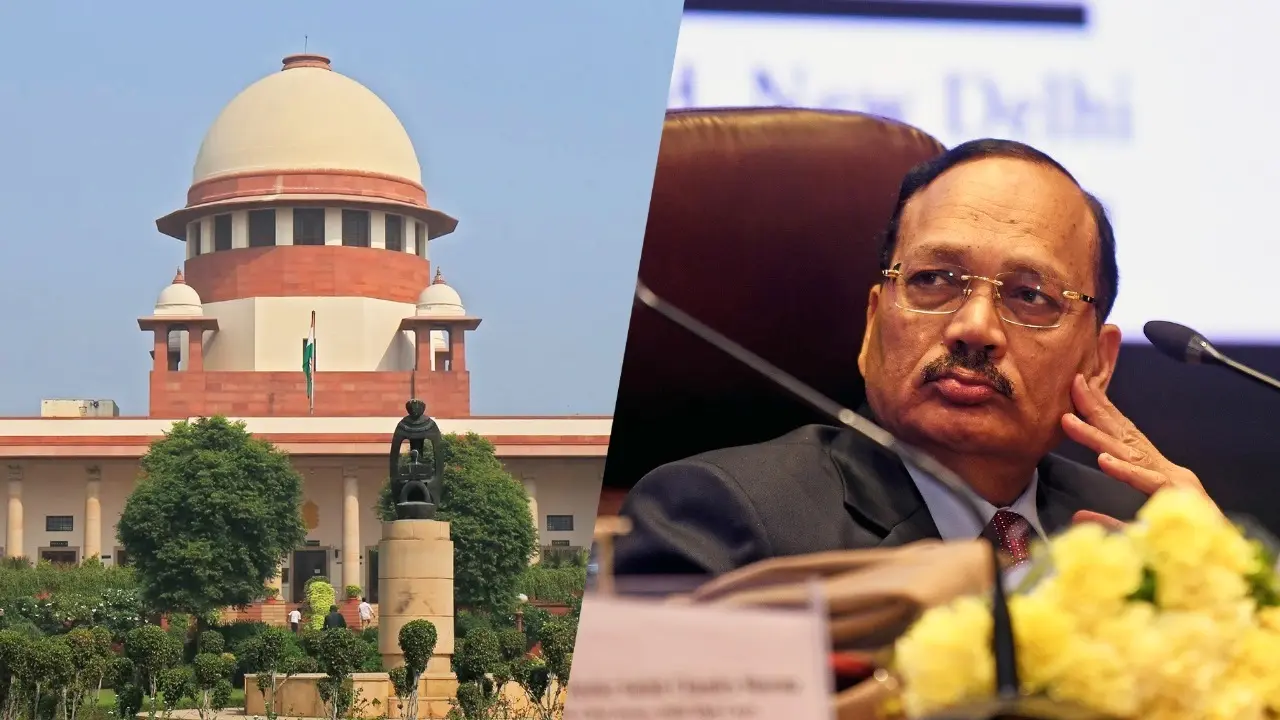
New Delhi: Justice Surya Kant, known for his integrity, reform-oriented approach and deep understanding of constitutional law, is set to take over as the next Chief Justice of India (CJI). The incumbent CJI, Justice BR Gavai, whose tenure ends on November 23, has formally recommended his name to the Union Law Ministry, following the seniority convention.
Born on February 10, 1962, in a middle-class family in Hisar, Haryana, Justice Surya Kant’s rise from a small-town lawyer to the country’s top judicial office is a story of grit, consistency and commitment to justice.
Education and Early Career
A graduate of Government Post Graduate College, Hisar (1981), he earned his law degree from Maharishi Dayanand University, Rohtak, in 1984 and later, pursuing academic excellence alongside his judicial career, he topped his LL.M. from Kurukshetra University in 2011. He began his practice at the Hisar District Court in 1984, moving to Chandigarh the following year to practise before the Punjab and Haryana High Court, specialising in constitutional, service and civil law.
Judicial Journey
Appointed Haryana’s youngest Advocate General at just 38 in 2000, he was designated a Senior Advocate in 2001 and elevated as a judge of the Punjab and Haryana High Court in 2004.
Advertisement
He was sworn in as the Chief Justice of Himachal Pradesh High Court on October 3, 2018. His appointment drew controversy as Justice AK Goel, a consultee who had been elevated to the Supreme Court from the Punjab and Haryana High Court, disagreed with the Collegium. Nonetheless, the Collegium appointed Justice Kant as Chief Justice of Himachal Pradesh HC.
In 2019, the Collegium elevated Justice Kant to the Supreme Court. In elevating him, the Collegium emphasised it was placing due weight on having adequate representation from all High Courts in the Supreme Court.
Advertisement
Known for his pragmatic yet empathetic approach, he has since authored over 50 judgments and has been part of 300 benches, with a strong focus on criminal, service and environmental law.
Key Judgments
In Jitendra Singh v. Ministry of Environment case, he held that ponds and local water bodies are protected under Article 21, terming their extinction unconstitutional.
In CBI v. Sakru Mahagu Binjewar, involving a conviction for murder, criminal conspiracy, rioting and intimidation and insult under SC and ST (Prevention of Atrocities) Act, 1989, he ruled that life imprisonment cannot be capped at 20 years, upholding the commutation of the death penalty to 25-year “actual imprisonment”.
He has also adjudicated on the abrogation of Article 370, One Rank One Pension, unstamped arbitration agreements and Rakesh Asthana’s appointment as Delhi Police Commissioner.
Reform and Leadership
In 2007, he was nominated as a Member of the Governing Body of the National Legal Services Authority (NALSA), where he served for two consecutive terms until 2011, actively contributing to legal aid and justice delivery initiatives. Currently serving as the Executive Chairman of NALSA and a long-time member of the Indian Law Institute, Justice Kant has championed access to justice through technology-driven legal aid, e-libraries and 24-hour legal clinics.
Expected to serve until February 2027, his tenure as CJI is likely to emphasise judicial transparency, digitisation and speedy justice, continuing the institution’s push toward modernisation.
Get Current Updates on India News, Entertainment News, Cricket News along with Latest News and Web Stories from India and around the world.