
From Wage Anger To Street Violence: What Triggered Noida Protests & Govt’s Big Response | All We Know So Far
Noida worker protests turn violent over low wages, causing massive traffic jams, arrests, and chaos across key routes connecting Delhi and NCR. Read to know the details.
- India News
- 6 min read

;'%3e%3cpath%20d='m8,15.99c4.41,0,7.99-3.58,7.99-7.99S12.41,0,8,0,0,3.59,0,8s3.58,7.99,7.99,7.99Z'%20style='stroke:%23fff;%20stroke-miterlimit:10;%20stroke-width:.02px;'/%3e%3cpath%20d='m3.08,3.37l3.82,5.11-3.84,4.15h.87l3.37-3.64,2.72,3.64h2.94l-4.04-5.39,3.58-3.87h-.86l-3.1,3.35-2.5-3.35h-2.94Zm1.27.64h1.35l5.97,7.99h-1.35l-5.97-7.99Z'%20style='fill:%23fff;'/%3e%3c/g%3e%3c/svg%3e)


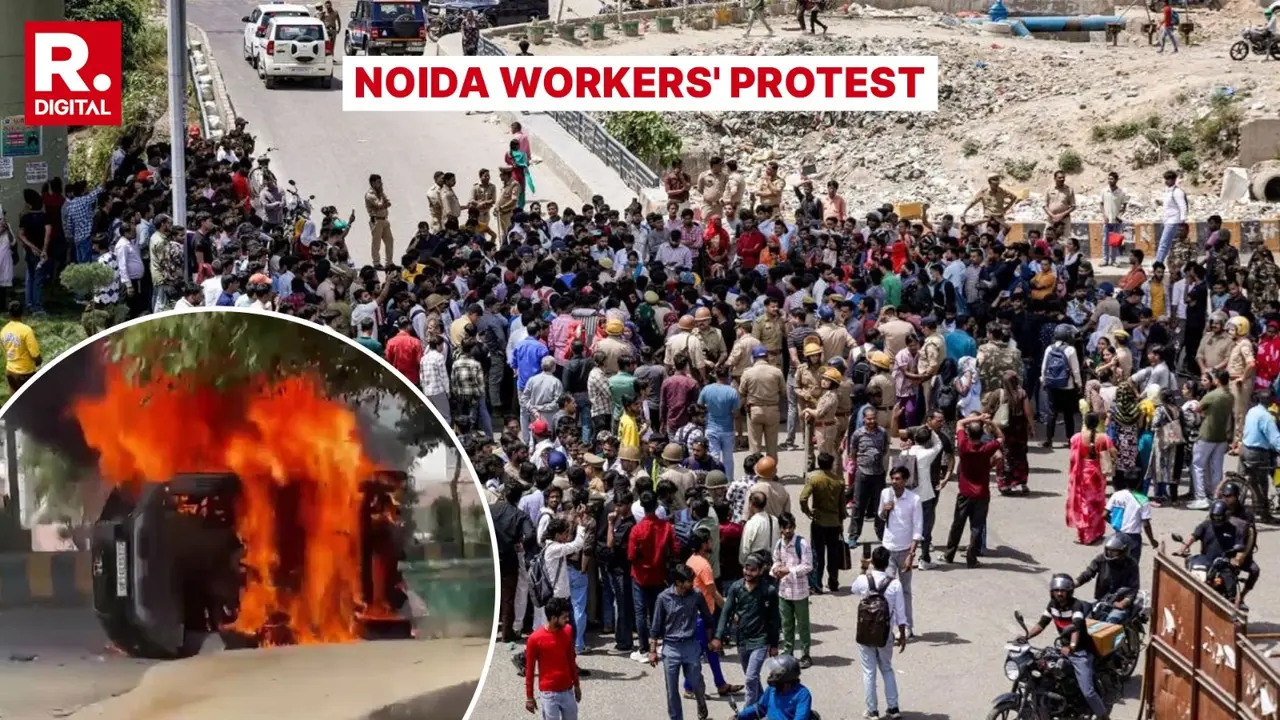
Noida, Uttar Pradesh: What began as a demand for fair wages turned into a day of chaos on Monday, as thousands of garment factory workers took to the streets of Noida, blocking key routes, clashing with police, and bringing daily life to a grinding halt.
At the heart of the unrest lies a growing frustration, workers say they are struggling to survive.
What Happened on Monday?
Large groups of workers gathered in various locations, particularly Sector 62, where protesters climbed onto road dividers, raised slogans, and blocked major routes. Roads connecting Sector 62 to Sector 16 and NH-9 were overcrowded, resulting in major congestion on the roads.
The situation worsened when entry into Noida from the Akshardham side was closed, leaving thousands of commuters trapped. Office workers experienced lengthy delays as arterial routes throughout the city turned practically impassable.
Advertisement
The disruption spread to NH-9 at SJM Hospital in Chhajarsi, when additional protestors stopped the road to Delhi. Traffic police moved vehicles to alternative routes such as ABES and Vijayanagar, but gridlock persisted.
How the Protest Turned Violent
Tensions escalated considerably in Phase 2 and parts of Sector 60. What began as a protest quickly escalated into violence, with claims of stone-throwing, vandalism, and burning. Several vehicles were damaged, and one was set ablaze. Protesters also set fire to the Vipul Motors factory and office, as well as automobiles parked on the property, resulting in extensive damage.
Advertisement
As the situation worsened, police and firefighters raced to the scene. Tear gas shells were deployed to disperse protesters, and significant deployment was carried out throughout industrial districts to restore order.
Officials insisted that the situation was now under control, with minimal force employed when necessary.
Mass Arrests and Police Action
At least 100 agitators have been detained in connection with the incident. Authorities verified that senior police and administrative authorities are on the ground, closely monitoring the situation. Surveillance has been stepped up, and attempts are underway to counsel employees and prevent further escalation.
Meanwhile, the Uttar Pradesh Police have filed FIRs against two social media accounts suspected of propagating falsehoods. Officials stressed that no firing occurred during the rally and advised the people to avoid misunderstanding.
Delhi Traffic on Alert
The violence's rippling effect spread to the national capital. The Delhi Police has been placed on high alert, with additional personnel stationed at all key access points from Noida. To prevent discontent from spreading, vehicles are being thoroughly inspected.
Barricades have been tightened, and fast response teams, together with paramilitary forces, have been stationed at strategic spots. Authorities claim they are constantly in contact with their Uttar Pradesh colleagues.
The Delhi Police have also issued a traffic advisory in view of the protests.
“Traffic at Noida severely affected due to ongoing agitation by the workers from private factories. They have completely blocked the Noida Link Road coming from Chilla Border (Delhi). Traffic movement towards Noida from the Chilla Border is severely affected. The public is hereby advised to plan their journey accordingly and use DND for travelling to Noida. Traffic intending to go to Noida may use DND from Sarai Kale Khan or alternatively use NH 24 - Kondli Bridge and enter Noida through Noida Mod.”
Why Workers Are Protesting
The protests are rooted in a deep wage disparity. Workers in neighboring Haryana reported a 35% increase in minimum pay, resulting in daily earnings of approximately ₹580-750. Unskilled workers in Noida earn approximately ₹350-435 per day.
They demand a monthly salary of ₹18,000 to ₹20,000, rejecting current annual increments of only ₹250-350.
Many people struggle to make ends meet on a monthly income of ₹11,000-13,000. LPG rates in the illicit market have reportedly reached ₹400 per kg, exacerbating their financial difficulties.
Beyond wages, workers are also demanding:
- Double pay for overtime
- Mandatory weekly offs
- Medical coverage
- Timely bonus payments
How Noida Compares to Other Regions
When wages are examined across locations, the disparities become even more obvious. Unskilled workers in Delhi get the highest monthly salary in the NCR, ranging from ₹18,456 to ₹19,846. Wages in Haryana, especially in Gurugram and Faridabad, have recently increased by 35% to ₹15,221. Workers in Noida and Greater Noida, Uttar Pradesh earn the lowest wages in the NCR, ranging from ₹10,192 to ₹11,314.
Other major industrial cities have higher pay scales, with Bengaluru at ₹16,137 and Chennai at ₹14,044. According to officials, this disparity is mostly attributable to discrepancies in Variable Dearness Allowance (VDA) computations and Uttar Pradesh's traditionally lower base wage levels. These figures are based on notifications and orders issued by the Delhi Labour Department, Haryana Labour Department Gazette, Uttar Pradesh Labour Department (under scheduled employment rates), and the Chief Labour Commissioner (Central).
What is Government Response?
The Uttar Pradesh government on Monday set up a high-level committee to tackle the growing industrial unrest in Gautam Buddha Nagar.
The move follows directions from Chief Minister Yogi Adityanath, with the Labour Department stepping in to protect workers’ interests while also working to restore normalcy. The initiative aims to bring all stakeholders to the table and ensure industrial harmony through dialogue.
Officials said the committee has been tasked with holding discussions with workers, industry representatives, and other stakeholders to find a resolution to the ongoing dispute, which has led to repeated protests in recent days.
The panel has already reached Gautam Buddha Nagar and will examine the situation on priority before submitting its report to the state government.
The committee will be headed by the Industrial Development Commissioner of Uttar Pradesh. It includes the Additional Chief Secretary (MSME) and the Principal Secretary (Labour and Employment) as members. An अधिकारी nominated from Kanpur will serve as the Member Secretary.
In addition, the panel brings together voices from both sides, with five representatives from labour unions and three members from industrial associations included in the group.
Get Current Updates on India News, Entertainment News, Cricket News along with Latest News and Web Stories from India and around the world.