
GST REFORMS To Accelerate India's Growth Story From Navratri: PM Modi
India's PM Modi launches 'GST Bachat Utsav' with next-gen GST reforms on Navratri, benefiting poor, middle class and MSMEs, boosting growth and ease of business.
- India News
- 4 min read

;'%3e%3cpath%20d='m8,15.99c4.41,0,7.99-3.58,7.99-7.99S12.41,0,8,0,0,3.59,0,8s3.58,7.99,7.99,7.99Z'%20style='stroke:%23fff;%20stroke-miterlimit:10;%20stroke-width:.02px;'/%3e%3cpath%20d='m3.08,3.37l3.82,5.11-3.84,4.15h.87l3.37-3.64,2.72,3.64h2.94l-4.04-5.39,3.58-3.87h-.86l-3.1,3.35-2.5-3.35h-2.94Zm1.27.64h1.35l5.97,7.99h-1.35l-5.97-7.99Z'%20style='fill:%23fff;'/%3e%3c/g%3e%3c/svg%3e)


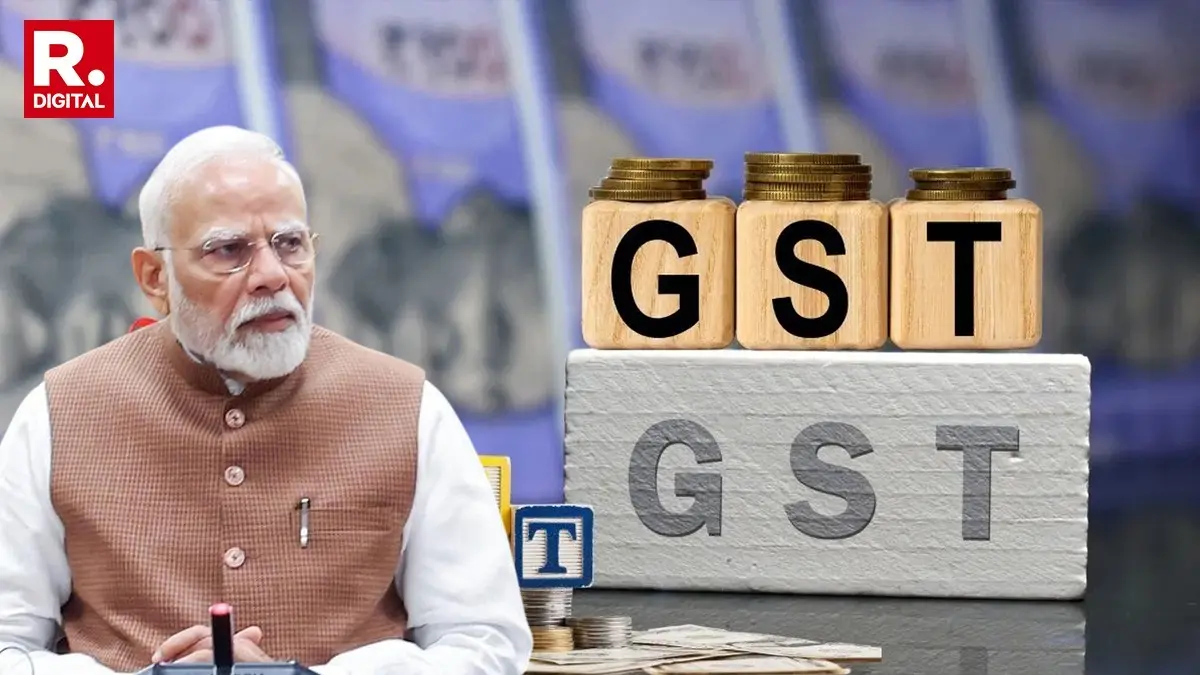
New Delhi: Prime Minister Narendra Modi addressed the nation on the eve of the rollout of Goods and Services Tax (GST) reforms, heralding the launch of ‘GST Bachat Utsav’, a move coinciding with the first day of Navratri. PM Modi said that every citizen, including the nation's poor, middle class, neo-middle class, youth, shopkeepers, and businessmen, would benefit from this initiative.
He congratulated all Indians on the next-generation GST reforms and the ‘GST Bachat Utsav’, asserting that the new taxes would accelerate India's growth, ease business operations, and bring each state to a level of equality.
PM Modi recalled the difficulties faced by businesses prior to the implementation of GST, citing an example of a company that found it more troublesome to transport goods from Bengaluru to Hyderabad, a distance of 570 km, than to export them to Europe and then send them back to Hyderabad. He stated that when his government was given the opportunity in 2014, making GST a priority for citizens and the country was paramount.
As per the PM, the dream of ‘One Nation, One Tax’ has finally come to fruition after discussions with every stakeholder, including the state governments and finding relevant solutions to all problems.
Advertisement
The Prime Minister outlined that with the next-generation GST reforms, only two tax slabs of 5% and 18% would exist. He asserted that with the reforms rolling out from September 22, daily amenities would become cheaper, with most daily need goods like toothpaste, brushes, soaps, etc., either having no tax or only a 5% tax. The neo-middle class, formed when people moved out of poverty, would see a lot of advantages, and both the middle class and the neo-middle class would receive a "double bonanza". GST on tourism has been reduced, making travelling cheaper and easier.
PM Modi emphasised the importance of walking on the path of Aatmanirbhar (self-reliance), with the MSME sector playing a big hand in this mission. MSMEs would be at a huge advantage with less tax to give and increased exports, a double advantage. He urged citizens to use goods ‘Made in India (Swadeshi)’, saying with pride, "I am Swadeshi, I use Swadeshi and produce Swadeshi".
Advertisement
The Prime Minister insisted that states should emphasise manufacturing within the country in the name of the Aatmanirbhar and Swadeshi mission.
Shopkeepers Are Embracing The GST Reforms: PM Modi
During his address, Prime Minister Modi was thrilled with how shopkeepers were embracing the GST reforms, noting that the business entities are actively passing on the benefits of GST reductions to customers. He even pointed out that at many places, shopkeepers are even displaying boards that compare prices before and after the reforms.
As Navratri begins, PM Modi extended greetings to all citizens, outlining that the nation is taking a big step forward in the Aatmanirbhar Bharat campaign with the Next Generation GST reforms kicking off on September 22.
Recalling India's first GST reform steps in 2017, PM Modi noted that citizens and traders were once tangled in the complications of taxes like Octroi, Entry Tax, Sales Tax, Excise, VAT, and Service Tax. Further, transporting goods between cities meant navigating multiple checkpoints, filling out tons of forms, and dealing with differing tax rules. PM Modi shared a striking example from a foreign newspaper about a company that found it easier to ship goods from Bengaluru to Europe and back to Hyderabad rather than directly to Hyderabad, a mere 570 km away.
He said this was just one of countless instances where lakhs of companies and crores of citizens faced daily hardships due to multiple taxes. The increased transportation costs ultimately hit the poor and regular customers. PM Modi stressed that upon taking office in 2014, the government prioritised GST for the people's and the nation's benefit.
How Will Next Generation GST Reforms Impact
According to experts, the Next Generation GST reforms are expected to have a major impact on India's economy. By simplifying the tax structure into two main slabs of 5% and 18%, with a special 40% slab for luxury and sin goods, the government expected to boost consumption, support MSMEs, and enhance the ease of doing business.
The consumers can look forward to cheaper essentials like household items, packaged foods, and small cars. The businesses, especially MSMEs, will benefit from simpler tax compliance, reduced costs, and improved cash flows. The reforms are also to make Indian goods more competitive globally by aligning with international best practices in indirect taxation.
Get Current Updates on India News, Entertainment News, Cricket News along with Latest News and Web Stories from India and around the world.