
How BITS Pilani Students Build Kamikaze Drones Now Used by the Indian Army
On India’s 79th Independence Day, discover how two BITS Pilani students built radar-evading kamikaze drones in their hostel room that are now being used by the Indian Army. A story of innovation, grit, and youth-led defense technology.
- India News
- 3 min read

;'%3e%3cpath%20d='m8,15.99c4.41,0,7.99-3.58,7.99-7.99S12.41,0,8,0,0,3.59,0,8s3.58,7.99,7.99,7.99Z'%20style='stroke:%23fff;%20stroke-miterlimit:10;%20stroke-width:.02px;'/%3e%3cpath%20d='m3.08,3.37l3.82,5.11-3.84,4.15h.87l3.37-3.64,2.72,3.64h2.94l-4.04-5.39,3.58-3.87h-.86l-3.1,3.35-2.5-3.35h-2.94Zm1.27.64h1.35l5.97,7.99h-1.35l-5.97-7.99Z'%20style='fill:%23fff;'/%3e%3c/g%3e%3c/svg%3e)


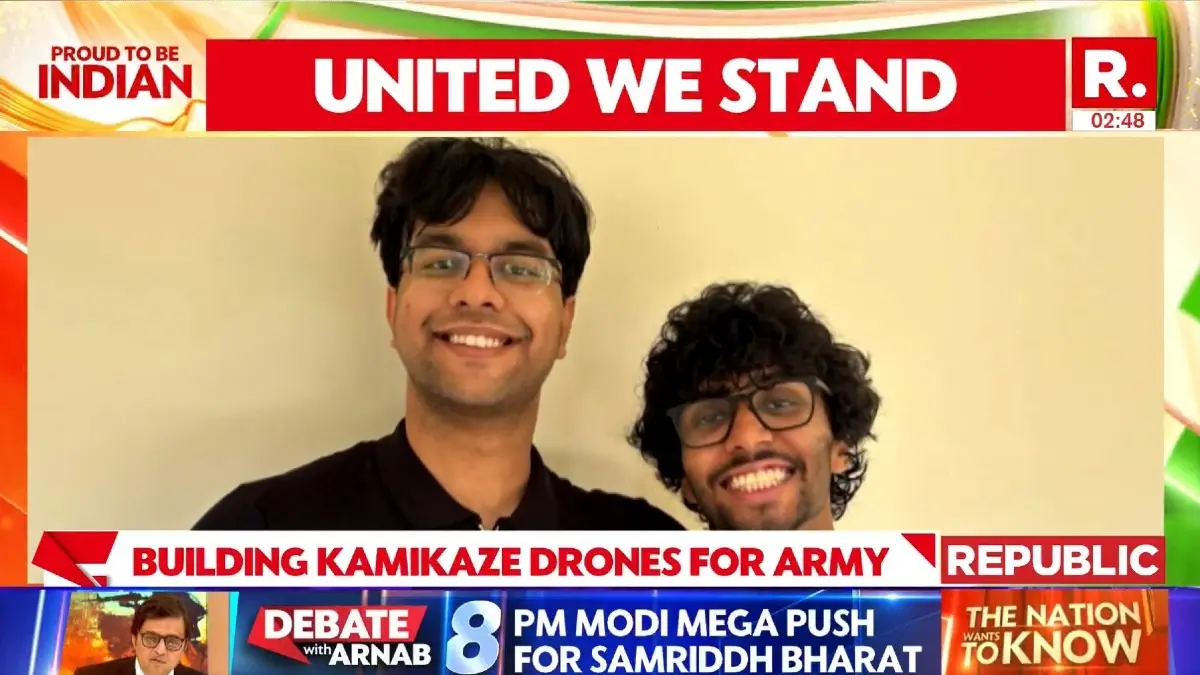
India today celebrates its 79th Independence Day today, not just with parades and flag hoisting but also with a pride in the innovation and spirits of its young minds. In a strong example of India's increasing self-reliance in defence technology, Jayant Khatri and Sourya Choudhury, both 20-year-old undergraduates from BITS Pilani, have created radar-evading kamikaze drones now used by the Indian Army in key border areas.
Built entirely from off-the-shelf parts in a small hostel room, the drones are capable of flying at over 300 km/hour, carrying a 1 kg payload, and manoeuvre with high accuracy in India's toughest terrains and climatic conditions.
From Cold Messages to Combat Zones
The duo co-founded Apollyon Dynamics earlier this year without any formal defence background, funding, or connections. However, they had a strong belief and determination that pushed them to create something that is crucial to India’s defence today.
“I started with cold emailing and reaching out to Army personnel on LinkedIn,” Jayant recalls. “Luckily, I got a message back from a Lieutenant Colonel. He promised an NCNC demo, that is, we just went there to Chandigarh, and in that unit, we had a no-cost, no-commitment demonstration of our drones. We demonstrated our drones, they liked our product, and post our demo, they procured a few of our drones.” After that, the duo received several referral orders through word-of-mouth advertising, where the Army told others that our drones are good. Mostly, it was just cold outreach."
Advertisement
That single breakthrough led to more orders and referrals. Within weeks, their drones were deployed in Jammu, Haryana, West Bengal, and Arunachal Pradesh. They even trained soldiers on-site to operate their systems.
Letting the Tech Speak
Instead of making sales pitches, they focused on performance. “We could’ve just talked about the drones,” says Sourya. “But we chose to fly them at 300 km/hr and push them to their limits in front of officers.” That’s how they showed their tech was viable. Sourya, while talking to Republic Media said that the simple formula that worked for them was- “Take whatever is thrown at you and show what your machines was capable of doing.”
Advertisement
From “Team Vidrohi” to Apollyon Dynamics
Their journey began in their first year of college when they formed a campus group called Team Vidrohi, meaning “rebel.” Inspired by real footage from the Russia-Ukraine conflict, they aimed to create tactical drones for real situations.
It took just 3–4 months of hard prototyping to develop the kamikaze version. What followed was rapid refinement and outreach until the Indian Army recognised their potential.
Today, it is a 20-member team developing next-gen VTOL and fixed-wing drone platforms, continuing to innovate in India.
Jayant emphasises that India's defence drone market, currently worth Rs 48,000 crore, is expected to grow significantly by 2030. Still, there’s a gap between supply and demand. “There’s still heavy reliance on foreign strategic partners,” he says. “The problem isn’t demand, it’s scale and supply chain.”
A Symbol of India’s Innovation Future
As the national flag flies high this Independence Day, stories like Jayant and Sourya’s present a new type of patriotism, one powered by innovation, determination, and a desire to serve to nation.
Get Current Updates on India News, Entertainment News, Cricket News along with Latest News and Web Stories from India and around the world.