
Updated 25 July 2025 at 19:13 IST
'Pehle Thi Aman Ki Aasha, Aaj Hai BrahMos Ki Bhasha': Dr. Sudhir Mishra Recalls Making of India's Supersonic Missile
Former CEO & MD of BrahMos Aerospace, Dr. Sudhir Mishra recalls the making of India's supersonic missile Brahmos, as he addressed the Republic Media Network Nationalist Collective conclave.
- India News
- 7 min read

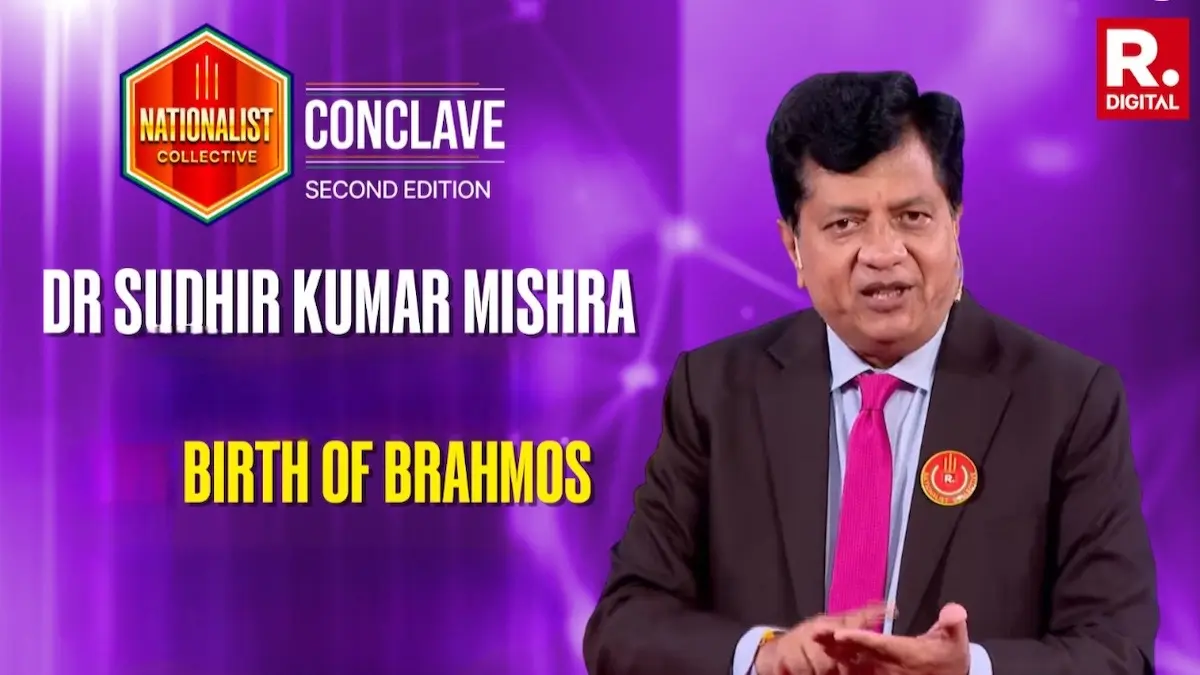
Noida: Dr. Sudhir Mishra, former CEO & MD of BrahMos Aerospace addressed Republic Media Network's Nationalist Collective Conclave and said proudly said that earlier we used to hope for peace but now our BhraMos missile speaks (pehle thi aman ki Aasha and aaj hai BrahMos ki bhasha) as he went down the memory lane and recalled the making of India's supersonic missile.
Dr. Sudhir Kumar Mishra revealed the untold story behind the making of BrahMos, India’s first supersonic cruise missile and shared how the vision and values of Dr. APJ Abdul Kalam shaped his journey.
Building upon his powerful address based on Brahmos missile journey, Dr Sudhir Mishra said, “So I used to think that how was Brahmos formed? In 1983, the Indian government started a project called Integrated Guided Missile Program. And it included earth, fire, sky, snake and trident. Out of which you know four very well. The fifth one has a different history, a different story.”
“When we started working on it because whenever you do a project in the world, a high-tech project, you don't make everything. You source components, materials, subsystems, knowledge from all over the world. But that's when Buddha smiled on India and when he smiled, the whole world imposed sanctions on us. When sanctions were imposed, we didn't even get the aluminium. The rest of the super alloys, special alloys, were very far away,” Mishra recalled.
Advertisement
The nature of human beings, or more specifically Indians, is that if you corner them, if you tell them that now you have to become weak and we will finish you, then they come back as their strength. They (Indians) return and say that we don't need anything, we will do everything ourselves… so we developed the whole technology indigenously in our country and with the support of people, teachers, professors and with the contribution of several small and medium enterprises, Dr Mishra said.
Speaking further, Dr Sudhir Mishra said that India's Integrated Guided Missile Development Programme (IGMDP) program is a success story. “We had developed a lot of technology indigenously. It was in 1993. We were very economically weak. Youngsters may not know, but we had no money to buy even 9 days of oil. And the Soviet Union was dissolved and they didn't have money either.”
Advertisement
In 1993, when Dr. Kalam was visiting Moscow, the institute was called NPO Machinostronia, (N-P-O-M). Dr. Yefremov was there. So during the meeting, Dr. Yefremov showed a picture of his half-completed supersonic ramjet engine to Dr. Kalam and said, “we were making this engine. We couldn't make it. There are many reasons. And it's very close to my heart. Just have a look at it. So, Dr. Kalam being Dr. Kalam, he used to think differently, out of the box and into the future."
Dr. Mishra mentioned Dr. Kalam told Russians that this is a fantastic engine. Let's make a missile. To this, Dr. Yefremov told him, “We don't have money. And I know you don't have money either.”
How India's supersonic missile was named Brahmos and why?
As discussions began between India and Russia over developing next generation missile, Dr Kalam told the Russians that we (India) has developed a lot of technology in IGMDP including the subsystems. And you (Russians) have developed this engine. You must have other technologies. So why don't we bring together all these technologies and come out with a world's fastest cruise missile.
"So, two poor people, world's fastest cruise missile, which has not been made in the USA, UK, France, or China. They are talking about it, that we will make it,” Dr Mishra said.
“There was an idea. They came back and formed a team, under the leadership of Dr. Sivdhanath Pillai,” he added.
Dr Mishra told, “Dr. Sivdhanath Pillai is like an elder brother to me. He prepared the entire technical, managerial, legal framework. And after preparing it, he decided that we can make a missile.”
“We will make it. And it was named BrahMos. Why BrahMos? By combining the Brahmaputra and the Moscow river, we made BrahMos,” Dr Mishra said.
Dr Mishra mentioned that it was decided between India and Russia that this missile will not be a technology transfer. It will be a joint development. They will take half of it and so do we.
“And we will integrate both in India. Why India? Because we said now we have enough capability. And our share is 50.5 per cent. So this company should be registered in India as an Indian company. So we will make it in India. What a fantastic decision. And the story started from there,” Dr Mishra narrated proudly.
Speaking further, Dr Mishra said, “We started making missiles. We redesigned all the subsystems of the IGMDP and made them specifically for Brahmos. After that, we went to the Navy. Indian Navy is a technology driven force. So we showed them the missiles that we are making for the Navy. Here, I want to tell you one thing. The ship is inside the sea. It is hundreds of kilometers inside. Hundreds of sailors are there. And if there is an accident, it will be very dangerous for the ship. And anything can happen. But Navy studied it and worked with us. And they said this is a fantastic missile. We know that you have taken all the safety, security measures. So let's make a missile. We will give you our ship. They gave us INS Rajput."
"And when we gave INS Rajput, we did a lot of flight tests from there. Then Indian Navy said that now we will give you a discarded ship whose tonnage was around 4,000. And you fire your missile with the warhead on it. Do the test and tell me. We fired at that ship. Ship was broken into two pieces. The flight took place about four and a half minutes. Missile was flying at the speed of almost 920 meters per second. The speed of the bullet is around 424 meters per second. It was flying at double the speed of the bullet. Ship got broken into two pieces. Sunk within four and a half, five minutes. And after that, we were out of orders. Indian Navy has nominated us today that all Indian Navy ships will be Brahmos.
How Army and Air Force adopted Brahmos missile
After a successful test with the Navy, Dr. Mishra said that the Indian Army took the missile from us. He added that for the Army, the platform, missile software and the warhead were changed. After the Army, the Air Force adopted it for which they modified the Sukhoi-30 aircraft.
“It took five years to modify the aircraft. If you change even one kilogram of its weight, you have to re-qualify it. You need to test it all over again, and that qualification process took four to five years. It’s a long story. HAL took the lead and achieved this with very little funding. OEMs were asking for hundreds of millions of dollars, but HAL completed it in just Rs 199 crore,” Dr Mishra said.
Lauding the performance of indigenous companies, Dr Mishra said, “We often criticise our Public Sector Undertakings (PSUs), but when they do a commendable job, we must give them credit by name. In this case, HAL worked intelligently."
The 2nd Edition of Nationalist Collective is: Presented By - Reliance Digital: Personalising Technology and Powered By - Tanvi Herbals: Tanvishata Tablets and Ravin Group: Jode Zindagi Ke Taar.
Get Current Updates on India News, Entertainment News, Cricket News along with Latest News and Web Stories from India and around the world.
Published By : Shashwat Bhandari
Published On: 19 July 2025 at 21:25 IST