
Indian Boots on Central Asian Soil: DUSTLIK 2026
India and Uzbekistan launch DUSTLIK 2026 in Namangan, featuring joint combat drills, special operations, and a push for deeper military interoperability and strategic cooperation.
- India News
- 6 min read

;'%3e%3cpath%20d='m8,15.99c4.41,0,7.99-3.58,7.99-7.99S12.41,0,8,0,0,3.59,0,8s3.58,7.99,7.99,7.99Z'%20style='stroke:%23fff;%20stroke-miterlimit:10;%20stroke-width:.02px;'/%3e%3cpath%20d='m3.08,3.37l3.82,5.11-3.84,4.15h.87l3.37-3.64,2.72,3.64h2.94l-4.04-5.39,3.58-3.87h-.86l-3.1,3.35-2.5-3.35h-2.94Zm1.27.64h1.35l5.97,7.99h-1.35l-5.97-7.99Z'%20style='fill:%23fff;'/%3e%3c/g%3e%3c/svg%3e)


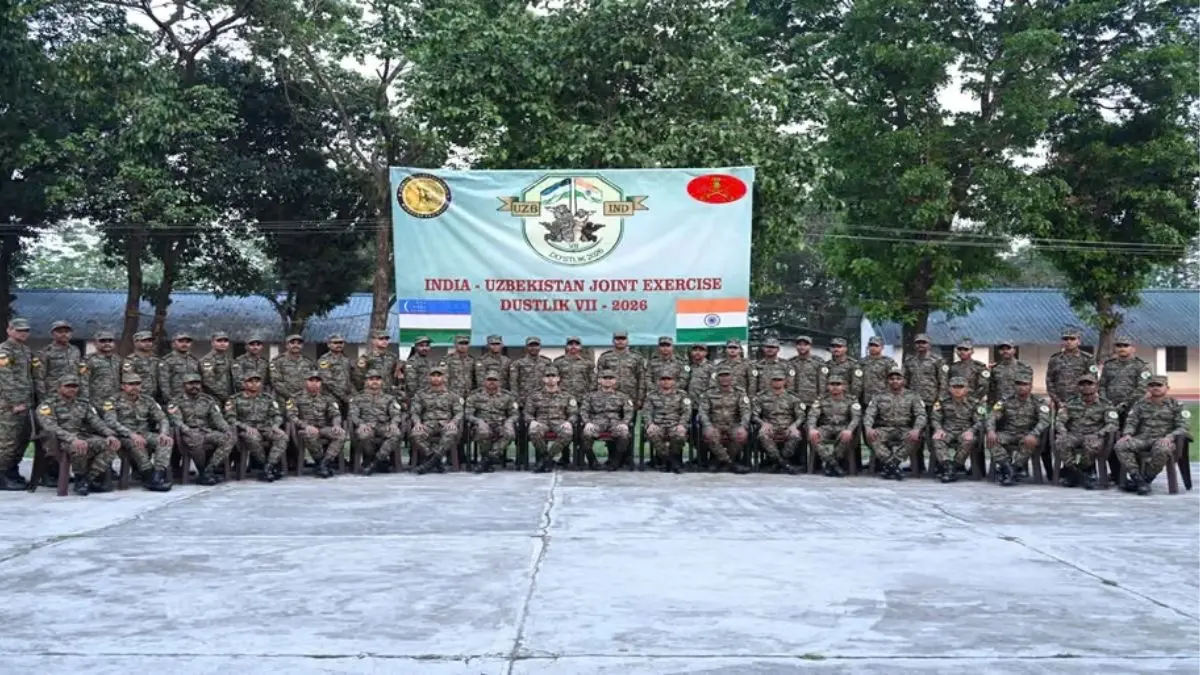
Sixty Indian soldiers and airmen touched down in Uzbekistan on Sunday as the 7th edition of the India-Uzbekistan joint military exercise DUSTLIK kicked off at the Gurumsaray Field Training Area in Namangan, setting the stage for 14 days of hard-edged combat training in semi-mountainous terrain that will test the operational readiness and battlefield coordination of the two allied militaries. The Indian contingent; comprising 45 troops of the Mahar Regiment and 15 personnel from the Indian Air Force will train shoulder-to-shoulder with an equal-sized Uzbek force until April 25, executing strike missions, seizure of enemy-held areas, land navigation drills, and joint special operations under a unified command framework.
The 2026 edition marks a significant step-up in ambition: both sides are now working to establish a common operational algorithm between their respective command-and-control structures; a clear and deliberate sign that DUSTLIK has moved well beyond handshakes and flag ceremonies into the serious business of military interoperability and real-world combat readiness. Strategically timed and tactically purposeful, this matters deeply to both nations, and now the two armed forces are converting decades of friendship into battlefield-ready synergy that counts when it matters.
The Crunch Point of DUSTLIK 2026
The operational heart of this year's exercise is as real and demanding as it gets. Key drills include land navigation in challenging terrain, strike missions on simulated enemy bases, and the seizure of enemy-held areas — all wrapped tightly in a framework of high physical fitness standards, rigorous joint tactical planning, joint tactical drills, and the basics of special arms skills. Crucially, the Indian contingent will immerse itself in Uzbek operational procedures and tactical doctrines while simultaneously sharing its own battle-hardened field experiences gained from decades of counter-insurgency operations, making this a genuine two-way exchange rather than a one-sided demonstration of capability. The exercise will also develop a unified operational algorithm between the command-and-control structures of both contingents, enabling them to plan and execute joint missions with precision and cohesion. Everything culminates in a gruelling 48-hour validation phase centred squarely on joint special operations and the neutralisation of unlawful armed groups — a mission-realistic finish under pressure that sets DUSTLIK 2026 firmly apart from routine bilateral military drills.
Advertisement
How DUSTLIK Went From a Handshake to a War Game
The DUSTLIK story is one of quiet, patient, but unmistakably steady progress. It started in November 2019 in the training fields of Chirchiq near Tashkent, where the inaugural edition ran for 10 focused days and concentrated on counter-insurgency and counter-terrorism operations in an urban scenario a modest but important first step in building genuine military trust and professional familiarity between New Delhi and Tashkent. That inaugural drill was as much about cultural understanding and mutual familiarity as it was about hard tactics, with soldiers from both sides exchanging combat experiences, sharpening their skills at arms, demonstrating combat power over extremist forces during the validation phase, and learning how the other army thinks, plans, and operates under pressure. From Chirchiq, the exercise shifted to Ranikhet in Uttarakhand in March 2021, then to Yangiarik in Uzbekistan in 2022, to Pithoragarh in the Himalayan foothills in 2023, to Termez in 2024, to Pune in 2025, and now to Namangan's Gurumsaray training ground in 2026 — seven editions, alternating flags, and a military relationship that has visibly and meaningfully deepened with each successive posting.
Advertisement

DUSTLIK Gets Bigger, Bolder Every Year
The one defining story that the DUSTLIK series is that it is the story of relentlessly expanding ambition and growing operational complexity. The 2023 edition in Pithoragarh introduced UN-mandate counter-terrorism scenarios in mountainous and semi-urban terrain, combining field training exercises with combat discussions, lectures, demonstrations, and putting explicit emphasis on exploiting new-generation equipment and emerging technology in the conduct of joint operations. Then came Termez 2024 arguably DUSTLIK's most complex edition to that point which dramatically added a Joint Command Post, an Intelligence Surveillance Centre, small-team insertion and extraction operations, special heliborne missions, cordon-and-search drills, room intervention procedures, and the demolition of illegal structures to an already demanding training menu. That 2024 edition also sent a pointed and progressive message: two women officers, one from the Regiment of Artillery and one from the Army Medical Corps, were embedded in the Indian contingent alongside combat support arms and services beyond infantry signalling clearly that DUSTLIK was maturing into a genuine multi-domain event reflective of the modern Indian Army's composition. Now in 2026, the exercise raises the bar once more a unified command algorithm, a joint Air Force component on both sides, and a 48-hour joint special operations finale that tests everything the two forces have built together.
Central Asia on New Delhi's Radar
Strip away the tactical drills, the camouflage, and the validation exercises and what you find at the very core of DUSTLIK is a clear, calculated, and increasingly urgent geopolitical logic. Defence has long been formally identified as a key pillar of the India-Uzbekistan strategic partnership, and both countries have institutionalised their counter-terrorism cooperation through the India-Uzbekistan Joint Working Group on Counterterrorism — a dedicated body designed to synchronise the law-enforcement agencies and special services of both nations across a shared set of threat perceptions and regional security challenges. On the defence industrial front, India has extended a significant Line of Credit of USD 40 million to Uzbekistan, backed by two major defence industrial workshops held in September 2019 and November 2020 that brought public and private sector defence companies from both countries into structured dialogue. For India, Uzbekistan is far more than a friendly neighbour it is a critical strategic doorway into the Central Asian heartland at a moment when New Delhi is pushing assertively to build influence across a region simultaneously being courted by China's Belt and Road Initiative and shadowed by Pakistan's proximity to a volatile Afghanistan, making every DUSTLIK edition a potent diplomatic signal as much as a military training event.
DUSTLIK 2026: The Drill That Speaks Louder Than Any Joint Statement
When soldiers train together under live conditions, they send a message that no diplomatic communiqué, no joint statement, and no bilateral summit can quite replicate and that is precisely what DUSTLIK 2026 is doing from the sunlit training fields of Namangan. In seven years and seven editions, this exercise has grown from a 10-day counter-terrorism familiarisation event at Chirchiq into a multi-domain, multi-service, command-integrated military drill that rigorously tests the two armies' ability to plan, coordinate, communicate, and fight together across realistic operational scenarios.
April 25, it will not just mark the end of a training cycle it will mark another milestone in a defence relationship that is quietly but unmistakably rewriting India's strategic posture in Central Asia. DUSTLIK did not arrive fully formed; it was built exercise by exercise, from the counter-terror drills at Chirchiq in 2019 to the command-integrated special operations now unfolding at Gurumsaray in 2026. Seven editions in, the message is unambiguous the India-Uzbekistan partnership has moved far beyond paperwork and protocol, and on the fields of Namangan, it is proving itself in boots, sweat, and operational synergy.
Get Current Updates on India News, Entertainment News, Cricket News along with Latest News and Web Stories from India and around the world.