
India’s Realpolitik Churns Fine: Charts Strategic Autonomy In A Multipolar World
India charts strategic autonomy in a multipolar world, balancing ties with global powers while safeguarding national interests.
- India News
- 5 min read

;'%3e%3cpath%20d='m8,15.99c4.41,0,7.99-3.58,7.99-7.99S12.41,0,8,0,0,3.59,0,8s3.58,7.99,7.99,7.99Z'%20style='stroke:%23fff;%20stroke-miterlimit:10;%20stroke-width:.02px;'/%3e%3cpath%20d='m3.08,3.37l3.82,5.11-3.84,4.15h.87l3.37-3.64,2.72,3.64h2.94l-4.04-5.39,3.58-3.87h-.86l-3.1,3.35-2.5-3.35h-2.94Zm1.27.64h1.35l5.97,7.99h-1.35l-5.97-7.99Z'%20style='fill:%23fff;'/%3e%3c/g%3e%3c/svg%3e)


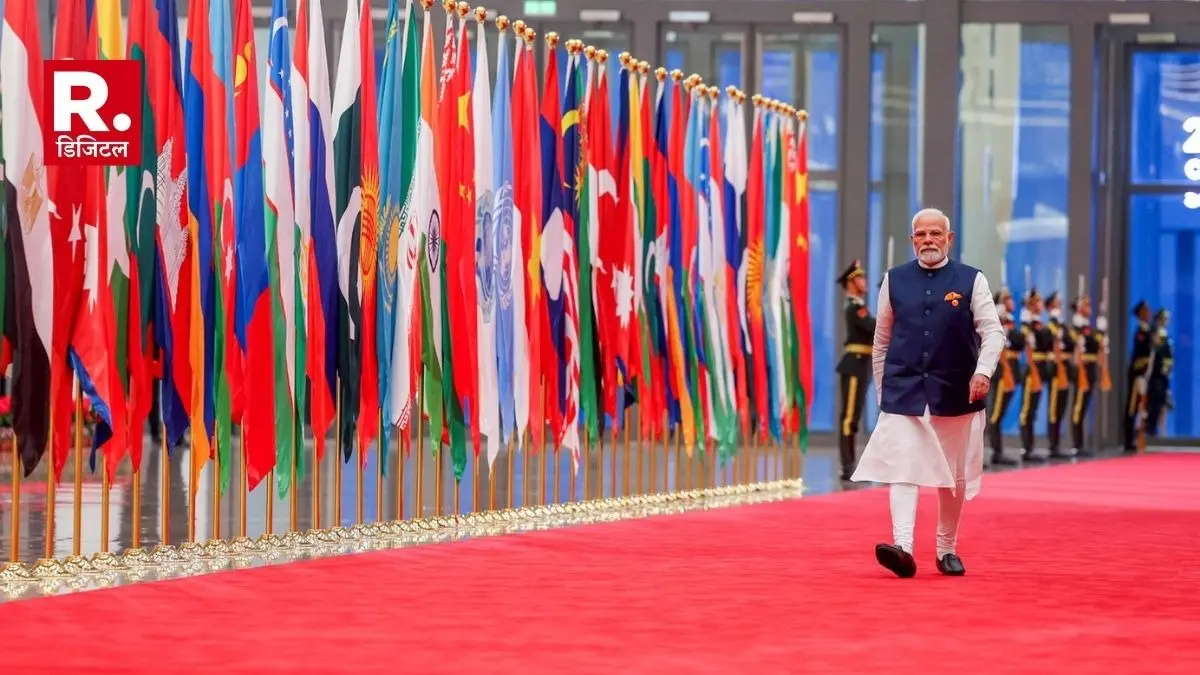
New Delhi: In a world fractured by geopolitical rivalries and economic upheavals, India under Prime Minister Narendra Modi is carving a path of resolute strategic autonomy, deftly balancing ties with global powers while safeguarding its national interests. The recent meeting between Modi and Chinese President Xi Jinping on the sidelines of the Shanghai Cooperation Organisation (SCO) summit in Tianjin on September 1, 2025, underscores New Delhi’s pragmatic approach, rooted in the timeless lessons of Kautilya’s Arthashastra. This ancient treatise on statecraft, emphasizing realpolitik, continues to inform India’s foreign policy as it navigates a multipolar world order with calculated precision.
The Tianjin talks, marking Modi’s first visit to China in seven years, were more than a diplomatic reset after the 2020 Galwan Valley clashes. They signaled India’s intent to stabilize relations with Beijing, a key rival, while managing strained ties with Washington and maintaining its historic partnership with Moscow. Modi and Xi’s pledge for a “fair, reasonable, and mutually acceptable” resolution to the long-standing border dispute, coupled with commitments to boost trade and investment, reflects a strategic recalibration. This move comes as U.S. President Donald Trump’s 50 percent tariffs on Indian goods, described by analysts as an economic declaration of war, have disrupted India’s role as a cornerstone of the “China Plus One” strategy, where global businesses sought alternatives to Chinese manufacturing.
Kautilya's Principles In India's Pragmatic Diplomacy
India’s response to these tariffs, which threaten $87 billion in exports from textiles to pharmaceuticals, is not to pivot toward any single power but to double down on its multi-alignment strategy. As former ambassador Jitendra Nath Misra aptly noted, “Hedging is a bad choice. But the alternative of aligning with anyone is worse.” This sentiment captures India’s refusal to be co-opted into any geopolitical bloc, whether the U.S.-led Quad or the China-Russia-dominated SCO. Instead, New Delhi is playing a high-stakes balancing act, drawing on Kautilya’s principles of leveraging alliances and rivalries to maximize national advantage without compromising sovereignty.
The Arthashastra teaches that a wise ruler engages adversaries and allies alike with pragmatism, keeping options open while securing strategic depth. PM Modi’s diplomacy embodies this doctrine. Despite U.S. pressure over India’s discounted Russian oil purchases, crucial for energy security, New Delhi has deepened ties with Moscow, as evidenced by External Affairs Minister S. Jaishankar’s recent visit to Russia. Simultaneously, India’s participation in the SCO alongside China and Russia sends a clear message: it will not be pressured into isolating Moscow or fully aligning with Washington’s Indo-Pacific agenda.
Advertisement
The timing of India’s cautious détente with China is telling. Beijing, reeling from its own U.S. tariffs, has positioned itself as a “partner” rather than a rival, with Foreign Minister Wang Yi urging Delhi to resist Washington’s “bullying.” While India remains wary of China’s intentions—given a trade deficit exceeding its defense budget and unresolved border tensions, it sees value in stabilizing ties to avoid a two-front squeeze from China and Pakistan. This pragmatic engagement, coupled with India’s leadership in South Asia through initiatives like naval drills with Sri Lanka and defense cooperation with Bangladesh, underscores its regional primacy and counters China’s Belt and Road ambitions.
India's Rise As Global Power Remains Unshackled
Scholars like Happymon Jacob argue that managing China will remain India’s core strategic preoccupation, yet former foreign secretary Nirupama Rao frames this as autonomy, not ambiguity: “India is a titan in chrysalis, too large and ambitious to bind itself to any single great power.” This vision of strategic autonomy is not a reactive stance but a proactive assertion of India’s role as a pole in a multipolar world. By maintaining robust ties with the U.S. through the Quad, engaging China in forums like BRICS and SCO, and preserving energy and defense partnerships with Russia, India is crafting a multi-vector doctrine that ensures flexibility in an unstable global order.
Advertisement
The Trump administration’s tariffs, while a setback, have not derailed India’s trajectory. History offers perspective: sanctions following India’s 1974 and 1998 nuclear tests eventually gave way to U.S.-India rapprochement when strategic logic prevailed. Analysts anticipate a similar cycle, but for now, India is absorbing the blows, keeping partners guessing, and buying time. This approach aligns with Kautilya’s counsel to prioritize long-term national interests over short-term alignments, ensuring India’s rise as a global power remains unshackled.
India's Diplomatic Balancing Act
In a fractured, multipolar world, India’s strategic autonomy is not just a policy, it’s a masterclass in realpolitik. Prime Minister Narendra Modi’s deft balancing of Washington, Beijing, and Moscow, while asserting regional dominance, cements India as a global titan. The recent Modi-Xi summit in Tianjin, against the backdrop of the SCO, underscores this: stabilizing ties with China, defying U.S. tariff pressures, and doubling down on Russian energy ties. Guided by Kautilya’s Arthashastra, India’s playbook is clear: engage all, align with none. With a $5 trillion economy poised to become the world’s third-largest and growing clout in the G20 and SCO, India is rewriting the rules.
As External Affairs Minister Jaishankar puts it, India will “engage America, manage China, cultivate Europe, reassure Russia,” and lead its neighborhood, beholden to no one. In this era of asymmetrical multipolarity, India’s path is unyielding: strategic autonomy is non-negotiable. No external pressure—be it Trump’s 50% tariffs or China’s border brinkmanship will derail this course. As global powers jostle for dominance, India’s calculated navigation ensures it doesn’t just survive, it thrives, shaping a new world order as a pole, not a pawn.
Get Current Updates on India News, Entertainment News, Cricket News along with Latest News and Web Stories from India and around the world.