
Indore High Court Declares Dhar Bhojshala a Hindu Temple of Goddess Vagdevi; Security Tightened Across Dhar
The Madhya Pradesh High Court Indore bench has ruled that the Dhar Bhojshala complex is a temple dedicated to Goddess Vagdevi (Saraswati) in the long-running Bhojshala-Kamal Maula dispute. Security has been intensified across Dhar following the verdict.
- India News
- 5 min read

;'%3e%3cpath%20d='m8,15.99c4.41,0,7.99-3.58,7.99-7.99S12.41,0,8,0,0,3.59,0,8s3.58,7.99,7.99,7.99Z'%20style='stroke:%23fff;%20stroke-miterlimit:10;%20stroke-width:.02px;'/%3e%3cpath%20d='m3.08,3.37l3.82,5.11-3.84,4.15h.87l3.37-3.64,2.72,3.64h2.94l-4.04-5.39,3.58-3.87h-.86l-3.1,3.35-2.5-3.35h-2.94Zm1.27.64h1.35l5.97,7.99h-1.35l-5.97-7.99Z'%20style='fill:%23fff;'/%3e%3c/g%3e%3c/svg%3e)


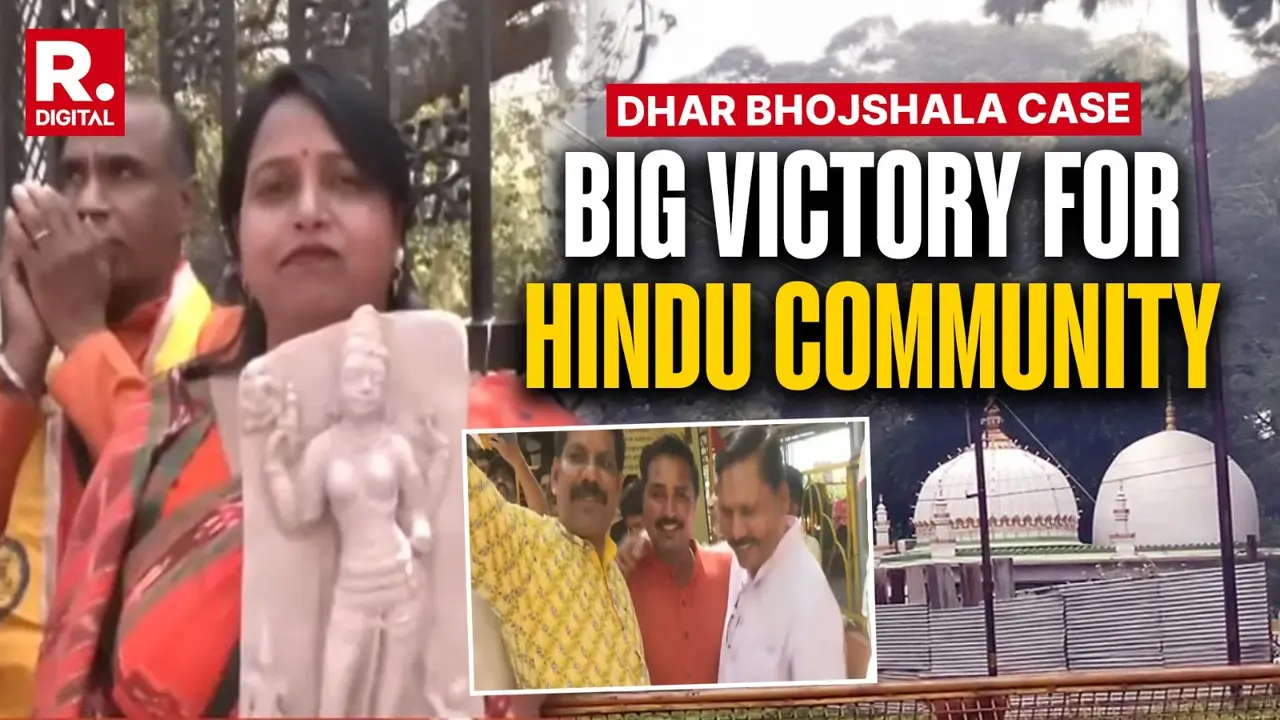
Bhojshala Verdict: The Indore bench of the Madhya Pradesh High Court on Thursday delivered a major verdict in the decades-old Bhojshala-Kamal Maula Mosque dispute in Dhar district, declaring that the religious character of the disputed site is that of Bhojshala, a temple dedicated to Goddess Vagdevi Saraswati and an ancient centre of Sanskrit learning.
The division bench comprising Justice Vijay Kumar Shukla and Justice Alok Awasthi pronounced the order while hearing petitions filed by Hindu Front for Justice and petitioner Kuldeep Tiwari seeking reclamation of the Bhojshala complex for Hindu worship and a ban on offering namaz inside the premises.
Court Says Historical Records Support Hindu Claim
In one of its strongest observations, the High Court said it had examined archaeological evidence, ASI survey reports, historical material and legal provisions before arriving at its conclusion.
The bench observed that “historical literature establishes” that the disputed site was originally Bhojshala, a centre of Sanskrit learning associated with Raja Bhoj of the Parmar dynasty.
Advertisement
The court further said the religious character of the area is that of Bhojshala and the temple of Goddess Vagdevi Saraswati.
“We have considered the archaeological and historical facts, ASI notifications and survey reports,” the bench said, adding that courts can rely on multidisciplinary archaeological studies carried out by the ASI.
Advertisement
The judges also referred to principles laid down in the Ayodhya Verdict while explaining the basis of the ruling.
Hindu Worship ‘Never Extinguished’
The High Court noted that Hindu worship at the site had continued over the years and “has never been extinguished.”
The bench held that the Bhojshala–Kamal Maula Mosque complex is a protected monument under law since March 18, 1904, but maintained that its religious identity remains that of Bhojshala.
The court described Bhojshala as an important centre of Sanskrit education linked to Raja Bhoj, the famous ruler of the Parmar dynasty.
ASI’s 2003 Order Set Aside
The court also quashed parts of a 2003 order issued by the Archaeological Survey of India (ASI), saying the order restricted Hindu worship rights while permitting Muslims to offer namaz at the complex.
“Offering namaz at Bhojshala has been quashed,” the bench observed during the hearing.
The ruling effectively allows Hindu prayers and worship at the site while ending the earlier arrangement permitting namaz.
Government Asked to Consider Alternative Land
While passing the judgment, the court also addressed concerns regarding the Muslim community.
The bench said that if members of the Muslim side apply for allotment of suitable land in Dhar district for construction of a mosque, the state government may consider the request according to law.
Advocate Vishnu Shankar Jain also stated after the verdict that the government could provide alternative land if sought by the Muslim community.
Centre and ASI to Manage Complex
The High Court directed the Union government and the ASI to take decisions regarding the future administration and management of the Bhojshala temple and Sanskrit learning centre.
However, the ASI will continue to maintain supervisory control over preservation and conservation work at the protected monument.
The bench stressed that governments have a constitutional obligation to preserve ancient monuments, temples, sanctum sanctorums and places of spiritual importance.
Saraswati Idol Issue Mentioned
The court also referred to the long-standing demand for bringing back the idol of Goddess Saraswati, believed to be kept in a museum in London.
The bench said representations regarding the idol have already been submitted before the government and authorities may consider them in accordance with law.
Muslim Side Responds to Bhojshala Verdict
Following the Indore High Court’s ruling recognizing Bhojshala as the temple of Goddess Vagdevi, petitioner Sahar Qazi from the Muslim side stated that they will review the verdict and approach the Supreme Court for further legal recourse. Emphasizing the importance of social harmony, Qazi appealed to all communities to maintain peace.
The Muslim side also indicated that they may submit an application to the government requesting land for a mosque at a location that would avoid future disputes and ensure coexistence without conflict. This measured response highlights both their intent to pursue legal remedies and their call for communal balance.
Sensitive Case With Major Political Impact
The Bhojshala dispute has remained one of Madhya Pradesh’s most sensitive religious and political issues for decades, with Hindu and Muslim groups both staking claim over the site in Dhar district.
Thursday’s ruling is being seen as a landmark judgment with major religious, legal and political significance across the country.
Get Current Updates on India News, Entertainment News, Cricket News along with Latest News and Web Stories from India and around the world.