
ISI-Linked Gang Network Busted in Delhi Police’s Operation Gang Bust–2; 1000 Teams Crack Down Across 5 States
Around 1000 police teams were constituted and deployed simultaneously across multiple locations to execute the crackdown.
- India News
- 5 min read

;'%3e%3cpath%20d='m8,15.99c4.41,0,7.99-3.58,7.99-7.99S12.41,0,8,0,0,3.59,0,8s3.58,7.99,7.99,7.99Z'%20style='stroke:%23fff;%20stroke-miterlimit:10;%20stroke-width:.02px;'/%3e%3cpath%20d='m3.08,3.37l3.82,5.11-3.84,4.15h.87l3.37-3.64,2.72,3.64h2.94l-4.04-5.39,3.58-3.87h-.86l-3.1,3.35-2.5-3.35h-2.94Zm1.27.64h1.35l5.97,7.99h-1.35l-5.97-7.99Z'%20style='fill:%23fff;'/%3e%3c/g%3e%3c/svg%3e)


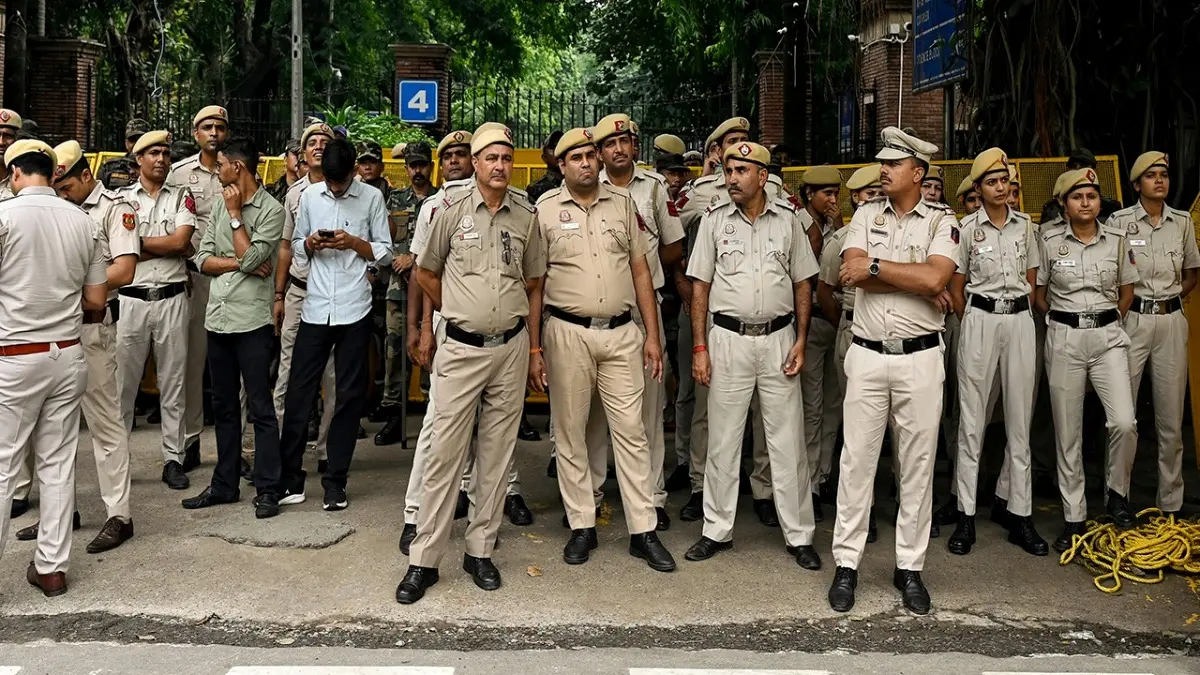
New Delhi: Delhi Police’s Special Cell has busted a major ISI-linked gangster network as part of its large-scale crackdown titled “Operation Gang Bust–2”, carried out over the past 48 hours. The operation, described by officials as highly focused and intelligence-driven, was aimed at dismantling organised criminal syndicates that had either remained active or resurfaced after earlier crackdowns, particularly those who had managed to evade action in January. With detailed groundwork, sustained surveillance and advanced reconnaissance, the Special Cell launched one of its most extensive coordinated actions in recent times.
Addressing the media, Pramod Kushwaha highlighted the significance of the operation, especially the exposure of cross-border linkages. “This operation has also led to the busting of an ISI-sponsored Shahzad Bhatti gang module, with key members of the network being identified and arrested, exposing cross-border linkages behind organised criminal activities,” he said, underlining the national security dimension of the crackdown.
According to officials, nearly 1000 police teams were constituted and deployed simultaneously across multiple locations, making it a meticulously planned and synchronised effort. The teams acted on 483 identified targets, which included a wide spectrum of operatives such as shooters, arms suppliers, social media handlers and local gang members who played different roles in sustaining these criminal ecosystems. The identification of such a large number of targets indicates the depth and spread of organised crime networks operating in and around the national capital.
In a sweeping series of raids, police conducted searches at 1014 hideouts, ranging from suspected safe houses to operational hubs used by gang members. These raids resulted in 481 detentions and apprehensions, marking a significant blow to multiple criminal networks. Officials said that the operation was not just about arrests but also about disrupting the logistical and financial backbone of these gangs, many of which operate through layered structures and interstate linkages.
Advertisement
The scale of recoveries during the operation further highlights the seriousness of the threat. Police seized 130 illegal weapons and 214 cartridges, pointing to the easy availability and circulation of arms among criminal groups. In addition, authorities recovered ₹19 lakh in cash, believed to be proceeds of crime or funds intended for illegal activities. The operation also led to the seizure of 34 vehicles, which were allegedly used for transportation of weapons, movement of gang members, or in the execution of crimes.
Significantly, the crackdown also exposed the involvement of gangs in other illegal trades. Police recovered 19 kilograms of narcotics, suggesting links to drug trafficking networks, and seized around 700 units of illicit liquor, indicating parallel operations in illegal liquor distribution. Officials noted that many of these gangs diversify their activities to maximise profits, often engaging in multiple illegal businesses simultaneously.
Advertisement
More than 30 gangsters were arrested during the operation, with many of them linked to notorious criminal outfits such as the Hashim Baba gang and the Tillu Tajpuria gang, along with several other local and interstate groups. These gangs have been involved in a range of criminal activities, including extortion, contract killings, illegal arms trade and drug trafficking. The arrests are expected to significantly weaken their operational capabilities.
One of the most crucial breakthroughs of the operation was the dismantling of the ISI-sponsored Shahzad Bhatti network, which points to the presence of cross-border support for certain criminal activities. Police confirmed that 9 members of this network were arrested, and investigations are underway to uncover the full extent of their operations, funding channels and handlers. Officials believe that such networks may be used to destabilise law and order by leveraging local criminal elements.
In another alarming revelation, police arrested 5 individuals identified as contract killers, who were allegedly in the process of planning targeted attacks on police personnel. This highlights the growing audacity of organised crime groups and their willingness to directly confront law enforcement agencies. Officials said timely intervention prevented potential attacks that could have had serious consequences.
The operation also brought to light the extensive interstate nature of these criminal networks. Arrests and linkages were traced to multiple locations, including Amroha and Azamgarh in Uttar Pradesh, Rajouri, parts of Punjab, and Alwar in Rajasthan. Notably, three gunrunners from Punjab were apprehended, indicating the role of interstate arms supply chains. Another आरोपी was arrested from Alwar, further underlining the geographical spread of the network.
Investigators revealed that the broader footprint of these gangs extends across Uttar Pradesh, Rajasthan, Haryana, Punjab and Madhya Pradesh, demonstrating how organised crime in the region is deeply interconnected. Such networks often exploit state boundaries to evade law enforcement, making coordinated multi-state operations like “Operation Gang Bust–2” crucial for effective action.
Perhaps the most concerning aspect of the crackdown was the revelation of planned attacks. Police stated that four accused were actively planning attacks on security agency targets in Delhi, while one suspect was preparing to carry out an attack in Uttar Pradesh. These disclosures indicate that the operation not only disrupted criminal networks but also averted potential security threats that could have had far-reaching implications.
Officials emphasised that the operation specifically targeted individuals who had either slipped through earlier crackdowns or had reactivated their networks. By focusing on these “leftover” operatives and combining intelligence inputs with field surveillance, the Special Cell was able to strike at the core of multiple syndicates simultaneously.
Get Current Updates on India News, Entertainment News, Cricket News along with Latest News and Web Stories from India and around the world.