
J&K Has Progressed, People Happy: SG Tushar Mehta Tells Supreme Court In Statehood Case
Supreme Court grants Centre four weeks to respond on restoring Jammu & Kashmir’s statehood, as petitioners question delay and raise federalism concerns.
- India News
- 5 min read

;'%3e%3cpath%20d='m8,15.99c4.41,0,7.99-3.58,7.99-7.99S12.41,0,8,0,0,3.59,0,8s3.58,7.99,7.99,7.99Z'%20style='stroke:%23fff;%20stroke-miterlimit:10;%20stroke-width:.02px;'/%3e%3cpath%20d='m3.08,3.37l3.82,5.11-3.84,4.15h.87l3.37-3.64,2.72,3.64h2.94l-4.04-5.39,3.58-3.87h-.86l-3.1,3.35-2.5-3.35h-2.94Zm1.27.64h1.35l5.97,7.99h-1.35l-5.97-7.99Z'%20style='fill:%23fff;'/%3e%3c/g%3e%3c/svg%3e)


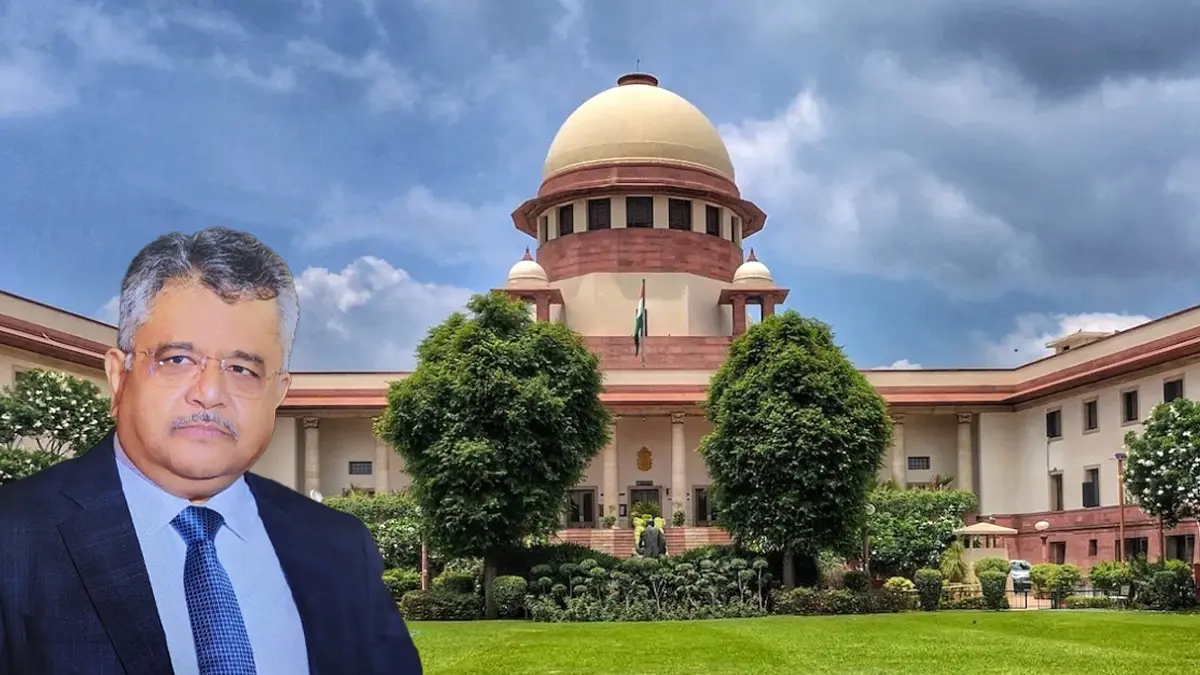
New Delhi: On Thursday, the Supreme Court granted the Union Government four weeks to respond to applications for the reinstatement of Jammu & Kashmir as a state.
A bench headed by Chief Justice of India BR Gavai and Justice K Vinod Chandran heard the arguments of Solicitor General of India Tushar Mehta that while peaceful elections were held last year in the region, more time was needed to think about the issue of recovering statehood in light of safety issues and the recent Pahalgam terror attacks.
Centre Seeks More Time Citing Security Concerns
“SG states that the elections were done in a peaceful manner and a government was elected. It is submitted that during the period of the last six years, there has been substantial progress in J&K. He however submits that certain events had taken place in the recent past, like the Pahalgam incident, which will have to be taken into consideration while taking a final call on this hearing,” the bench noted.
Additionally, the Solicitor General told the Court that the Union Government was discussing the issue with the local government.
Advertisement
Activist Khurshaid Ahmad Malik, college instructor Zahoor Ahmad Bhat, and MLA Irfan Hafiz Lone are among the candidates. The Supreme Court affirmed the revocation of Jammu & Kashmir's special status in the case In Re: Article 370 of the Constitution, in which the applications were submitted.
‘Pahalgam Happened Under Their Watch,’ Says Petitioners’ Counsel
In reference to the Pahalgam incident, CJI Gavai said during the hearing that the area was still vulnerable to security concerns.
Advertisement
Speaking on behalf of Zahoor Bhat at this point, Senior Advocate Gopal Sankaranarayanan stated: "Pahalgam occurred under their watch, Union of India — Union Territory, so under their watch."
SG Mehta objected forcefully, asking, "What is 'their watch'? Our government is in charge of it. I take issue with this.
"Much water has flowed since then," Sankaranarayanan said, referring to the Union's guarantee in the 2023 Article 370 ruling for the return of statehood.
"And blood too," SG Mehta retorted, adding that this person before the Supreme Court views the Indian government as your government rather than mine.
Sankaranarayanan requested that the issue be referred to a five-judge Constitution panel, since the original judgment on cancellation was delivered by a bench of similar strength. He made it clear that the applicants' main goal was to have the Union's pledge enforced in a timely manner.
According to Sr. Adv. Maneka Guruswamy, "Non-Restoration Raises Federalism Concerns."
Speaking on behalf of MLA Irfan Hafiz Lone, Senior Advocate Maneka Guruswamy contended that the ongoing rejection of statehood presents significant constitutional concerns about Indian federalism.
What does it signify for federalism if a State may be turned into a Union Territory in this way? The J&K assembly passed the resolution for statehood a year ago. "It's dangerous to allow J&K to stay a UT," she remarked.
"Articles 1, 2, and 3 do not envisage the conversion of a State into a Union Territory," she continued, citing constitutional provisions. The Union promised. What would happen if that federalism guarantee wasn't followed?
‘Centre Could Downgrade Any State,’ Warns N.K. Bhardwaj
Speaking on behalf of other petitioners, Senior Advocate N.K. Bhardwaj cautioned that allowing such a conversion will give the Center the power to downgrade any State into a Union Territory whenever it pleases.
“If this is permitted, then they can convert any State into a UT if the government is inconvenient. Tomorrow if they convert UP as a UT — UP has a border with Nepal. Or convert Tamil Nadu. You cannot convert a State to UT. This has never happened in our history.”
‘At Least Table the Bill in Parliament,’ Says PC Sen
Speaking on behalf of a petitioner who had contested the repeal of Article 370, Senior Advocate PC Sen argued that Parliament could at least try to bring the restoration bill and start the House debate.
Sen also cited the Report of Justices Anjana Prakash and A.P. Shah, which highlights the low investment rates and rise in suicides in the J&K region.
The Counsel was attempting to paint a "grim picture" of the area for the entire world, SG Mehta interrupted.
"What's causing your agitation? CJI Gavai instructed the SG to let him finish the submissions.
‘People of Jammu Suffering Due to Lack of Finances’
Jammu lawyers' counsel argued that the region's residents were suffering from unemployment and a lack of development funding.
In instance, there is no development in the Jammu region. People tell lawmakers that they lack the funds to handle the development projects in the Jammu area when they approach them.
He emphasized that the area has remained peaceful in spite of the Pahalgam incident. "The security threat cannot be a reason to deny statehood because the Mata Vaishno Devi Shrine Board is managing the Yatra despite the heavy rains; there has been an influx of tourists."
In response, SG Mehta insisted, “J&K has progressed; everyone is happy. 99.9% of people there consider the Government of India as their own. These arguments are meant for some forum outside, not this Court. They have to be taken with a pinch of salt.”
Background: Article 370 Judgment and Pending Assurance
In light of the Solicitor General's guarantee that statehood will be restored, the Supreme Court upheld the revocation of Jammu and Kashmir's special status in its Article 370 finding but declined to rule on the validity of the Jammu and Kashmir Reorganisation Act, 2019.
Although the Court did not specify a timeframe, it had ordered that such restoration occur "as soon as possible."
The applicants now argue that the Union has not restored statehood in accordance with the Court's directive, even though the Union Territory's elections were concluded on October 8, 2024.
After four weeks, the case will be heard.
Get Current Updates on India News, Entertainment News, Cricket News along with Latest News and Web Stories from India and around the world.