
‘Judiciary Is Bleeding’: Supreme Court Cracks Down On NCERT, Bans Class 8 Book Over ‘Corruption’ Chapter, Warns Of Criminal Contempt
Taking suo motu cognisance of a controversial NCERT Social Science textbook, the Supreme Court calls it a ‘calculated move’ to undermine courts. Halting further distribution and seizure of all copies currently in circulation, the apex court has issued show-cause notices to top education officials.
- India News
- 6 min read

;'%3e%3cpath%20d='m8,15.99c4.41,0,7.99-3.58,7.99-7.99S12.41,0,8,0,0,3.59,0,8s3.58,7.99,7.99,7.99Z'%20style='stroke:%23fff;%20stroke-miterlimit:10;%20stroke-width:.02px;'/%3e%3cpath%20d='m3.08,3.37l3.82,5.11-3.84,4.15h.87l3.37-3.64,2.72,3.64h2.94l-4.04-5.39,3.58-3.87h-.86l-3.1,3.35-2.5-3.35h-2.94Zm1.27.64h1.35l5.97,7.99h-1.35l-5.97-7.99Z'%20style='fill:%23fff;'/%3e%3c/g%3e%3c/svg%3e)


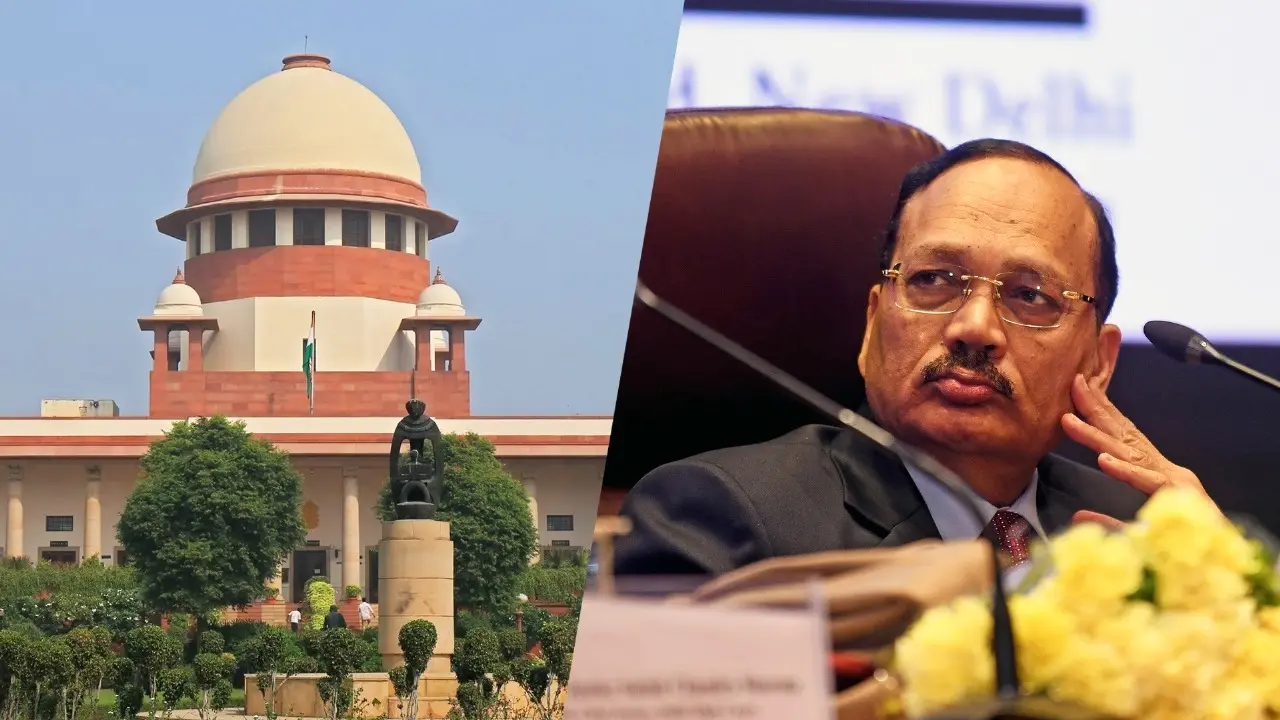
New Delhi: The Supreme Court on Thursday banned the production and distribution of a Class 8 Social Science textbook published by the National Council of Educational Research and Training (NCERT), taking suo motu cognisance of a chapter titled “The Role of the Judiciary in Our Society”, which referenced judicial corruption allegations and case backlogs.
The Bench comprising Chief Justice of India Surya Kant, Justices Joymalya Bagchi and Vipul M Pancholi also issued a show-cause notice to the Secretary of School Education, Ministry of Education, and the NCERT Director, as to why action under the Contempt of Courts Act or any other law should not be taken against them.
The chapter identifies corruption as a serious concern affecting judicial credibility. It also outlines the scale of case pendency in courts and explains the reasons behind it, including shortage of judges, complex legal procedures and inadequate infrastructure.
The case was triggered after media reports flagged the contents of the book titled “Exploring Society: India and Beyond, Vol II”.
Advertisement
Calling the development “deeply shocking”, CJI Surya Kant said the court was compelled to act to safeguard institutional integrity and prevent lasting damage to public confidence in the judiciary.
‘Calculated Move To Undermine Judiciary’
Reading out portions from the order, the CJI said a chapter under the heading “Role of Judiciary in Our Society” prominently carried a section titled “Corruption in the Judiciary”, referring to “hundreds of complaints” against judges and suggesting systemic opacity and institutional corruption.
Advertisement
“We are reluctant to reproduce the chapter,” the CJI said, “but it prominently refers to complaints as if no action was taken and selectively extracts words from a former CJI’s speech to suggest the judiciary itself has acknowledged corruption.”
The Bench said the narrative appeared one-sided, omitting the “illustrious history” of constitutional courts, including their role in preserving the democratic fabric and upholding the Basic Structure doctrine.
“It seems to us that there is a calculated move to undermine the institutional authority and demean the dignity of the judiciary,” the CJI said. “If allowed to go unchecked, it will erode the sanctity of judicial office in the estimation of the public at large and in the impressionable minds of youth.”
‘Judiciary Is Bleeding Today’
In one of the strongest remarks of the hearing, the CJI said, “They fired the gunshot. Judiciary is bleeding today.”
The court expressed serious concern that the book’s content was not confined to students alone. “It travels from teachers to students to parents, to society and the next generation,” the CJI said, warning that foundational misconceptions at a young age could distort understanding of constitutional institutions.
While clarifying that the proceedings were not meant to stifle legitimate criticism, the court said robust discourse strengthens institutions, but “biased narrative” at the school level, presented without balance, was unacceptable.
“The necessity of judicial intervention is not from a desire to suppress criticism but to uphold the integrity of education,” the CJI said.
Centre Tenders Apology, Court Unimpressed
Appearing for the Centre, Solicitor General Tushar Mehta opened by tendering an unconditional apology in the suo motu matter.
However, the Bench noted that the communication sent earlier to the Registrar General had defended the contents instead of introspecting.
“There is no word of apology in this,” the CJI said, referring to the initial response. “Instead of introspection, the authority was defending. This was a deep-rooted conspiracy,” he said.
The Solicitor General informed the court that 32 copies had reached the market and that distribution had been halted following a press release by the Department of School Education under the Ministry of Education. He added that the two individuals involved in drafting the chapter would never again be associated with the ministry or the University Grants Commission in any capacity.
The CJI, however, cautioned against letting individuals “go scot-free”, stressing that accountability must be fixed at the appropriate level.
Show-Cause Notices, Threat Of Contempt
In its order, the court issued show-cause notices to the Secretary of the Department of School Education and to the Director of NCERT, asking why action should not be initiated against them under the Contempt of Courts Act or any other applicable law.
“Given the serious consequences and an everlasting adverse impact on the independence of judiciary, such misconduct will fall within the purview of criminal contempt,” the CJI warned. “If proved to be a deliberate move, it would undoubtedly interfere with the administration of justice besides scandalising the institution,” he said.
The Bench also made it clear that distributing the book henceforth would amount to wilful breach of the court’s order.
Immediate Ban, Seizure Of Copies
The Supreme Court directed:
- An immediate ban on production and distribution of the book.
- Seizure and confiscation of all physical copies in circulation.
- Removal of the PDF version and any digital copies available online.
- Issuance of necessary takedown directions to prevent further circulation.
The top court noted that despite the government’s claim that distribution had been halted, copies were still accessible in the market and on social media.
‘Silence Is Egregious’: CJI Notes Broader Implications
The controversy has sparked a wider debate over how institutions, especially the judiciary, are portrayed in school curricula. While some legal experts have underlined the importance of teaching critical thinking, the court made it clear that critique must be balanced and contextual.
The Bench pointed out that the chapter appeared to focus heavily on corruption and case pendency, even referencing the phrase “justice delayed is justice denied”, but failed to highlight transformative measures undertaken by courts, including expansion of legal aid, streamlining access to justice and landmark constitutional interventions.
“The silence is egregious,” the CJI said, noting that the judiciary has itself acted firmly against corruption and misuse of office, including against high-ranking officials.
The top court indicated that it would examine whether the apology was genuine or merely an attempt to “wriggle out of consequences” after irreversible reputational damage.
The CJI made it clear that while scrutiny of the judiciary was permissible, even necessary, “one-sided, school-level portrayal of systemic corruption” would not go unchecked.
“The framers of the Constitution carefully demarcated the roles of the legislature, executive and judiciary to preserve democratic balance. We are of the firm conviction that rigorous discourse helps the living vitality of the institution, but this cannot come at the cost of eroding its very foundation,” the CJI added.
Get Current Updates on India News, Entertainment News, Cricket News along with Latest News and Web Stories from India and around the world.