
Leh Violence: Magisterial Inquiry Ordered, 26 Protesters Freed Amid Tensions
Ladakh has ordered a magisterial inquiry into the September 24 Leh violence that left four dead and over 120 injured during protests led by Sonam Wangchuk.
- India News
- 3 min read

;'%3e%3cpath%20d='m8,15.99c4.41,0,7.99-3.58,7.99-7.99S12.41,0,8,0,0,3.59,0,8s3.58,7.99,7.99,7.99Z'%20style='stroke:%23fff;%20stroke-miterlimit:10;%20stroke-width:.02px;'/%3e%3cpath%20d='m3.08,3.37l3.82,5.11-3.84,4.15h.87l3.37-3.64,2.72,3.64h2.94l-4.04-5.39,3.58-3.87h-.86l-3.1,3.35-2.5-3.35h-2.94Zm1.27.64h1.35l5.97,7.99h-1.35l-5.97-7.99Z'%20style='fill:%23fff;'/%3e%3c/g%3e%3c/svg%3e)


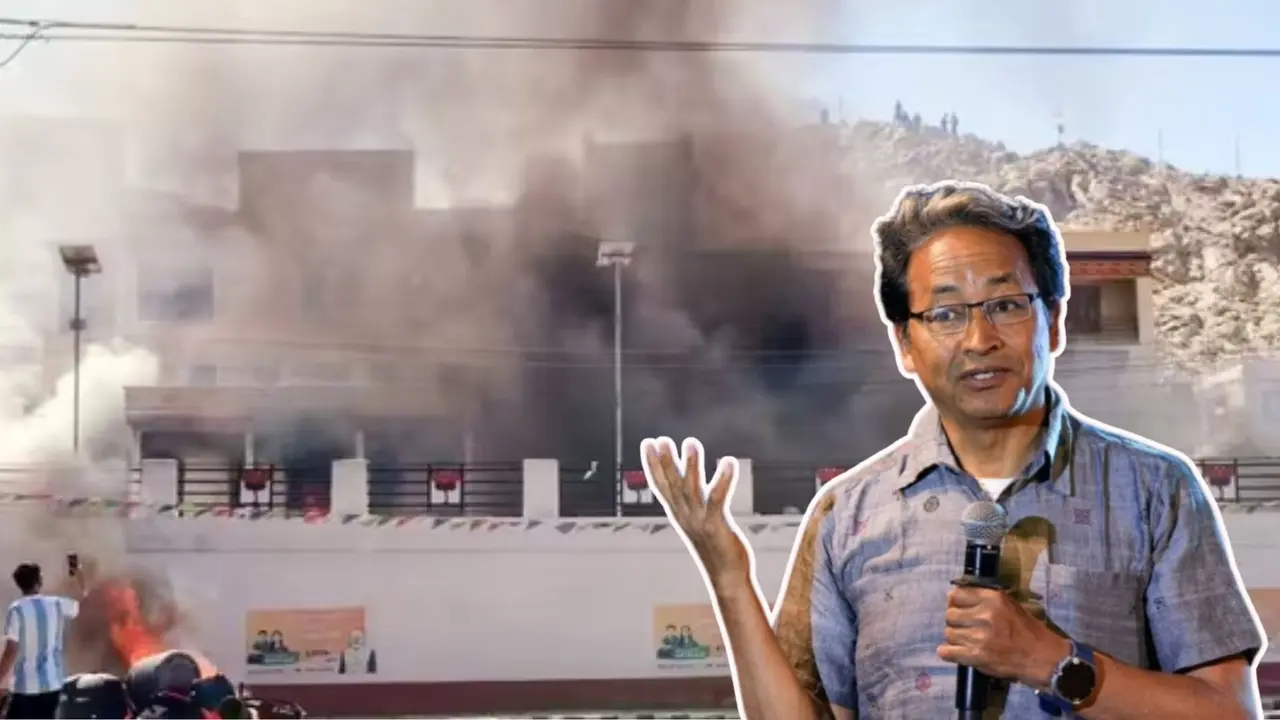
New Delhi: Ladakh administration has ordered a magisterial inquiry into the deadly violence that erupted on September 24, claiming four lives and injuring over 120 people, including 78 security personnel.
The probe, led by IAS officer Mukul Beniwal, sub-divisional magistrate of Nubra, is to investigate the sequence of events, police actions, and factors contributing to the breakdown of law and order. The probe report is set to be submitted within four weeks.
The administration has further invited the public to submit evidence, including oral statements, photographs, or videos, between October 4 and October 18 at the DC office conference hall in Leh or Beniwal’s office, emphasizing transparency in uncovering the truth.
The violence, which marked a tragic escalation of a non-violent protest, began on the 15th day of a hunger strike led by environmentalist and Ramon Magsaysay Award winner Sonam Wangchuk.
Advertisement
Wangchuk, who began his fast on September 10, was demanding statehood for Ladakh, inclusion under the Sixth Schedule for tribal safeguards, exclusive land and job rights for locals, and separate parliamentary seats for Leh and Kargil. His arrest under the National Security Act (NSA) on September 25 has sparked widespread outrage, with demands for his immediate release.
The deceased in Leh violence have been identified as Jigmet Dorje from Khranak, Rinchen Dadul from Hanu, Stanzin Namgyal from Igu, and Tsewang Tharchin from Skurbuchan.
Advertisement
Eyewitnesses and family members claim the victims were peaceful demonstrators caught in the crossfire, alleging excessive use of force by security personnel, including tear gas, pellets, and live ammunition.
The protests, organized by the Ladakh Apex Body (LAB) and Kargil Democratic Alliance (KDA), gained momentum after reports of the deteriorating health of two female activists, Tsering Angchuk and Tashi Dolma.
On September 24, a large number of Gen-Z protesters enforced a shutdown in Leh, blocking roads and marching toward government buildings. Clashes erupted as demonstrators reportedly pelted stones, prompting security forces to respond with force.
Bharatiya Janata Party (BJP) office in Leh was set ablaze, along with several security vehicles, including a CRPF van. Government offices were also targeted, leading to a curfew under Section 163 of the Bharatiya Nagarik Suraksha Sanhita (BNSS) and a temporary internet shutdown.
Meanwhile, the Ministry of Home Affairs (MHA) has accused Wangchuk of inciting violence through “provocative statements,” citing his references to youth-led movements like the Arab Spring and protests in Nepal, Bangladesh, and Sri Lanka.
On Sept 25, MHA also cancelled the Foreign Contribution Regulation Act (FCRA) license of Wangchuk’s NGO, the Students’ Educational and Cultural Movement of Ladakh (SECMOL), for misuse of foreign funds.
Meanwhile, 26 detained protesters have been released as a goodwill gesture, though curfews remain in place selectively, and security forces are on high alert due to Ladakh’s strategic location near China and Pakistan.
LAB and KDA have withdrawn from scheduled talks with MHA officials, boycotting a high-level meeting set for October 6, led by Union Minister of State for Home Affairs Nityanand Rai.
“We cannot negotiate while our leader is detained unjustly,” a LAB spokesperson said, labelling Wangchuk’s arrest an attempt to suppress legitimate demands.
Political parties, including National Conference, Congress, Janata Dal (United), CPI (M), and former BJP MP Jamyang Tsering Namgyal, have called for a thorough probe and Wangchuk’s release.
Ladakh’s broader crisis stems from discontent over the loss of autonomy following its 2019 bifurcation from Jammu and Kashmir into a union territory. With 97 percent of the population being tribal, locals fear demographic changes, land grabs, and dilution of cultural identity without Sixth Schedule protections, which grant autonomous councils’ legislative powers over land and resources.
“This is not just about statehood; it’s about dignity and survival,” said KDA leader Sajjad Kargili.
Get Current Updates on India News, Entertainment News, Cricket News along with Latest News and Web Stories from India and around the world.