
Govt Proposes to Increase Lok Sabha Seats From 543 To 850 | First Draft Of Historic Constitution Amendment Bill Inside
Reasoning the motive behind the increase in seats, the government has stated, “While the freeze of seats on the basis of population figures of the year 1971 census served an important policy purpose, the country’s demographic profile has since undergone substantial changes."
- India News
- 4 min read

;'%3e%3cpath%20d='m8,15.99c4.41,0,7.99-3.58,7.99-7.99S12.41,0,8,0,0,3.59,0,8s3.58,7.99,7.99,7.99Z'%20style='stroke:%23fff;%20stroke-miterlimit:10;%20stroke-width:.02px;'/%3e%3cpath%20d='m3.08,3.37l3.82,5.11-3.84,4.15h.87l3.37-3.64,2.72,3.64h2.94l-4.04-5.39,3.58-3.87h-.86l-3.1,3.35-2.5-3.35h-2.94Zm1.27.64h1.35l5.97,7.99h-1.35l-5.97-7.99Z'%20style='fill:%23fff;'/%3e%3c/g%3e%3c/svg%3e)


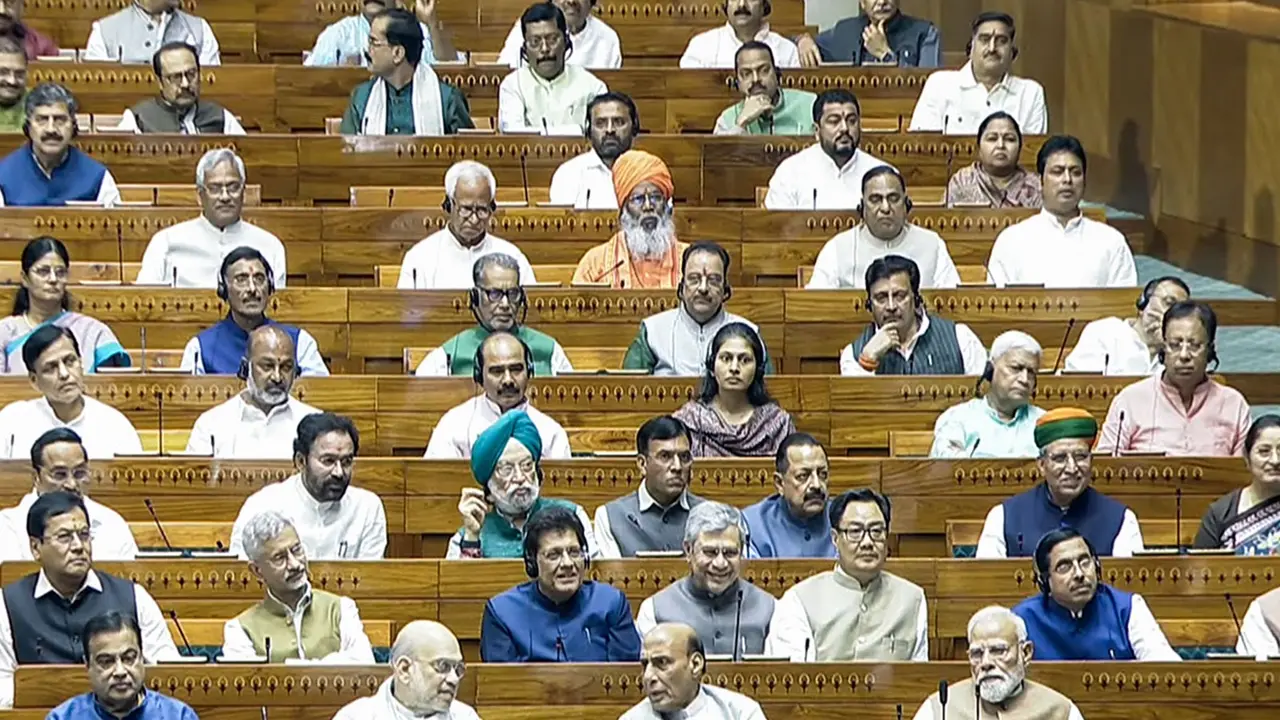
New Delhi: The Centre has proposed to increase the strength of the Lok Sabha from 543 to 850, according to a government circular accessed by several media outlets. Among the 850 seats, 815 have been allotted for states, while 35 for Union Territories, the circular read, adding that these changes will come into effect from the 2029 Lok Sabha elections.
Reports indicate that the bill has already been shared with the MPs, and it might be introduced in the special session of Parliament that is slated to commence from April 16. The Constitution states that 530 seats have been allotted for states, and 20 for Union Territories. A delimitation commission, that came into effect later on, had fized the total number of seats to 543.
As per reports, the central government has circulated the Constitution (131) Amendment Bill with the MPs.
Why The Constitution 131st Amendment Bill Was Introduced
Republic Media has accessed the first draft of the Constitution 131st Amendment Bill which is all set to be enacted by the Parliament.
Advertisement
Reasoning the motive behind the increase in seats, the government has stated, “While the freeze of seats on the basis of population figures of the year 1971 census served an important policy purpose, the country’s demographic profile has since undergone substantial changes, as reflected in the population figures of the latest published census, including significant inter-State and intra-State population shifts, rapid urbanisation and migration, and disproportionate growth in certain regions, resulting in wide disparities in the population and the constituencies.”

Nari Shakti Vandan Adhiniyam Bill
In another watershed moment in the Parliament, the Union Cabinet have cleared a Bill that seeks to amend the Constitution to implement the 33 per cent quota for women in the Lok Sabha and the state assemblies.
Advertisement
The Constitution (One Hundred and Sixth Amendment) Act, 2023, popularly known as the ‘Nari Shakti Vandan Adhiniyam’, amended article 239AA and inserted articles 330A, 332A and 334A in the Constitution, to provide for reservation of nearly one-third of seats for women in the House of the People and the Legislative Assemblies (including women belonging to the Scheduled Castes and the Scheduled Tribes).
Mentioning the objective of the Bill, the Centre pointed out that it intends to achieve “greater participation of women in the House of the People, the Legislative Assembly of a State and the Legislative Assembly of the National Capital Territory of Delhi.”
“The said provisions contemplate that such reservation shall become operative after the first delimitation is undertaken on the basis of the relevant census taken after the commencement of the said Amendment Act,” the bill mentioned.
Reasoning the urgency behind bringing about reservations for women in Parliament at this juncture in the special session of the Parliament, the 131st Amendment Bill mentioned, “The next census and the consequential delimitation exercise thereafter will take considerable time and thus, delay the effective and dedicated participation of women in our democratic polity. Hence, the objective of the proposed Bill is to operationalise one-third reservation for women, including women belonging to the Scheduled Castes and the Scheduled Tribes, in the House of the People and the Legislative Assemblies of the States, the National Capital Territory of Delhi and the Union territories through delimitation exercise to be undertaken on the basis of the population figures of the latest published census.”
Highlighting how the reservation of seats for women is linked to the readjustment in allocation of seats in the Lok Sabha, the Bill states, “The implementation of reservation of seats for women is linked to the constitutional scheme of readjustment in the allocation of seats in the House of the People and the Legislative Assemblies and re-drawing boundaries of territorial constituencies by the Delimitation Commission.”
How Has The Opposition Reacted
The Opposition has opposed the Centre's delimitation push, for using the 2011 Census data. Several parties including the AAP, RJD and and the DMK have mainteined that the delimitation exercise should be based on the updated 2021 Census figures.
INDIA bloc parties have also demanded clarity on the demand for a “quota within quota” for women representation from the backward classes.
Opposition leaders are expected to hold a meeting at Congress chief Mallikarjun Kharge’s residence in Delhi, which might be attended by party leaders from the Trinamool Congress and the DMK.
Get Current Updates on India News, Entertainment News, Cricket News along with Latest News and Web Stories from India and around the world.