
‘Make Every Home and Shop a Symbol of Swadeshi’: PM Modi’s Navratri Message to Proudly Choose Made-in-India Product
Prime Minister Narendra Modi appeals citizens to adopt swadeshi products and highlights the new GST reforms as a “Bachat Utsav” that will cut costs, empower MSMEs, and drive India toward self-reliance and inclusive growth.
- India News
- 3 min read

;'%3e%3cpath%20d='m8,15.99c4.41,0,7.99-3.58,7.99-7.99S12.41,0,8,0,0,3.59,0,8s3.58,7.99,7.99,7.99Z'%20style='stroke:%23fff;%20stroke-miterlimit:10;%20stroke-width:.02px;'/%3e%3cpath%20d='m3.08,3.37l3.82,5.11-3.84,4.15h.87l3.37-3.64,2.72,3.64h2.94l-4.04-5.39,3.58-3.87h-.86l-3.1,3.35-2.5-3.35h-2.94Zm1.27.64h1.35l5.97,7.99h-1.35l-5.97-7.99Z'%20style='fill:%23fff;'/%3e%3c/g%3e%3c/svg%3e)


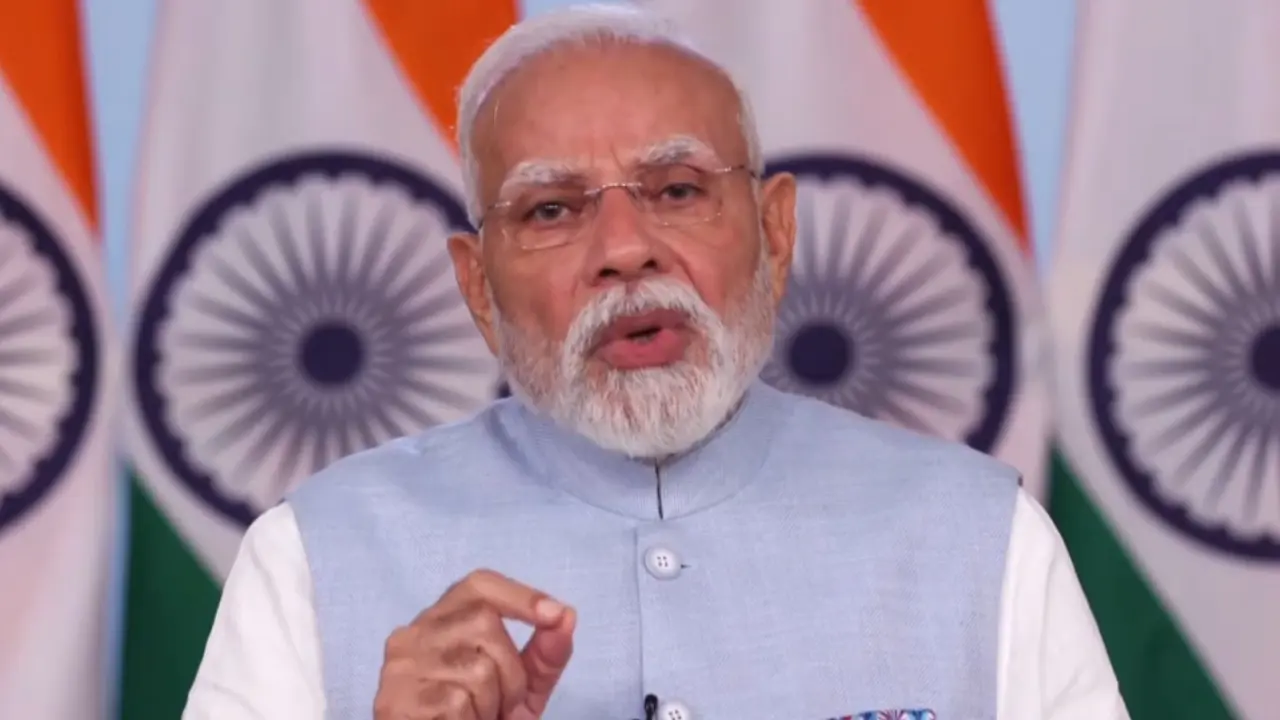
New Delhi: While addressing the nation on Sunday, Prime Minister Narendra Modi reiterated his call to encourage swadeshi (indigenous) products, asking citizens to move towards self-reliance and reduce dependence on foreign-made goods. He emphasized the point during his speech that many people are unaware of whether common products, such as combs, are manufactured in India or another country.
Additionally, PM Modi emphasized the necessity of more knowledge and thoughtful consumer decisions, calling the GST reforms a "Bachat Utsav" saying, ‘Today, unknowingly, a lot of foreign things have entered our everyday life. We don’t even know whether we have foreign or Indian combs in our pockets. We have to get rid of them as well. We have to buy goods that are made in India; goods that have the hard work of our country’s youth, goods that have the sweat of our country’s sons and daughters.’
The Prime Minister claimed that the GST reforms will result in significant cost reductions for the general population and that they are in line with the Union Government's "Nagrik Devo Bhava" policy.
"We are moving forward by following the mantra of 'Nagrik Devo Bhava', and we can see its reflection in the next generation's GST reforms. If we combine the income tax exemption and the GST exemption, the decisions made in one year will save the people of the country more than Rs 2.5 lakh crore, and that's why I say, 'This is a savings festival,'" he said.
Advertisement
The PM emphasized self-reliance as the road to a developed India, claiming that lower GST rates will directly assist small enterprises and MSMEs. "To reach the goal of a developed India, we must walk on the path of self-reliance, and a very big responsibility to make India self-reliant also lies on our MSMEs. What is needed by the people of the country, what we can make in our own country, we should make right here in the country... The reduction in GST rates and the simplification of rules and procedures will greatly benefit our MSMEs, small industries, and cottage industries," he added.
Additionally, he compared the desire for economic power to Swadeshi during the independence movement. "Their sales will increase, and they will have to pay less tax, meaning they will also receive a double benefit... Just as the country's independence gained strength from the mantra of Swadeshi... similarly, the country's prosperity will also gain strength from the mantra of Swadeshi alone," he said.
Advertisement
Approved during the 56th meeting of the GST Council earlier this month, the Goods and Services Tax (GST) structure reform is scheduled to take effect on September 22.
A simplified two-slab regime of 5% and 18% will now take the place of the current four-rate scheme. For luxury and sin items, a special 40% slab has been set aside.
This new framework aims to lower the cost of living, strengthen MSMEs, broaden the tax base, and promote inclusive growth. It is anticipated to facilitate compliance, lower consumer prices, increase manufacturing, and support a variety of industries, from agriculture to automobiles and from FMCG to renewable energy.
The textile and handicraft sectors stand to benefit significantly. The GST on yarn and fibers has been lowered to 5%, and the inverted duty structure on man-made fibers has been fixed.
Get Current Updates on India News, Entertainment News, Cricket News along with Latest News and Web Stories from India and around the world.