
‘No Shortage’: Hardeep Puri Quells Panic Over LPG Crisis, Says India's Crude Supply Secure, Stable
Amid the global energy disruption caused by the West Asia conflict, Hardeep Singh Puri tells the Lok Sabha that India has no fuel shortage, assuring the nation that petrol, diesel and LPG supplies remain stable.
- India News
- 11 min read

;'%3e%3cpath%20d='m8,15.99c4.41,0,7.99-3.58,7.99-7.99S12.41,0,8,0,0,3.59,0,8s3.58,7.99,7.99,7.99Z'%20style='stroke:%23fff;%20stroke-miterlimit:10;%20stroke-width:.02px;'/%3e%3cpath%20d='m3.08,3.37l3.82,5.11-3.84,4.15h.87l3.37-3.64,2.72,3.64h2.94l-4.04-5.39,3.58-3.87h-.86l-3.1,3.35-2.5-3.35h-2.94Zm1.27.64h1.35l5.97,7.99h-1.35l-5.97-7.99Z'%20style='fill:%23fff;'/%3e%3c/g%3e%3c/svg%3e)


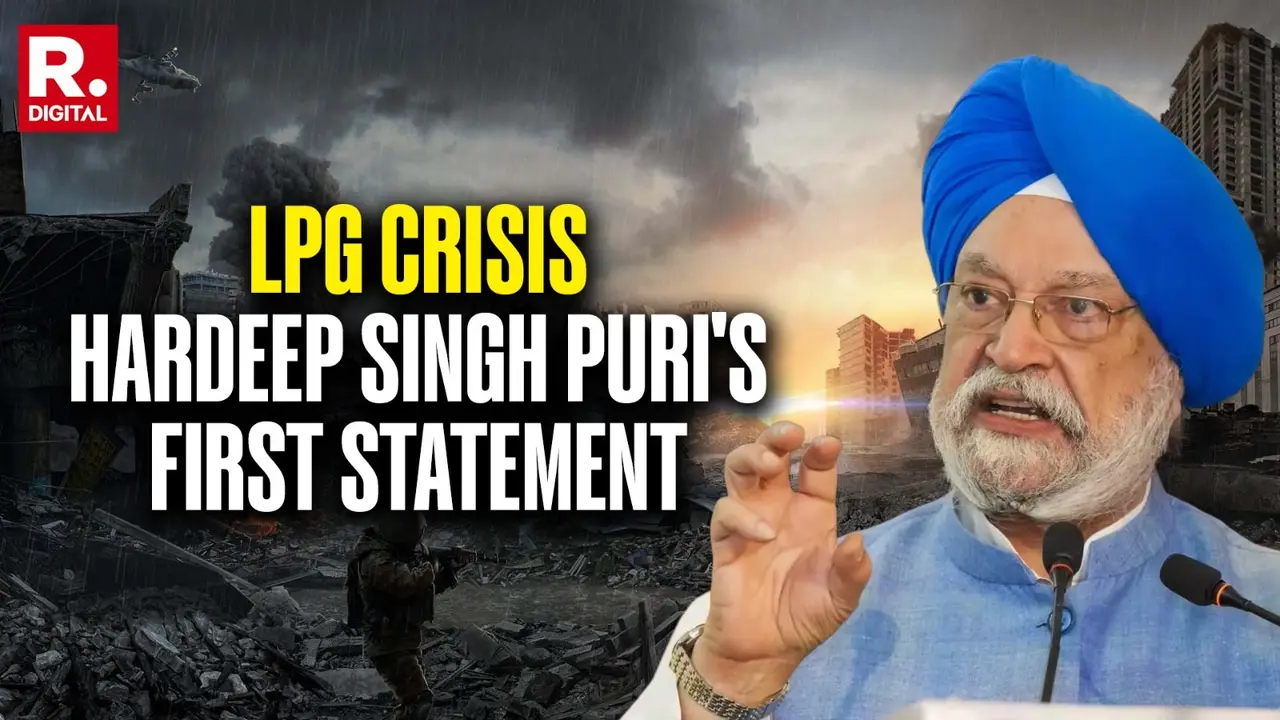
New Delhi: Amid concerns over a possible fuel crisis triggered by the ongoing conflict in West Asia, Petroleum Minister Hardeep Singh Puri addressed the Lok Sabha and assured the nation that India’s fuel supply remains stable despite the global energy disruption.
Puri said the government has taken several measures to ensure that India does not face any shortage of petrol, diesel, gas or LPG despite disruptions in global energy supply.
Global Energy Disruption After Strait of Hormuz Closure
Speaking in the House, the minister said the world is currently facing an unprecedented energy disruption due to the conflict involving Iran, Israel and the United States.
“The world has not faced a moment like this in modern energy history.”
Advertisement
He highlighted the importance of the Strait of Hormuz, saying its disruption has affected global energy supply.
“Today is the 13th day since the passage through the state of Hormuz, through which 20% of the world's food, 20% of the world's natural gas, and 20% of the world's LPG flows was disrupted following the military operation between Iran, Israel and the US.”
Advertisement
“For the first time in recorded history, the state of Hormuz has been effectively closed to commercial shipping.”
Despite the situation, he said India is managing the crisis better than many countries.
“Despite India having no role in causing the conflict, like many countries, India has to navigate through its consequences.”
India’s Crude Oil Supply Secure
Puri said India’s crude supply remains stable due to diversified sources of imports. “Honourable Speaker, India's crude supply position is secure, and volumes secured exceed what Hormuz would have delivered.”
“Before the crisis, approximately 45% of India's crude imports transited through the Hormuz route. Thanks to the honourable Prime Minister's outstanding diplomatic outreach and goodwill, India has secured crude volumes that exceed what the disrupted state of Hormuz could have delivered in the same period. Non-Hormuz sourcing has risen to approximately 70% of crude imports, up from 55% before the conflict began. India sources crude from 40 countries, as against 27 in 2006 and 2007.”
He also assured the House that fuel supplies across the country remain normal.
“Refineries are operating at high capacity utilisation. In several cases, they are exceeding 100%. There is no shortage of petrol, diesel, kerosene, ATF or fuel oil. The availability of petrol, diesel, aviation turbine fuel, kerosene and fuel oil is fully assured. Retail outlets across the country are stocked, and supply chains for these products are functioning normally. Additional allocation of PDS kerosene has been issued to all the states.”
Natural Gas Supply Prioritised for Homes and Vehicles
The minister said the government has already prioritised natural gas supply under emergency measures.
“Natural gas supply has been managed through prioritised allocation, and the position is stable, well beyond immediate need. India produces approximately 90 million metric standard cubic metres per day of natural gas domestically. A further 30 million metric standard cubic metres per day was previously imported through Gulf sources, now affected by the force majeure declaration of a major Qatari processing facility.”
He added that the government invoked emergency provisions to manage supply.
“The force majeure declaration, the natural gas control order issued on 9 March 2026, under the Essential Commodities Act, established an immediate priority sequence. Domestic pipe gas goes to homes and CNG for vehicles receives 100% supply with no cuts. Industrial and manufacturing consumers will receive up to 80% of their previous six-month average. Fertiliser plants will receive up to 70%, protecting the agricultural input chain ahead of the sowing season. Refineries and petrochemical units absorb a managed reduction with the assurance that the shortfall has been substantially made up through alternative procurement. Large LNG cargos are arriving on an almost daily basis through alternative supply routes. India has sufficient gas production and supply arrangements to sustain this position even in the event of a prolonged conflict. Power generation for every household and for industry is fully protected.”
Government Steps to Ensure LPG Supply
Addressing concerns over cooking gas availability, the minister said LPG procurement has been diversified.
“It should be noted that India was previously importing approximately 60% of the LPG requirements from Gulf countries such as Qatar, UAE, Saudi Arabia and Kuwait, and 40% is produced domestically. Procurement has now been actively diversified, with cargos being secured from the United States, Norway, Canada, Algeria and Russia.”
He also said refineries were directed to increase LPG production.
“In addition to Gulf sources, the LPG control order issued on 8 March 2026 directed all refineries to maximise LPG use and channel the entire output of C3 and C4 hydrocarbon streams comprising propane, butane, propylene and butene exclusively to the three oil marketing companies for domestic cooking gas. Hence, in the last five days, LPG production has been increased by 28% through refinery directive, and further procurement is currently underway.”
Puri emphasised that the government’s priority is protecting domestic cooking gas supply.
“Modi government's foremost priority is that the kitchen of India's 33 crore families, especially the poor and the underprivileged, do not face any shortage. Domestic supply is fully protected and the delivery cycle is unchanged. The standard time for booking to delivery for domestic LPG cylinders remains 2.5 days unchanged from pre-crisis norm. Hospitals and educational institutions have been placed on uninterrupted priority supply, and their access to LPG is fully assured regardless of broader demand conditions.”
Panic Booking, Hoarding Being Addressed
The minister said field reports indicate panic buying rather than an actual shortage.
“Field reports indicate hoarding and panic booking at the distributor and retail level, driven by consumer anxiety rather than any actual supply shortage. The rush booking pressure in some localities reflects a demand distortion, not a production or supply failure.”
To prevent diversion, stricter delivery verification measures have been introduced.
“Delivery authentication coverage is being expanded from 50% to 90% of consumers under this system.A cylinder can only be logged as delivered when the consumer confirms receipt through a one-time code on their registered mobile, making undocumented diversion effectively impossible to conceal.”
The government has also introduced booking limits.
“A 25-day minimum booking period has been introduced as a demand management measure in urban areas and 45 days in rural and Durgam kshetra areas. OMC field officers and the anti-adulteration cell are coordinating enforcement at the distributor level. The Home Secretary has shared a meeting with Chief Secretaries of all states to align state-level administration with the central supply and information framework.”
Committee Formed to Monitor Commercial Supply
The minister said the government has constituted a committee to regulate supply.
“The government has therefore taken the responsible course to regulate this channel with clear priorities and a transparent allocation mechanism. A three-member committee comprising executive directors from IOCL, HPCL and BPCL was constituted on 9 March 2026. Extensive meetings have been held and state civil supply departments and restaurants associations across the country are continuing. The committee has assessed genuine need by geography and sector to ensure available commercial volume. Commercial LPG requirement is going to be supplied from today by OMCs in coordination with the state government so that there is no hoarding or black marketing.”
Alternate Fuels Introduced to Reduce LPG Pressure
The minister said the government is also allowing alternate fuels temporarily.
“Alternate fuel options are being activated to ease pressure on LPG and gas channels. Kerosene is being made available through retail outlets and PDS channels and fuel oil is being made available for industrial and commercial consumers. The Ministry of Environment has advised state pollution control boards to permit for the duration of this crisis period the use of biomass, RDF pellets and kerosene coal as alternate fuels for the hospitality and restaurant segment for one month. This would enable a wider range of establishments to switch and free up LPG for priority consumers.”
Prices Shielded Despite Global Spike
Puri also said the government has protected consumers from global price spikes.
“Consumer prices have been shielded from global market conditions. Despite the Saudi contract price rising 41% between July 23 and March 26, the PMUI beneficiary price has fallen 32% in the same period and stands at Rs 613 per 14.2 kg cylinder in Delhi. The non-subsidised consumer price stands at Rs 913 following the recent Rs 60 adjustment against a market-determined price of approximately Rs 987. Of the Rs 134 per cylinder adjustment required by prevailing global market conditions, the government absorbed Rs 74. The effective additional cost for a PMUI household is under Rs 80 per day. Equivalent LPG prices in the neighbourhood stand at Rs 1,046 in Pakistan, Rs 1,242 in Sri Lanka and Rs 1,208 in Nepal.”
‘No Rumour-Mongering’: Minister Urges Unity in India
Concluding his statement, Puri urged people not to spread misinformation.
“This is not the moment for rumour-mongering or fake narratives. India is navigating the most severe global energy disruption in recorded history. Crude supplies are flowing. Gas is prioritised for homes and farms. LPG production has been stepped up by 28%. Consumer prices are held far below what markets and regional competitors dictate. Schools are open. Petrol is on the forecourt. Every citizen, regardless of political affiliation, has a stake in that. India must stand united behind the energy warriors, behind the institutions managing the crisis and behind the national interest. The record of preparation and the record of response speak for themselves.”
How the Iran War Has Affected Fuel Prices Worldwide
The ongoing conflict involving Iran has disrupted global energy markets, pushing oil prices sharply higher and raising fears of prolonged supply shortages. Since the conflict began, global oil prices have risen by more than 25%, and economists warn they could cross $100 per barrel if shipping disruptions continue.
The closure of the Strait of Hormuz, one of the world’s most important oil routes, has become a major concern. The route normally carries a large share of global oil and gas supplies, and attacks on ships and energy infrastructure in the region have forced several producers to halt shipments.
Countries such as Saudi Arabia, United Arab Emirates, Iraq and Kuwait have seen disruptions in oil exports as tankers struggle to move through the conflict zone.
Analysts say the interruptions have also damaged infrastructure, delayed shipments and forced refinery shutdowns, creating uncertainty in global energy markets. If the disruptions continue for a longer period, economists warn it could slow global economic growth and lead to higher fuel prices across the world.
Get Current Updates on India News, Entertainment News, Cricket News along with Latest News and Web Stories from India and around the world.