
Omar Abdullah Criticises Pakistan’s Withdrawal from India Clash, Warns Against Politicising Sport
J&K Chief Minister Omar Abdullah criticises Pakistan’s boycott of the India T20 World Cup match, saying politics has overshadowed sport, while ICC warns of action over the withdrawal.
- India News
- 3 min read

;'%3e%3cpath%20d='m8,15.99c4.41,0,7.99-3.58,7.99-7.99S12.41,0,8,0,0,3.59,0,8s3.58,7.99,7.99,7.99Z'%20style='stroke:%23fff;%20stroke-miterlimit:10;%20stroke-width:.02px;'/%3e%3cpath%20d='m3.08,3.37l3.82,5.11-3.84,4.15h.87l3.37-3.64,2.72,3.64h2.94l-4.04-5.39,3.58-3.87h-.86l-3.1,3.35-2.5-3.35h-2.94Zm1.27.64h1.35l5.97,7.99h-1.35l-5.97-7.99Z'%20style='fill:%23fff;'/%3e%3c/g%3e%3c/svg%3e)


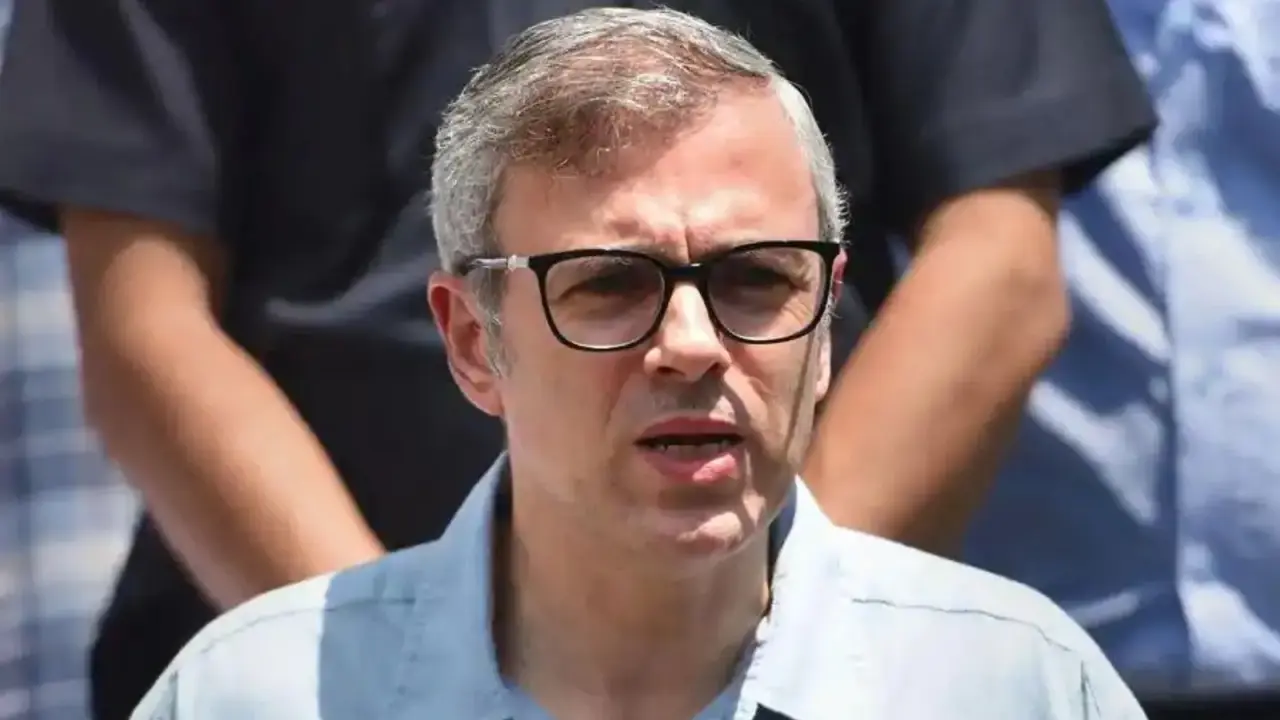
New Delhi: Jammu and Kashmir Chief Minister Omar Abdullah on Tuesday described Pakistan’s decision to withdraw from the high-profile T20 World Cup match against India as a regrettable consequence of the persistent overlap between sports and politics.
Abdullah, known for his keen interest in cricket, voiced disappointment at the way contests between India and Pakistan are consistently framed as political confrontations rather than sporting encounters.
Addressing reporters in the Jammu Assembly lawns, he said, “We have now completely blurred the distinction between sport and politics. Time and again, whenever India faces Pakistan, the media portrays it as a war rather than a game. It is never treated like a regular match,”.
Chief minister argued that the disproportionate hype surrounding India-Pakistan fixtures was one of the reasons controversies of this nature continue to erupt.
Advertisement
“When India plays other nations, the matches do not attract the same level of frenzy. But against Pakistan, the narrative is magnified to the point of distortion. That is when situations like this arise. It should not be the case. Yes, Pakistan is participating in the tournament, but they have chosen not to play against us,” Abdullah said.
Pakistan’s decision to boycott the February 15 clash in Colombo has already drawn sharp criticism from the International Cricket Council (ICC), which has warned Islamabad of serious repercussions. ICC has made it clear that selective withdrawal from fixtures violates the spirit and rules of the competition, and disciplinary measures could follow.
Advertisement
Pakistan’s stance, communicated through an official government statement, is being widely interpreted as a political protest. The boycott is linked to Bangladesh’s exclusion from the tournament after the ICC rejected Dhaka’s request to shift matches from India to Sri Lanka on security grounds. Islamabad has argued that the decision was unfair and has aligned itself with Bangladesh in protest.
Observers say the move highlights once again how cricket in South Asia is often overshadowed by geopolitics. India-Pakistan matches have historically carried symbolic weight far beyond the boundary ropes, reflecting the state of bilateral relations.
Analysts caution that Pakistan’s withdrawal could isolate it within the cricketing fraternity. World Cup, designed to showcase sporting excellence, risks being overshadowed by political disputes. ICC’s firm response signals its determination to safeguard the integrity of the tournament.
For millions of cricket fans across the subcontinent, the India-Pakistan clash is traditionally the most anticipated fixture of any competition. Pakistan’s withdrawal deprives audiences of a contest that has historically drawn record viewership and generated immense excitement.
“Cricket has always been more than a game for us, but when politics interferes, the essence of sport is lost. Pakistan’s withdrawal is unfortunate, because fans deserve to see competition on the field, not decisions shaped by diplomatic disputes,” said Ghulam Nabi, a retired schoolteacher from Srinagar.
“As a fan, I feel disappointed, but I also see this as a reminder of how fragile the boundary between politics and sport has become. ICC must ensure that tournaments are not reduced to political statements,” said Shafqat Hussain, a businessman from Pulwama.
Get Current Updates on India News, Entertainment News, Cricket News along with Latest News and Web Stories from India and around the world.