
Opposition Will Face Anger Of Women On Quota Bills, Congress Biggest OBC Opponent: Amit Shah
Union Home Minister Amit Shah lambasted opposition parties, saying they will face women’s anger over their stance on quota bills and called Congress the biggest opponent of OBCs.
- India News
- 7 min read

;'%3e%3cpath%20d='m8,15.99c4.41,0,7.99-3.58,7.99-7.99S12.41,0,8,0,0,3.59,0,8s3.58,7.99,7.99,7.99Z'%20style='stroke:%23fff;%20stroke-miterlimit:10;%20stroke-width:.02px;'/%3e%3cpath%20d='m3.08,3.37l3.82,5.11-3.84,4.15h.87l3.37-3.64,2.72,3.64h2.94l-4.04-5.39,3.58-3.87h-.86l-3.1,3.35-2.5-3.35h-2.94Zm1.27.64h1.35l5.97,7.99h-1.35l-5.97-7.99Z'%20style='fill:%23fff;'/%3e%3c/g%3e%3c/svg%3e)


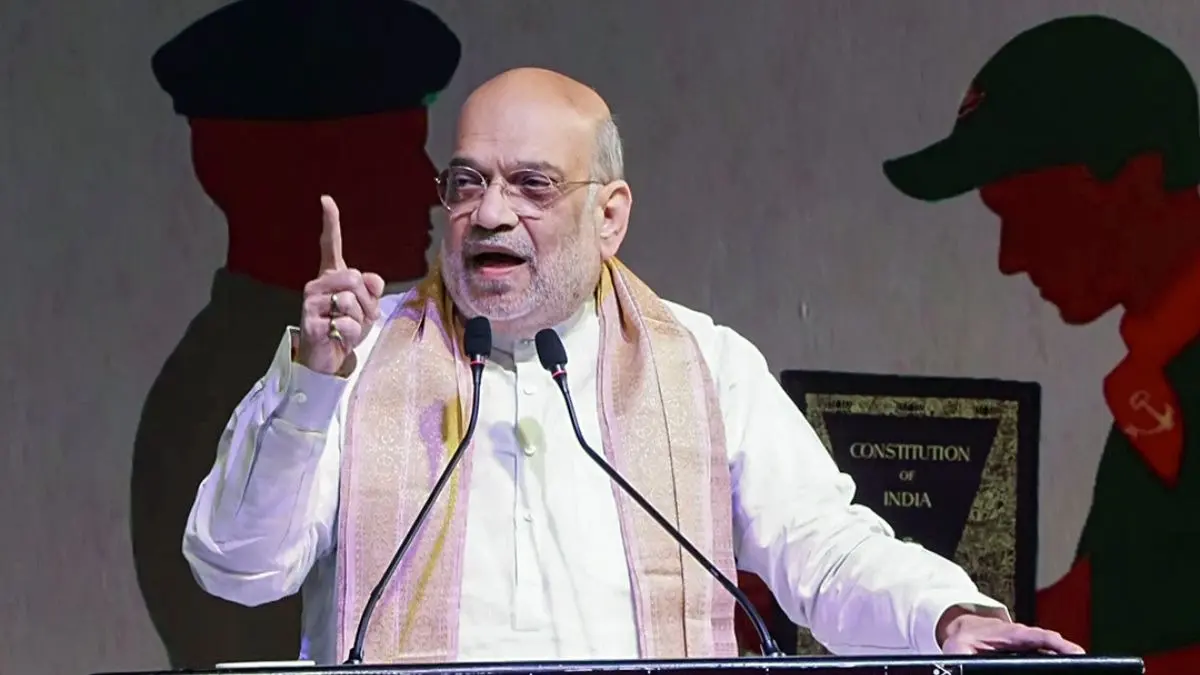
New Delhi: Union Home Minister Amit Shah on Friday slammed the opposition parties over their stance on the bills, including the Delimitation Bill brought by the government for early implementation of women's reservation and said they will face anger of women not just in the 2029 Lok Sabha elections, but at every level, in every election, and at every place.
Replying to the two-day debate in Lok Sabha on the Delimitation Bill, 2026; the Constitution (131st Amendment) Bill, 2026 and the Union Territories Laws (Amendment) Bill, 2026, he said the objective is to implement the principle of "one person, one vote, one value," which was laid down by the Constituent Assembly as the foundation of India's democracy.
He said the Constitution provides for delimitation from time to time, and it is through this process that the number of seats for the Scheduled Castes and the Scheduled Tribes increases.
Shah stated that those opposing delimitation are, in effect, opposing the increase in seats for Scheduled Castes and Scheduled Tribes.
Advertisement
He said that the Constitution has entrusted the government with the responsibility of creating a balanced, inclusive, and practical democratic framework, and at present, this responsibility rests with the government led by Prime Minister Narendra Modi.
Shah said that maintaining federal balance, ensuring representation in the Lok Sabha in proportion to population, and balancing the powers of the states are also key objectives of delimitation.
Advertisement
He said delimitation also takes into account new geographical realities, administrative changes, urbanization, enhanced connectivity through roads and railways, and the creation of new districts.
Shah noted that all these principles are enshrined in Articles 81, 82, and 170 of the Constitution, and to implement them, the government has brought this constitutional amendment. He said that these Bills have been introduced to fulfill the responsibility of promoting women's empowerment, ensuring equal representation, and building a balanced federal structure.
Union Home Minister said that the Nari Shakti Vandan Act stipulates that reservation for women will be ensured in the delimitation exercise to be carried out after the Census conducted post-2026.
He added that the number of seats has remained frozen since 1971, and today there are 127 constituencies with more than 2 million voters each.
Shah said that in 1972, the then Prime Minister first brought a Delimitation Bill, increasing the number of seats from 525 to 545, and then froze them. He stated that in 1976, during the Emergency, the 42nd Amendment was brought, which halted delimitation in order to retain power. "At that time too, the principal opposition party had deprived the people of the country of delimitation, and even today, it is the same party that is depriving the nation of it," he said.
He said that in 2001, the 84th Amendment was enacted, which froze the number of seats until 2026. From 1976 to 2026--a period of 50 years--the people of the country did not receive representation in proportion to the population.
Shah noted that this limit ends in 2026, but even if delimitation is undertaken then, the process cannot be completed before 2029, as the Delimitation Commission is required to conduct public hearings in every constituency.
Union Home Minister said that in 1976, the country's population was 54.79 crore, whereas today it is 140 crore.
He stated that it is the government's responsibility that, as the number of members in the House increases, the number of working days of the House should also be increased.
He said that the government wants to increase the number of seats in every state by 50 per cent so that no state's pro rata share is affected.
Noting that some members had questioned why the Census was not conducted on time, Shah explained that the Census was scheduled for 2021, but it was not held due to COVID-19.
He added that even after the pandemic subsided, it took considerable time for the country to recover. Shah further said that when the Census process began in 2024, some parties raised a legitimate demand for a caste-based Census.
fter discussions with all stakeholders, it was decided that a caste Census would be conducted. He stated that the ongoing Census will include caste enumeration.
He asserted that southern states have as much right over this House as the northern states.
Taking a dig at opposition members, he said those who have taken an oath on the Constitution are now trying to create a divide between North and South, which will not be allowed.
He said that no one can attain power by dividing the country.
The Union Minister said that at present, the total number of Lok Sabha seats in Karnataka, Andhra Pradesh, Telangana, Tamil Nadu, and Kerala is 129, which constitutes 23.76 per cent of the total 543 Lok Sabha seats in the country.
He said that if these seats are increased by 50 per cent and allocated among the five states, the number would rise from 129 to 195.
He further said that after delimitation, when the total number of Lok Sabha seats in the country increases to 816, the share of seats allocated to the southern states would be 23.87 per cent.
He alleged that Congress has been the biggest opponent of Other Backward Classes (OBCs) in the country, noting that in 1957, the recommendations of the Kaka Kalelkar Commission, which had suggested reservation for OBCs, were received, but the then government, led by Congress, shelved the report.
He said that when the Mandal Commission report was submitted, the then Congress government also put it in cold storage.
It was only when VP Singh's government came to power in 1990 that the Mandal Commission recommendations were implemented. He added that at that time, the senior-most leader of the party delivered the longest speech of his career opposing the Mandal Commission. Shah alleged that Congress had also opposed the caste-based Census in both 1951 and 1971.
Shah said that for the opposition, winning elections is paramount, but for the government, the nation and its people come first.
He stated that ensuring the representation and participation of the people of the nation is of utmost importance. He said, the people of the entire country are aware of the opposition's superficial concern, and women of the country will also know that their rights have been taken away by the opposition parties.
Shah said that in 1992, the government led by P. V. Narasimha Rao brought the 72nd and 73rd Constitutional Amendments and did the commendable work of providing 33 percent reservation for women in Panchayats.
He said that from 2008 to 2014, Manmohan Singh brought the 108th Constitutional Amendment Bill and introduced it in the Rajya Sabha. The Bill was passed in the Rajya Sabha, but it never reached the Lok Sabha.
When the new Parliament building was inaugurated, the Nari Shakti Vandan Act was the first Bill to be passed unanimously, and it was also passed in the Rajya Sabha, he said.
He stated that 22 women were elected to the first Lok Sabha; 19 in the sixth; 44 in the eighth; 51 in the fourteenth; a record 78 in the seventeenth; and 75 women members have been elected to the eighteenth Lok Sabha.
He said that these figures reflect the growing enthusiasm of women in the country to participate in politics.
Noting that the government has followed the principle of "women-led development" in both letter and spirit while pursuing women's reservation, he said around 1.4 million women have so far served as elected representatives in Panchayats across the country.
He added that no matter what opposition they may face, they will continue to strive to empower women and ensure their participation in legislative institutions.
Shah said Congress opposes all measures of the government.
He said wherever opposition leaders go during elections, they will have to face the anger of the women of the country.
The Constitution (131st Amendment) Bill, 2026 was later defeated in the House and the government decided not to pursue the Delimitation Bill, 2026 and the Union Territories Laws (Amendment) Bill, 2026, stating that the three were interlinked. The three bills were taken up together for discussion.
Get Current Updates on India News, Entertainment News, Cricket News along with Latest News and Web Stories from India and around the world.