
PM Modi Calls Japanese PM 'Visionary', 'Younger Sister' On Her India Visit As 120 Business Agreements Signed Between Two Nations
The two leaders held delegation-level talks at Hyderabad House and witnessed the signing of a Memorandum of Cooperation (MoC), marking a significant step forward in the Special Strategic and Global Partnership between the two nations.
- India News
- 6 min read

;'%3e%3cpath%20d='m8,15.99c4.41,0,7.99-3.58,7.99-7.99S12.41,0,8,0,0,3.59,0,8s3.58,7.99,7.99,7.99Z'%20style='stroke:%23fff;%20stroke-miterlimit:10;%20stroke-width:.02px;'/%3e%3cpath%20d='m3.08,3.37l3.82,5.11-3.84,4.15h.87l3.37-3.64,2.72,3.64h2.94l-4.04-5.39,3.58-3.87h-.86l-3.1,3.35-2.5-3.35h-2.94Zm1.27.64h1.35l5.97,7.99h-1.35l-5.97-7.99Z'%20style='fill:%23fff;'/%3e%3c/g%3e%3c/svg%3e)


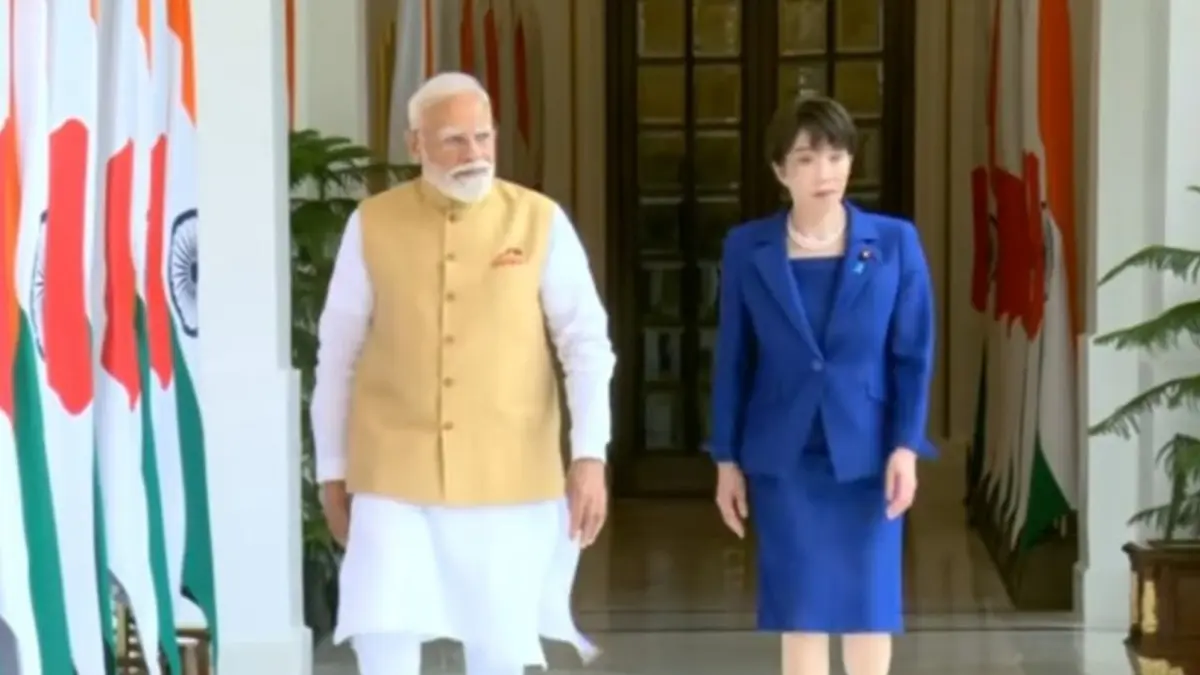
Delhi: Prime Minister Narendra Modi on Thursday warmly welcomed Japanese Prime Minister Sanae Takaichi to India for the Annual Summit, addressing her as his "younger sister" and hailing her as a “visionary” leader. The two leaders held delegation-level talks at Hyderabad House and witnessed the signing of a Memorandum of Cooperation (MoC), marking a significant step forward in the Special Strategic and Global Partnership between the two nations.
In his opening remarks during the joint press statement, PM Modi expressed delight at hosting Takaichi on her first visit to India as Prime Minister.
"Excellency and my younger sister, Prime Minister Takaichi... It gives me great pleasure to welcome Prime Minister Sanae Takaichi to India," he said. He highlighted her historic position as Japan's first woman Prime Minister and noted her roots in Nara Prefecture, a key center of shared Buddhist heritage between the two countries.
The summit saw concrete outcomes, including the signing of the first agreement on a core development project in the defence sector. PM Modi emphasized the complementary strengths of the two economies, stating, "India's scale and Japan's quality combined can deliver success." He added that over 120 business agreements have already been signed between Indian and Japanese entities, with both sides targeting 10 trillion yen worth of Japanese investments into India.
Advertisement
Shared Vision for Economic and Strategic Security
Modi described economic security as "shared security" and pointed to new initiatives on resilient supply chains and green hydrogen. He noted that cooperation in defence, artificial intelligence, and advanced technology is "growing by leaps and bounds." The Prime Minister underscored that the India-Japan partnership provides much-needed stability to the world amid global uncertainties.
"Today, both India and Japan are among the world's largest economies. A free, prosperous, and rules-based Indo-Pacific is our shared priority," Modi said. He recalled his recent remarks at the G7 Summit about mutual trust being the greatest strategic asset in times of turbulence, stating that the India-Japan relationship fully embodies this principle.
Advertisement
Japan has long been a key partner in India's growth story, particularly in sectors like automotive and electronics. Modi described the current visit as the beginning of a new chapter in bilateral ties built on decades of friendship and trust.
PM Modi also said that India and Japan are also working to contribute to the global clean energy future.
"We have also launched a key initiative on energy resilience to tackle situations like oil shocks. Furthermore, our cooperation in batteries, green hydrogen, and nuclear energy will make a significant contribution to the global clean energy future. India and Japan view economic security as shared security and energy transition as a shared opportunity; we are committed to advancing this agenda together. Today we have also established the India-Japan Next-Generation Mobility Partnership Framework," he said.
Japanese PM Takaichi's Statement
Japanese Prime Minister Sanae Takaichi outlined ambitious plans to deepen bilateral ties with India, announcing the launch of the Japan-India Cooperative Biogas for Growth (CBG) initiative, significant investments, and enhanced defence and energy security cooperation alongside Prime Minister Narendra Modi.
Takaichi highlighted the co-creation of economic growth through investment and innovation, committing Japan to bolster its supply and technological capabilities via investments in 17 strategic sectors. She expressed strong support for Modi's Viksit Bharat vision of transforming India into a developed nation by 2047, noting the shared goal of building strong, prosperous economies through future-oriented investments.
During the visit, around 120 cooperation agreements between Indian and Japanese companies were announced, including investments on the scale of 2 trillion yen. Takaichi emphasised the role of business delegations in driving public-private partnership efforts.
In the strategic and defence domain, the two sides agreed to expand maritime security cooperation. Plans include joint exercises between a Japan Maritime Self-Defense Force destroyer and an Indian Navy vessel, enhanced activities in the Indian Ocean, naval maintenance and overhaul collaboration, and equipment cooperation under India's Make in India initiative. Takaichi said she has directed officials to organise the next Japan-India 2+2 ministerial meeting before the end of the year.
On economic and energy security, the leaders addressed challenges such as supply chain vulnerabilities and non-market practices. They released a joint statement under the Power Asia Initiative for concrete cooperation, including a bilateral dialogue to strengthen India's petroleum stockpiling system. Japan also extended support for India's membership in the International Energy Agency (IEA). In energy transition, cooperation will focus on India's goal of establishing 1,000 biogas plants leveraging cooperatives and cow dung resources.
Takaichi and Modi aligned their strategic visions, linking Japan's updated Free and Open Indo-Pacific (FOIP) strategy -- emphasising self-reliance and resilience -- with Modi's Mahasagar (Great Ocean) Initiative for the Indian Ocean region. Both leaders stressed the importance of maritime security for regional stability and sovereignty.
The Japanese Prime Minister described the relationship in warm personal terms, referring to the India-Japan bond as a brother-sister partnership. She noted that next year marks the 75th anniversary of diplomatic relations and expressed commitment to further strengthening the Special Strategic Global Partnership, bringing the people of both nations closer together.
Takaichi said the two countries are entering a new phase of collaboration, leveraging their complementary strengths amid global uncertainties.
The leaders' meeting at Hyderabad House focused on deepening collaboration across multiple domains, reinforcing the two democracies' commitment to peace, stability, and progress in the Indo-Pacific region.
Get Current Updates on India News, Entertainment News, Cricket News along with Latest News and Web Stories from India and around the world.