
Modi@9: 5 speeches by PM Modi which shaped how people perceive him
PM Modi's speeches make headlines almost everyday. After 9 years on the hotseat of governance, here is a list of the PM's speeches that left a lasting impact.
- India News
- 4 min read

;'%3e%3cpath%20d='m8,15.99c4.41,0,7.99-3.58,7.99-7.99S12.41,0,8,0,0,3.59,0,8s3.58,7.99,7.99,7.99Z'%20style='stroke:%23fff;%20stroke-miterlimit:10;%20stroke-width:.02px;'/%3e%3cpath%20d='m3.08,3.37l3.82,5.11-3.84,4.15h.87l3.37-3.64,2.72,3.64h2.94l-4.04-5.39,3.58-3.87h-.86l-3.1,3.35-2.5-3.35h-2.94Zm1.27.64h1.35l5.97,7.99h-1.35l-5.97-7.99Z'%20style='fill:%23fff;'/%3e%3c/g%3e%3c/svg%3e)


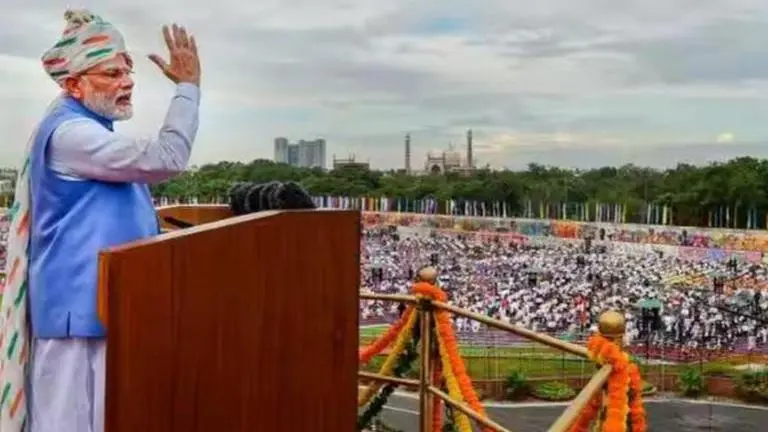
Prime Minister Narendra Modi ascended to power in part because of his discursive approach, which refers not just to the subjects he has highlighted in his speeches but also to his oration. In his capacity as Gujarat's chief minister, he used acronyms and formulations to personally as well as politically target the political leaders/parties on the opposite side of the spectrum.
Here we try to list top five speeches of PM Modi which shaped how he is perceived today:
Swachh Bharat Mission inauguration
As soon as PM Modi was elected to power, he tried to mobilise India’s populace for Swachh Bharat Mission leveraging his connect with the public. Through his speech, he turned a basics of hygiene into a mass movement. He achieved this by himself publicly cleaning the roads and reiterating the importance of cleanliness from time to time and also by asking people to dedicate 100 hours a year i.e. two hours a week to cleanliness.
Demonetisation address
PM Modi on November 8, 2016 shocked the nation with his demonetisation announcement. This date is etched in memories of Indians for various reasons. But through this decision PM Modi established that his government is not here like any other government and his government means serious business even if he has to take daring decisions. In subsequent speeches after demonetisation too, he used his speeches to pacify the Indian populace who were in distress after the demonetisation drive. One quote from his speech is, "I know what kind of powers I have taken on. I am aware they will not let me live. I am looting what they had accumulated over 70 years, brothers and sisters give me 50 days.”
Advertisement
76th Independence Day speech
Every speech of PM Modi from Red Fort is keenly heard by people, but his address on the 76th Independence Day was different because he touched upon a subject not adequately discussed within the national narrative -- ‘Nari Shakti’. Talking about women's toilets and basic hygiene was criticial and the prime minister took on the problem head on and sent a powerful message to the nation to take a pledge to stop the disrespect of women.
“Maybe this subject is not one to be discussed from the Red Fort, but we have inculcated a deformity, in our language and conduct we disrespect women and we should take a resolution to get rid of this,”
Advertisement
He also listed 'Paanch Pran' to be taken by the public for next 25 years which are:
- Resolution for developed India in the next 25 years
- Getting rid off from any signs of slavery
- Taking pride in India’s heritage and legacy
- Unity and solidarity
- Duty of citizens, including ministers towards the nation
PM Modi’s address at 76th UN Session
Prime Minister Modi, speaking at the United Nations, talked about how the global agency was losing its significance. The PM batted for reforms in the UN and called for adoption of technology in a big way. Stinging Pakistan and China without naming them in his UN speech, he said, "Countries with regressive thinking are using terrorism as a political tool must understand that terrorism is an equally big threat to them."
Central Vista inauguration
The revamped ‘Rajpath’ stretch from Rashtrapati Bhavan to India Gate was renamed from Kingsway/Rajpath to Kartavya Path as PM Modi highlighted in his speech that the symbol of gulaami (slavery). Kingsway, is now history. Not only was the Kartavya Path renamed, but the colonial legacy was also shed by installing a statue of Netaji Subhash Chandra Bose—who played a crucial role in India’s Independence movement— on a canopy previously housing King George V’s statue.
PM Modi said, "Rajpath was for British Raj for whom Indians were slaves, the emotion and structure of Rajpath were a sign of slavery. Today the architecture is changed and its soul has changed too.”
Prime Minister Modi addresses his fellow citizens as brother, sister, friend and mother, in a way, establishing his near-familial connect with the people of India. His speeches are often structured through binaries -- wherein he asks the audience a simple question after a discursive take on a complex problem. His speeches are also often filled with anecdotes from his childhood and he also displays his strong grasp on data points to define the country's priorities.