
Malegaon Blast 'Saffron Terror' Narrative Collapses: NIA Court Exposes Cracks in Probe; Flags Contaminated Evidence, Flawed Panchnama
All accused in the 2008 Malegaon blast case acquitted as NIA court cites lack of evidence, faulty UAPA sanctions, and serious lapses in investigation.
- India News
- 4 min read

;'%3e%3cpath%20d='m8,15.99c4.41,0,7.99-3.58,7.99-7.99S12.41,0,8,0,0,3.59,0,8s3.58,7.99,7.99,7.99Z'%20style='stroke:%23fff;%20stroke-miterlimit:10;%20stroke-width:.02px;'/%3e%3cpath%20d='m3.08,3.37l3.82,5.11-3.84,4.15h.87l3.37-3.64,2.72,3.64h2.94l-4.04-5.39,3.58-3.87h-.86l-3.1,3.35-2.5-3.35h-2.94Zm1.27.64h1.35l5.97,7.99h-1.35l-5.97-7.99Z'%20style='fill:%23fff;'/%3e%3c/g%3e%3c/svg%3e)


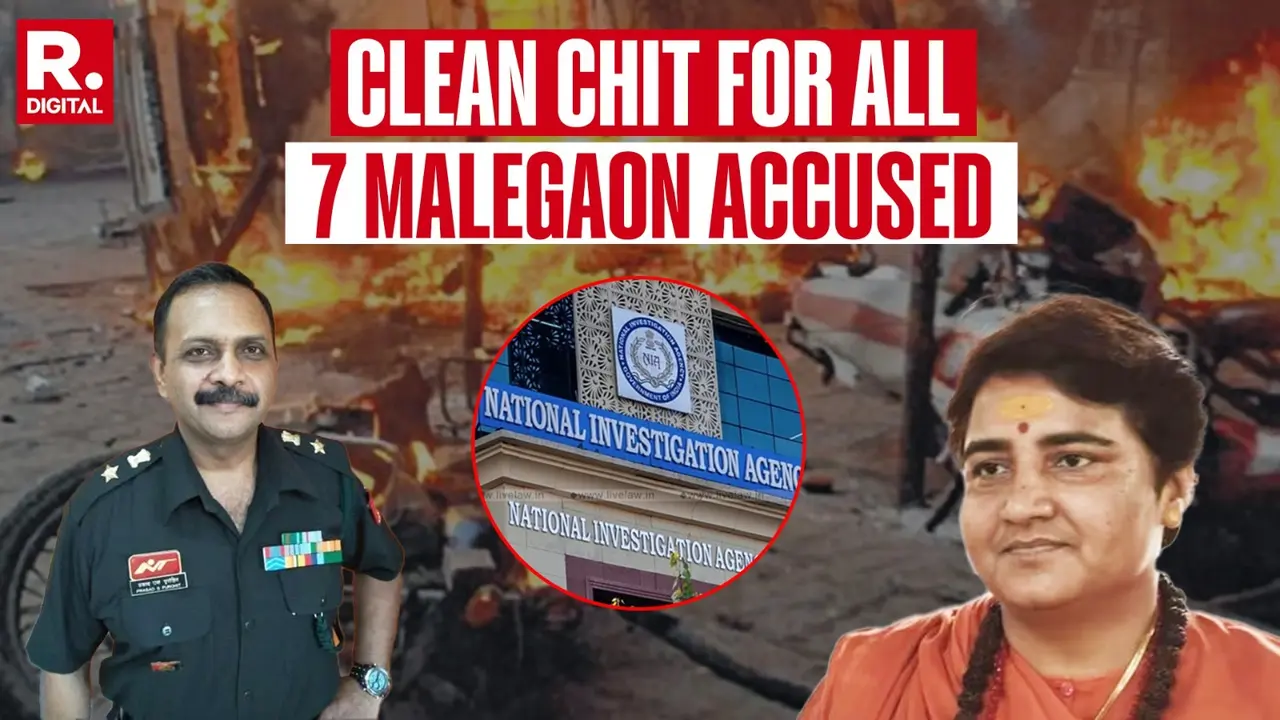
New Delhi: Seventeen years after the 2008 Malegaon blast killed six and injured dozens in the communally sensitive town of Malegaon, a special NIA court in Mumbai on Wednesday acquitted all seven accused, including BJP MP Sadhvi Pragya Singh Thakur and Army officer Lt Col Prasad Purohit, citing lack of evidence and serious lapses in the investigation.
Special Judge A.K. Lahoti ruled that while the prosecution was able to prove that a blast occurred, it failed to establish that the explosive was placed in the motorcycle allegedly linked to the accused. The court observed that key forensic and procedural lapses weakened the prosecution's case beyond repair.
Court's Key Statements on 2008 Malegaon Blast Case
In a scathing assessment of the investigation, the court said, “There is no evidence that any bullet was found at the time of the accident. Contaminated samples were sent for forensic investigation, so the evidence could not be established.”
On the central claim that the motorcycle used in the blast belonged to Sadhvi Pragya, the court stated that “without having reliable data, the prosecution could not provide proof that the bike at the scene of the incident belonged to the Sadhvi.” Furthermore, the court pointed out that the bike did not have a clear chassis number, and “prosecution could not prove that it was in Sadhvi Pragya’s possession immediately before the blast.”
Advertisement
On charges under the Unlawful Activities Prevention Act (UAPA), the court said, “UAPA will not be invoked in this case as sanction was not taken as per rules. Both the sanction orders of the UAPA in the case are defective.”
The court also took note of the contradictory narratives presented by the Maharashtra Anti-Terrorism Squad (ATS) and the National Investigation Agency (NIA), remarking, “There is a huge difference between the chargesheets of ATS and NIA.”
Advertisement
In reference to Lt Col Purohit, the court ruled:
“There is no evidence of storing or assembling the explosives in Shrikant Prasad Purohit's residence. No sketch of the spot was done by the investigation officer while doing the panchnama. No fingerprint, dump data or anything else was collected for the spot.”
The court further added:
“There is no evidence against Prasad Purohit that he made and supplied the bomb. It could not be proved who planted the bomb.”
Noting the challenges during evidence collection, the court stated,
“Evidence was not collected by experts after the incident. There has been contamination of evidence. After the incident, riot-like situation took place at the place and local people attacked the police force.”
The court also revised the total number of injured, stating that “the injured people were not 101 but 95 only, and there was manipulation in some medical certificates.”
Finally, commenting on one of the key prosecution narratives, the court stated:
“Abhinav Bharat organisation was used as a common reference by the prosecution. There is no evidence that the money of the Abhinav Bharat was used for terror activities.”
The Blast and its Aftermath
The Malegaon blast occurred on the night of September 29, 2008, near Bhikku Chowk. A low-intensity explosive device planted on a motorcycle killed six people and injured dozens, sparking fear in the already tense town.
The motorcycle was allegedly traced to Sadhvi Pragya, leading to the arrests of her and six others. Lt Col Purohit was accused of helping procure explosives and facilitating meetings of the radical group Abhinav Bharat. Both denied the charges and claimed they were framed and tortured.
Initially investigated by the Maharashtra ATS, the case was later taken over by the NIA in 2011. The NIA dropped some charges filed under the Maharashtra Control of Organised Crime Act (MCOCA) but retained sections under UAPA and the Indian Penal Code. Both Pragya and Purohit were granted bail in 2017.
A Long and Controversial Legal Journey
The case, often described as one of India’s most politically sensitive terror trials, witnessed multiple twists, including retracted confessions, allegations of planted evidence, and sharp political divides over the framing of "saffron terror."
With today’s verdict, all seven accused stand acquitted. The judgment not only brings an end to a 17-year legal saga but also raises critical questions about the handling of terror investigations in India.
Get Current Updates on India News, Entertainment News, Cricket News along with Latest News and Web Stories from India and around the world.