
'Public Servant Tag is Irrelevant if...', Solicitor General Tushar Mehta Argues as SC Halts Kuldeep Sengar's Bail in Unnao Rape Case
The Supreme Court’s vacation bench, led by Chief Justice Surya Kant, examined key legal questions regarding the definitions of "public servant" and "dominant position" under the POCSO Act.
- India News
- 8 min read

;'%3e%3cpath%20d='m8,15.99c4.41,0,7.99-3.58,7.99-7.99S12.41,0,8,0,0,3.59,0,8s3.58,7.99,7.99,7.99Z'%20style='stroke:%23fff;%20stroke-miterlimit:10;%20stroke-width:.02px;'/%3e%3cpath%20d='m3.08,3.37l3.82,5.11-3.84,4.15h.87l3.37-3.64,2.72,3.64h2.94l-4.04-5.39,3.58-3.87h-.86l-3.1,3.35-2.5-3.35h-2.94Zm1.27.64h1.35l5.97,7.99h-1.35l-5.97-7.99Z'%20style='fill:%23fff;'/%3e%3c/g%3e%3c/svg%3e)


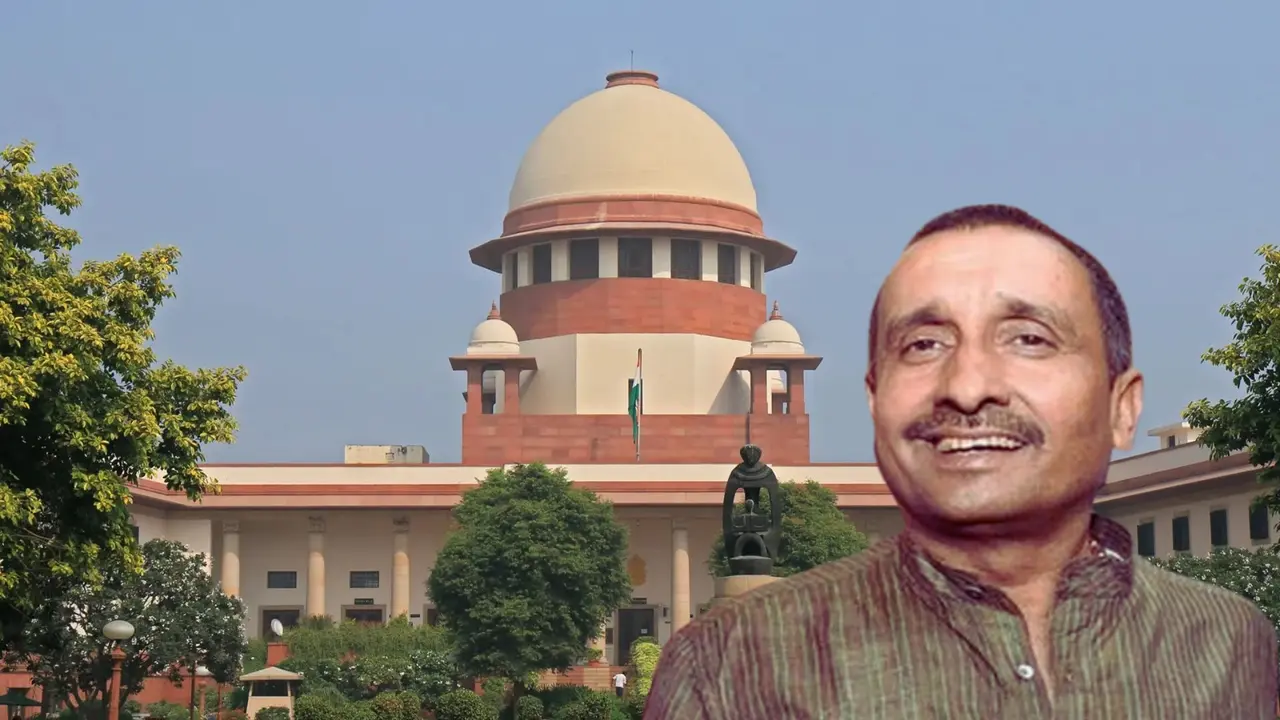
New Delhi: The Supreme Court on Monday examined crucial questions surrounding the interpretation of “public servant” and “dominant position” in cases of sexual offences against minors under the Protection of Children from Sexual Offences (POCSO) Act while hearing the Central Bureau of Investigation’s challenge to the Delhi High Court order granting bail to former Uttar Pradesh MLA Kuldeep Singh Sengar.
The matter was taken up by a vacation bench led by Chief Justice of India Surya Kant, along with Justices J.K. Maheshwari and Augustine George Masih.
They engaged in a detailed exchange on how the law treats aggravated sexual assault when the accused holds a position of dominance over a child.
CJI questions relevance of ‘public servant’ tag in cases involving minors
The Chief Justice posed a pointed question to the prosecution: “Are you saying the concept of public servant is irrelevant if the victim is a minor?”
Advertisement
Responding, the Solicitor General Tushar Mehta, appearing for the CBI, argued that penetrative sexual assault is an independent offence under POCSO and that aggravated punishment applies when the offender enjoys a dominant position over the victim.
“Penetrative sexual assault is an independent offence. Now clause 4 provides for the punishment. Now after amendment, there are certain situations where there is an aggravated offence. The categories are if the person is in a dominant position over the victim,” Mehta submitted.
Advertisement
To explain the scope of dominance, Mehta cited examples involving officials acting during the course of duty.
“Please take the example that when during the course of duty, if a constable does such an act, he will be guilty of this. Then if any army officer on duty does such an act, then he will be guilty of aggravated sexual assault,” he said.
He further argued that while the term “public servant” is borrowed from the IPC, its application under POCSO must be contextual.
“Public servant is not defined in this section, and it is defined from borrowing that what IPC says shall be the definition... But a definition needs to be contextual...unless the context otherwise provides.”
The Chief Justice sought clarity on whether dominance, rather than formal designation, was the key factor.
“So you say a public servant is someone who is enjoying a dominant position at that point in time...so you say that when someone comes to an MLA for some help, the act being done is in a dominant position and that any such act will be an aggravated act. This is your argument.”
Addressing concerns on the application of law, the Solicitor General stressed that the amendment did not create a new offence.
“Suppose for the sake of argument we say that he is not a public servant under Section 5. Then he falls under Section 3. The amendment did not create a new offence but only an enhancement of punishment. So a new offence cannot be created retrospectively, but here, that is not the case.”
The bench also examined the legislative intent behind stricter sentencing.
“So you say the amendment doesn't obliterate the offence, and rather the legislature says the offence is against the ethos of society and it is being taken seriously,” the Chief Justice observed, summarising the prosecution’s stance.
Mehta drew the Court’s attention to Section 42A of the POCSO Act, which gives the statute overriding effect in case of conflict with other laws, arguing that the High Court failed to consider this provision.
“I urge the conscience of this Court to stay this order for the sake of the child who was a victim of this,” he pleaded.
Section 42A of POCSO overrides other laws, says CBI
The Solicitor General further at the onset drew the court’s attention to Section 42A of the POCSO Act, which gives overriding effect to the statute in case of inconsistency with other laws. He submitted that the Delhi High Court failed to consider this provision while granting bail.
Emphasising the gravity of the case, the SG informed the court that the convict remains incarcerated in a separate murder case involving the victim’s father.
Urging the court to consider the impact on the child victim, he appealed to the conscience of the bench to stay the bail order.
After hearing the submissions, the bench, also comprising Justice J.K. Maheshwari, observed that several substantial questions of law arise for consideration. Notices were issued, and the respondents were granted four weeks to file their counter affidavits.
Delhi High Court bail order stayed
After hearing arguments from both sides, the three-judge bench of the Supreme Court of India on Monday said that several substantial questions of law arose for consideration. While acknowledging that the Supreme Court does not ordinarily stay orders releasing convicts without hearing them, the bench said the present case warranted an exception.
“In view of the peculiar facts, where the convict stands convicted for a separate offence, we stay the operation of the Delhi High Court order dated December 23,” the Chief Justice said.
As a result, Sengar will not be released pursuant to the high court’s order. The court granted four weeks’ time for filing a counter affidavit and listed the matter for further hearing.
CBI Moves Supreme Court Against Bail Order
The CBI has approached the Supreme Court after the Delhi High Court, on December 23, suspended Sengar’s life sentence and granted him bail. While allowing the relief, the High Court observed that Sengar had already spent over seven years and five months in custody.
The court also held that Sengar could not be treated as a “public servant” under Section 5(c) of the Protection of Children from Sexual Offences (POCSO) Act or under Section 376(2) of the Indian Penal Code.
Based on this interpretation, he was exempted from aggravated offence provisions, leading to the suspension of his sentence.
In its petition, the CBI has argued that the High Court’s decision is legally flawed and weakens the protective intent of the POCSO Act, 2012. The agency strongly disagreed with the conclusion that an elected MLA does not qualify as a public servant under Section 5(c) of the Act.
The bail order has triggered widespread outrage, with critics questioning the adequacy of safeguards imposed by the court. While the High Court directed Sengar to furnish a personal bond of ₹15 lakh and restricted his movement, the CBI has maintained that these conditions are insufficient to protect the survivor and prevent any possible influence on the case.
‘I've Faith’: Survivor Expresses Faith in SC
Reacting to the development, the Unnao rape case survivor said she has faith that the Supreme Court will deliver justice. Speaking to ANI, she appealed to Uttar Pradesh Chief Minister Yogi Adityanath to ensure her safety and that of her family.
“I have faith in the Supreme Court that it will give me justice. I am raising the voice of every woman. Had the CBI taken action earlier, I would have got justice. His bail would have been rejected because he raped me. My father was killed. My family members were killed. The security of my family members and witnesses was removed. My husband was fired from his job. My children are unsafe at home,” she said.
What is the Unnao Rape Case?
The case dates back to June 2017, when a 17-year-old girl from Unnao was allegedly lured to Sengar’s residence on the pretext of a job by the neighbor and distant relative named Shashi Singh. According to the survivor, Sengar raped her while threats were issued to silence her.
The survivor further alleged that she was abducted again days later, held captive for over a week, gang-raped, and later sold to another man for ₹60,000.
Self-immolation attempt and national outcry
On April 8, 2018, a day before her father succumbed to injuries sustained in police custody, the survivor attempted self-immolation outside the Uttar Pradesh Chief Minister’s residence in Lucknow. The incident drew nationwide attention, following which the probe was handed over to the CBI. Sengar was arrested on April 13, 2018.
2019 crash and Supreme Court intervention
In July 2019, while Sengar was in jail, a vehicle carrying the survivor, her lawyer, and two relatives was hit by a speeding truck in Rae Bareli. The two relatives were killed, and the survivor sustained critical injuries.
Following the incident and allegations of threats, the Supreme Court transferred all related cases to a special court in Delhi for a day-to-day trial and ordered central security cover for the survivor.
Conviction and subsequent legal developments
Sengar was convicted and sentenced to life imprisonment in 2019. Over the years, he has been granted interim bail on multiple occasions, including for his daughter’s wedding and medical treatment at AIIMS. The December 23 order suspending his life sentence marks a significant turn in a case that came to symbolise a survivor’s battle against political influence.
Get Current Updates on India News, Entertainment News, Cricket News along with Latest News and Web Stories from India and around the world.