
Exclusive/ Renowned Economist Jeffrey Sachs Blasts Trump's 500% Tariff Fiasco, Calls Move 'Thuggishness' Of 'Unstable' US President | Full Conversation Inside
Jeffrey Sachs shreds Trump's 500% tariff plan, calling it thuggish and economically damaging, urging India to maintain independence and build alliances with China, Russia, and BRICS nations.
- India News
- 20 min read

;'%3e%3cpath%20d='m8,15.99c4.41,0,7.99-3.58,7.99-7.99S12.41,0,8,0,0,3.59,0,8s3.58,7.99,7.99,7.99Z'%20style='stroke:%23fff;%20stroke-miterlimit:10;%20stroke-width:.02px;'/%3e%3cpath%20d='m3.08,3.37l3.82,5.11-3.84,4.15h.87l3.37-3.64,2.72,3.64h2.94l-4.04-5.39,3.58-3.87h-.86l-3.1,3.35-2.5-3.35h-2.94Zm1.27.64h1.35l5.97,7.99h-1.35l-5.97-7.99Z'%20style='fill:%23fff;'/%3e%3c/g%3e%3c/svg%3e)


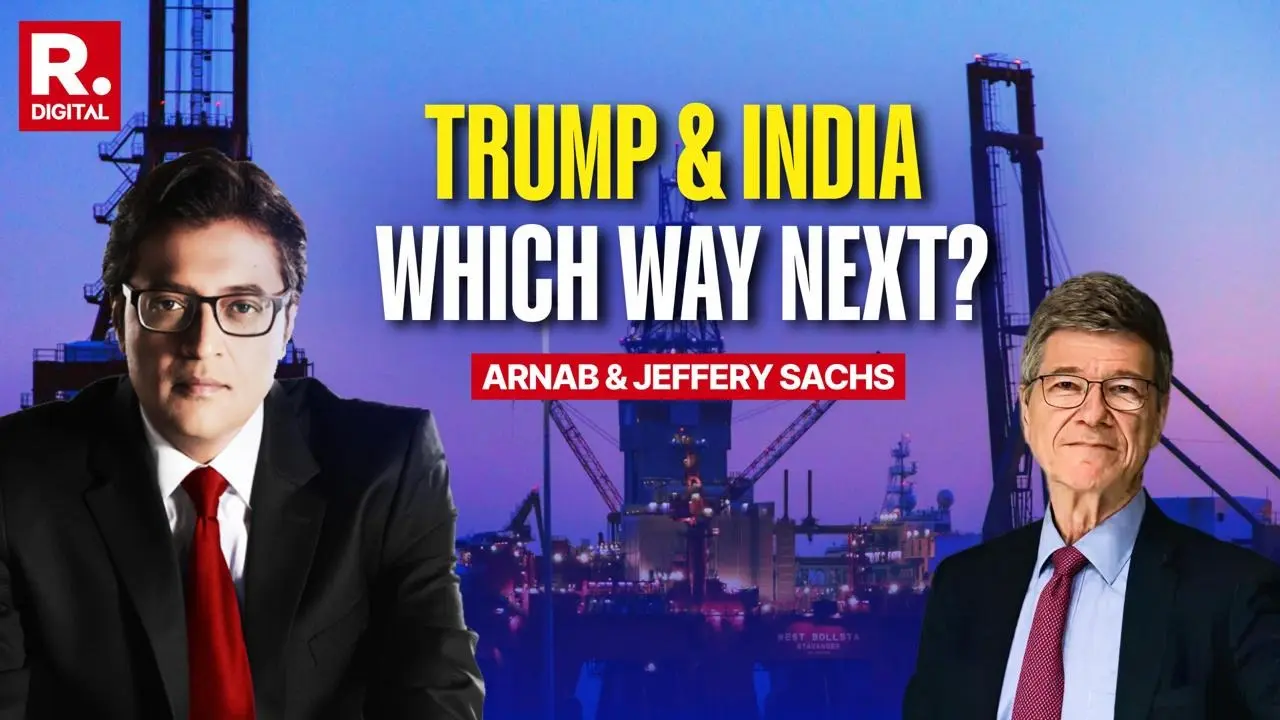
New Delhi: Donald Trump's presidency has been a disaster, and his latest 500% tariff fiasco is just another example of his reckless incompetence, as renowned American Economist and Senior Advisor at the UN, Jeffrey Sachs, blasted the “thuggishness” of the US President, calling him "a psychologically unstable person". In an exclusive conversation with Republic Media Network's Editor-in-Chief Arnab Goswami, Sachs described Trump's actions as a bizarre misuse of power, warning that they're not only hurting the US economy but also isolating the country globally.
He upfront asserted that Trump's proposed 500% tariffs on countries like India, China and Brazil, buying oil from Russia, are a perfect example of his thuggish behaviour. Sachs stated that these tariffs are not only economically damaging but also a clear abuse of power. He, however, believed that Trump's behaviour is merely a symptom of a broken political system in the United States, where the military-industrial complex holds major sway. Branding India as the world's superpower, he suggested that the country should be aware of the US games and urged India to maintain its independence and focus on building relationships with countries like China and Russia.
The American Economist stressed that Trump's tariffs are not just a problem for the US, but for the entire world. Sachs believed that the world needs to move towards a multipolar order, where countries like India and China can play leading roles. He urged India to seize this opportunity and assert its independence on the global stage. In the exclusive conversation with Arnab Goswami, Sachs went blunt when discussing Trump's policies, saying they are not only hurting the US economy but also isolating the country globally.
The public policy analyst, Sachs, expressed concern over Trump's unpredictable behaviour, stating that the US is no longer a reliable partner. He urged India to maintain its independence and not get entangled in the US's games. Though Sachs added that India is too big to play the US game and should instead focus on building its own alliances. He suggested that India should work with China, Russia, and other BRICS nations to promote a multipolar world, where it can play a leading role alongside countries like China and Russia. He advised India to focus on strengthening its relationships with these nations rather than relying on the US.
Advertisement
Sachs attributed Trump's behaviour to a broken political system in the US, where the military-industrial complex holds big sway.
He added that Trump's proposed 500% tariffs on countries buying oil from Russia have led to fears of a global trade war, explaining that these tariffs are not only economically damaging but also a clear abuse of power.
Advertisement
Sachs Hails BRICS Factor
As per American Economist Sachs, he sees Trump's tariffs as a blessing in disguise for the BRICS nations, saying they have unified the group like never before. "The imposition of the 25% penalty tariff on India overnight unified the BRICS countries as never before," he noted. Sachs believes India's interests lie in a multipolar world, where it can play a leading role alongside countries like China and Russia.
He also praised India's measured approach to Trump's tariffs, advising the country to take a deep breath and avoid dramatic reactions. He suggested India should focus on strengthening its relationships with other nations, rather than relying on the US for defense or trade.
Here's the exclusive conversation between Arnab Goswami and Jeffrey Sachs, where the renowned American Economist pulled no punches on Trump's tariffs and global politics:
Arnab Goswami: We've heard that Trump has approved a bill to punish those who buy uranium or petroleum products from Russia, and that, according to this bill of which I've seen a draft, at least 500% tariffs should be imposed on these countries. This is going into the unreal sphere. First question, is he likely to do something as drastic in your view?
Jeffrey Sachs: With Trump, things are out of control. He's invading countries, he's threatening countries, he left more than 50 treaties and UN organisations today. He's a psychologically unstable person in a political system that has broken down in the United States, so we don't have constitutional control. Tomorrow, it is said that the Supreme Court might rule on the legality of Trump's overall tariff system, if the court is honest, which is a big assumption, of course, in the US these days, but if the court turns out to be honest, it will strike down all of what has happened up until now, because Trump has grossly abused his power. This is unconstitutional, what he has been doing. It is illegal, but he's gotten away with it because we are not in a constitutional order in the United States right now. We are in some combination of rule by the security apparatus and a very, in temperate, president.
Arnab Goswami: Now, you have said, don't play the American game. India is too big for the US game. You also said recently that India and China ought to get along in view of this strategic unpredictability of the Trump administration. What shape do you believe such an arrangement can take, given that there are already, you know, we have a long history of tensions with, and trust issues with China, and likewise perhaps. And how would it serve India's interests in the long term and the aftermath of the Trump era if we are to try and get along with China or China is to try and get along with us? Are you looking at an ad hoc arrangement only for the Trump period or a long term understanding?
Jeffrey Sachs: Absolutely for a long term because we should be moving and we can be moving to a truly multipolar and multilateral world. I've urged China very strongly to press for, and I think it would work, India to have the sixth permanent seat at the UN Security Council. I think this is extremely important to save the UN. So I want India to have a permanent seat in the Security Council. I want China to support that. And I want India and China to resolve their disputes because the main objective of the two should be to create a multipolar world that is not dominated by the United States or dominated by the West because that's passe. And in order for that to happen, that requires cooperation. The BRICS is a great format for that. But for the United States, it up until this year was trying to play India. You join us against China. One of the policies I really, really think is misguided for India. I'm sorry to say, is the Quad. What is India doing in the Quad? India is a great power. It should not be part of an American game because that is disadvantageous for India. It's disadvantageous for a multipolar world. It's disadvantageous for stability. The Quad is an American game and India is too great a country to play an American game. Now, I think everyone sees I've been saying it for a long time and friends in India didn't quite believe me. The United States is unstable. It is irresponsible. It's actually dangerous. And this, I think, has to be taken to heart. I'm sorry to say it is a reality right now.
Arnab Goswami: Professor Sachs, there are some people in India who always favour a longer term, deeper understanding with America and look upon our alignments either with Russia or China on the one side or with America on the other. And given that many people historically over the years, influential people in politics and business have been leaning towards America, their argument is this, Professor Sachs, that look here. This is a temporary situation. Don't go versus America because of Trump because Trump is going to be a lame duck after the midterm elections. I don't think so. I just began by saying in my lead tonight that I think Trump is so erratic, he's going to want a third term. So I believe it's a long term problem. But what would you say to those Indians who would say, listen, just hold your cards. Do nothing as of now?
Jeffrey Sachs: Well, I would say one thing. Trump is a symptom. He's not only a cause that if man like that could be elected and reelected is a symptom of a broken political system. And the American political system is broken in two fundamental ways. One is that it is, in fact, a military security state when it comes to foreign policy. It has nothing to do with Congress. It has nothing to do with legal oversight. Congress is supposed to be the one that declares war. But you see, Trump is the one that does what he wants. And when a congressman says, well, that's unconstitutional, he sneers at the Congress. And that's the end of the story right now. Now that's a long story. We could go back to 1947 with the creation of the CIA to understand that story. I've lived it my whole life. We have a deep state that is the security state. That's not fiction. That is the military industrial complex, the one that President Eisenhower warned us about on January 17 1961 in his farewell address. And it's real. It exists. And it is out of control. That's number one. The system is also broken because it's unbelievably corrupt. The last election cycle was a $16 billion election cycle. Silicon Valley decided who the vice president would be. They sat Trump down next to JD Vance, the donors, and they said, here's your vice president, Mr President. This is a corrupt system. So to think that Trump is the end of the story is a misunderstanding. Even the attempt, by the way, to overthrow the Maduro government goes back more than 20 years. These are long-term projects. The idea of capturing Ukraine for the West is a long-term project. It goes back already to Bush Jr., to Obama, who oversaw a coup, or the US participation in a coup in February 2014, to the NATO enlargement. These are long projects of the military industrial state. And Trump, of course, is in a giddy, extraordinarily dangerous state of mind right now. So I don't deny that we're in something absolutely unusual. It's extreme. But the fact that he's there is itself a reflection. I'm sorry to say it. I'm an American. I live there. But I'm sorry to tell you, it's not a simple situation that's just going to go away with the midterms. And for India, India is a great country. It's the largest, most populous country in the world. It should not be playing the games of an unstable country. Now, of course, India has so many wonderful people living in the United States, going to school in the US and so forth. I understand all of that. But from a foreign policy point of view, India's interest is in a multipolar world where India plays a leadership role. And that can be done with China, with Russia, with other regions. Yeah.
Arnab Goswami: I in fact said that a while back, I was just saying that it's a great opportunity for us to position ourselves as a more credible leading power in the global south. I frankly don't know much about the belt wave blob as they are called about how these people who function in the administration or the bureaucracy in the U.S. We call them informally the deep state, how they are functioning. But I have followed very closely some of the things you've said. And I think you've been extremely on the ball on that. I personally, Professor Sachs, don't know whether Trump has captured the deep state or whether the deep state has captured Trump.
Jeffrey Sachs: And the fact of the matter is if I may say it is the latter, actually.
Arnab Goswami: Is the deep state of Trump, you think?
Jeffrey Sachs: Yes. The way that it works, the way that it works is we have a war machine. It's a trillion-dollar-a-year war machine. It's got 750 to 800 overseas military bases in about 80 countries. It's got the CIA everywhere. It's got the National Endowment for Democracy. It's got the National Democratic Institute. I know these, I've watched it close up for 40 years. It plays a role. It's got the dollar roll through the sanction system through swift and so forth. That's the system. The only way the U.S. actually operates normally is if a president, at least, is on the ball to keep a foot on the brake. One really tried to stop it, by the way, John F. Kennedy. And there's a good reason to believe they killed him for it. But the other presidents sometimes tried to slow down this war machine. And Trump now is giddy that he's going to unleash it. He's threatening everybody. He's threatening, of course, he's gone to war with Venezuela, he's threatening Canada, he's threatening Mexico, he's threatening Colombia, he's threatening Denmark, he's threatening Iran, he's threatening Nigeria. This we haven't seen. But basically underpinning all of this is a military industrial machine, which is pervasive in the U.S. political context when it comes to foreign policy.
Arnab Goswami: That's going to be a big debate, if I were to start with what you just said, where Lee Harvey Oswald was working for the American Deep State? So I'll swerve away from that one to a point that's very relevant for our audiences in India. Professor Sachs, some of my recent commentaries, I have tried to draw a comparison between what has happened in Venezuela, in the context of our region, to what happened in Bangladesh. You've also spoken about it, to what happened in Nepal. And despite my own personal animosities and anger with the support for terrorism by Pakistan, to what has happened in Pakistan with Imran Khan. You have also spoken about it. I think yours is one of the best commentaries of the way in which America has carried out regime change. Now India is too big, too large for them to try to do something. Knowing and you understand everything very well. The Deep State, America, politics, their intelligence agents, everything. De-legitimise operations, civil society, “funding”, street unrest, anarchy. I am of the view that we have a prime minister who is very forthright about the nation first. And as you may have observed, he's not going to compromise on the nation first. But what are the threats? What are the things we should watch out for in the context of Bangladesh, Nepal, Venezuela, and the general mindset in the Trump administration?
Jeffrey Sachs: Well, let me just say if I were any leader in any country or if I were advising them, I would say, do not allow the National Endowment for Democracy, the National Democratic Institute, the National Republic Institute, and similar agencies to be funding operations within your country. Because this is a game. This is not some benign role. This is a game of influence. This is a game, often of destabilisation. And it's been played dozens and dozens of times. If you know how to watch for it, you can see it, like you say, in so many places. The United States said Imran Khan has to go and within 30 days, he was gone. He's still in jail on absolutely absurd, tragic charges, tragic from his individual point of view. And I think for the stability of this region. And in Venezuela, this was an ongoing project. I've watched it close up. There are so many lives that are told in the U.S., by the way, one president, the president of Haiti, said to me at one point, they're going to take me out. And I rather naively said, no, no, Mr. President, we're not going to allow this to happen. And one day, the American ambassador literally knocked on his door and said, Mr. President, save your life. You have to get in this aeroplane. And the next time the man touched the ground, he was in the Central African Republic. Haven't been deposed by the United States. And I just want to add, I called the New York Times, station chief in Port-au-Prince Haiti, and said, well, are you going to write about this? A coup just took place in broad daylight. She said, oh, my editor is not very interested in that story. So this game is played all over the world. It should not be played. It's deadly. This kind of destabilisation has to end. But now Trump says, I don't have to hide it. I'm just king of the world. I can do what I want. I own Venezuelan oil. I want Greenland. Canada's our 51st state. This is very serious. I want people to understand.
Arnab Goswami: What about India?
Jeffrey Sachs: Well, India is a superpower. India just needs to keep its head by the United States. But it shouldn't be playing a US game either.
Arnab Goswami: Why do you say that? Why do you feel we are playing a US game?
Jeffrey Sachs: Well, the Quad to my mind is a US game.
Arnab Goswami: Do you think we should get out of the Quad, Professor Sachs?
Jeffrey Sachs: Absolutely. I don't think there's any role in the world.
Arnab Goswami: Wouldn't doing that, you know, provoke Trump even further, America even further. You just walk out of the Quad. Can you do that?
Jeffrey Sachs: The United States has no credible threat on India. India is a superpower. And the BRICS, by the way, I like the BRICS a lot. I think it's extremely important that half the world has come together to say, we want multilateralism. We want multipolarity. We don't want to be bossed around by the United States, we want just a normal world, because the BRICS is actually behaving very responsibly. India has the presidency of the BRICS this year and the BRICS can send a message to the 85% of the world that is not the US and Europe and a couple of other allies.
Arnab Goswami: Are you saying, Professor Sachs, that this is India's moment? Actually, this could be India's opportunity. It could be an opportunity for Prime Minister Modi.
Jeffrey Sachs: Of course, I love this country. It should be clearly one of the leaders of global stability because it's a very important country. And it's going to be more and more important. And it's going to be in the top two economies of the world in the next 25 years. And the United States, you're going to look back and it's one-fourth the size of this country and population. And it has no right to boss anyone around, but it can't boss India around. And so all I'm saying is that India, the idea that the US and India and Japan and Australia are working together to contain China is not in India's interest. India's interest is in a bilateral relationship with your counterpart. And I truly believe, by the way, that the issues which have inflamed things between China and India, of course, they date back to 1914 to the McMan line and so forth. These are solvable issues compared to the real stakes in the world today, where India and China have absolutely a common agenda to build a stable, multilateral, multipolar world where the interests of India and China are as aligned as can be.
Arnab Goswami: Last year, you quoted Henry Kissinger and you said to be an enemy of the United States is dangerous, but to be a friend is fatal. If I were to ask you to put that in the context of Pakistan's growing friendship, the military government, there's growing friendship with the US, who see themselves as friends of the US, that's my first question to you. How do you view Pakistan and the crypto deals between the Trump family, the crypto open crypto deals between the Trump family and the Pakistani military establishment? How do you view that and how do you think that's going to play out?
Jeffrey Sachs: Pakistan is sad, very sad, because it needs economic development and social development and a long term framework so that it can develop not short term games of listening to the US military or enriching the president of the United States. So this is the real drama, which is Pakistan from an economic development point of view has been lost for a long, long time and it's a drama with so many people and with nuclear power, it's a real drama. The United States, of course, I think it's obvious to say there's nothing about Pakistan or Pakistan's development. This is my main point, the United States, I'm sorry to say, it doesn't care about any other place and so it uses these places, but it leaves them in a wreckage and Pakistan is in a wreckage economically and from a development point of view.
Arnab Goswami: My last question to you this evening is that you've seen what happened yesterday. I mean, I'm always, always in our newsroom, we're always on the edge. When we saw the tanker being taken over, the Russian flag, oil tanker in the North Atlantic, this game of dies. Trump thinks he has the upper hand on it. You know, do you think everyone could come together and counter him? Because this is a long term battle for energy and for oil. Nobody is going to back off. Russia is not going to back off. China is not going to back off. India is not going to back off. So it's a lot of brinkmanship by Trump, where he feels he holds the cards now. But could it just swing the other way?
Jeffrey Sachs: First of all, Trump doesn't hold the cards because real economics is about skills. It's about technology. It's about educating young people. It's about building infrastructure. It's not about invading countries, seizing tankers, claiming that Venezuela is ours. This thuggery means nothing from an economic point of view for the United States. It's just thuggishness. That's all. There's no merit or benefit for the United States in it. It's only harm. And so, and of course, it's reckless. It's dangerous. It's shocking to be seizing vessels on the high seas. The principle of freedom on the high seas goes back centuries, not to Trump. And this is my main point. But what India really, I hope does is, work with Russia, with China, with Brazil, with the BRICS, with the African Union, to say to the 15% of the world in the US, Britain, Europe, calm down, we're the vast majority, stop playing games.
Arnab Goswami: Well, we really love this. People are loving your thoughts. Can I just tell you, Professor, we keep a lot of tabs on streaming traffic right now, record-breaking streaming traffic, which means people are liking what Jeffrey Sachs is saying. Of course, he's very famous, very well known, very direct, like him or not like him. He doesn't pull his punches.
Get Current Updates on India News, Entertainment News, Cricket News along with Latest News and Web Stories from India and around the world.