
Rise of AAP Rebel Raghav Chadha: From Arvind Kejriwal's Protege to Independent Voice in Indian Politics
In the volatile world of Indian politics, few trajectories have been as meteoric as that of Raghav Chadha. Once hailed as the articulate young face of the AAP, the 37-year-old has emerged as a rebel, challenging the party that propelled his rise and starting a new chapter in his political journey.
- India News
- 6 min read

;'%3e%3cpath%20d='m8,15.99c4.41,0,7.99-3.58,7.99-7.99S12.41,0,8,0,0,3.59,0,8s3.58,7.99,7.99,7.99Z'%20style='stroke:%23fff;%20stroke-miterlimit:10;%20stroke-width:.02px;'/%3e%3cpath%20d='m3.08,3.37l3.82,5.11-3.84,4.15h.87l3.37-3.64,2.72,3.64h2.94l-4.04-5.39,3.58-3.87h-.86l-3.1,3.35-2.5-3.35h-2.94Zm1.27.64h1.35l5.97,7.99h-1.35l-5.97-7.99Z'%20style='fill:%23fff;'/%3e%3c/g%3e%3c/svg%3e)


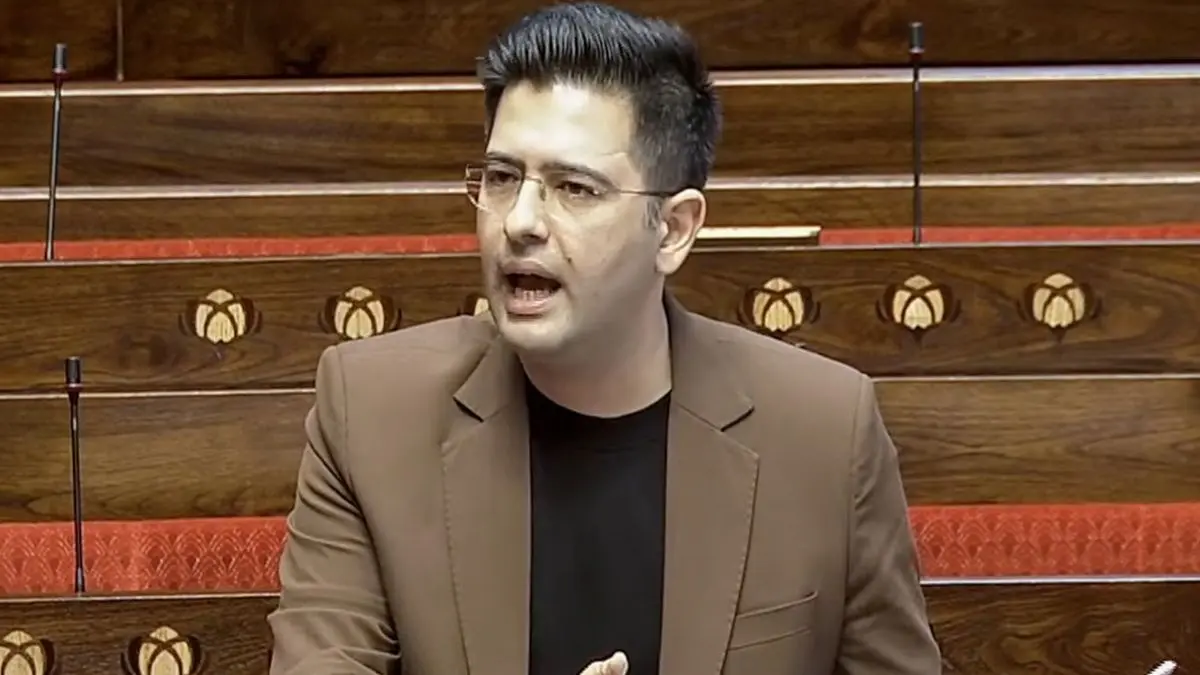
New Delhi: In a seismic shift that has reshaped the political landscape of the capital, Raghav Chadha, the quintessential "poster boy" of the Aam Aadmi Party (AAP), has officially joined the Bharatiya Janata Party (BJP). This high-profile defection comes just weeks after a public fallout with the AAP leadership, which saw him stripped of his position as the party's Deputy Leader in the Rajya Sabha.
Chadha, accompanied by several other AAP MPs including AAP MP Ashok Mittal who replaced him as AAP's Rajya Sabha Deputy Leader, announced the "merger" with the BJP today, citing a deviation in AAP’s core principles and a growing disconnect with the party high command.
In the volatile world of Indian politics, few trajectories have been as meteoric, and now as contentious, as that of Raghav Chadha. Once hailed as the articulate young face of the Aam Aadmi Party (AAP), the 37-year-old chartered accountant-turned-Rajya Sabha MP has emerged as a prominent rebel, challenging the very party that propelled his rise and sparking speculation about a new chapter in his political journey.
Born on November 11, 1988, in Delhi, Chadha's entry into politics was rooted in the anti-corruption fervor of the early 2010s. A graduate of Delhi University and a qualified CA, he joined the India Against Corruption movement at just 22 and quickly became involved with AAP from its inception in 2012. Arvind Kejriwal personally encouraged the young activist to help draft the Delhi Lokpal Bill, marking his first significant contribution.
Advertisement
Chadha rose rapidly through AAP's ranks. He served as one of the party's youngest national spokespersons, national treasurer at age 26 after AAP's sweeping 2015 Delhi victory, and vice chairman of the Delhi Jal Board. His sharp debating skills and polished media presence made him a go-to figure for the party on television and public platforms. In Punjab, Chadha played a pivotal role as co-in-charge, helping orchestrate AAP's landslide 2022 assembly win, where the party secured 92 of 117 seats under Chief Minister Bhagwant Mann.
His ascent peaked when he became one of India's youngest Rajya Sabha MPs in 2022, elected from Punjab. Seen as Kejriwal's trusted lieutenant and a product of the "Arvind Kejriwal school of politics," Chadha embodied AAP's promise of clean, youth-driven governance focused on the "aam aadmi."
Advertisement
The Meteoric Rise: From Ramlila Maidan to Parliament at a Glance
The Meeting with Kejriwal: Chadha met Arvind Kejriwal in 2011 during the height of the India Against Corruption movement. Impressed by the young CA's financial acumen, Kejriwal drafted him to help write the Delhi Lokpal Bill.
A Founding Member: When AAP was formed in 2012, Chadha was one of its youngest founding members. At 26, he became the party’s National Treasurer, managing the finances of a rising political startup.
The MLA Stint: In 2020, he won the Rajinder Nagar assembly seat by a massive margin, quickly becoming the Vice Chairman of the Delhi Jal Board and a frequent face on national television.
Youngest Rajya Sabha MP: In 2022, following AAP’s landslide victory in Punjab, a campaign Chadha is credited with architecting, he was sent to the Upper House, becoming the youngest Member of Parliament in Rajya Sabha history at the time.
Cracks in the Relationship
Cracks in his relationship with AAP leaders began to surface. By early 2026, internal differences over strategy, parliamentary approach, and loyalty came to a head. On April 2, 2026, AAP formally removed Chadha as its Rajya Sabha deputy leader, replacing him with Punjab MP Ashok Kumar Mittal. The party went further, requesting the Rajya Sabha Secretariat not to allot him speaking time from AAP's quota, a move widely interpreted as an attempt to sideline him.
The "Rebel" Voice in the House
For years, Chadha was the BJP’s most articulate critic in Parliament. He famously used his financial expertise to tear into the Union Budget, calling it "anti-people," and was a vocal opponent of the Delhi Services Bill. His speeches on inflation and GST on essential goods, the unemployment crisis, and the suspension of democratic norms often went viral, making him a "Gen Z" political icon. However, his recent silence during Arvind Kejriwal’s 2024 incarceration and his subsequent removal as Deputy Leader marked the beginning of the end of his decade-long association with AAP.
Why the Switch?
Sources close to Chadha suggest the rift deepened after he was replaced by Ashok Mittal as the party's Rajya Sabha Deputy Leader on April 2, 2026. The AAP leadership had accused Chadha of "softening" his stance toward the Centre and failing to follow party whips on key votes.
AAP leaders hit back, accusing Chadha of "soft PR," avoiding strong confrontations with the Centre and Prime Minister Narendra Modi, and skipping opposition walkouts. Delhi AAP chief Saurabh Bharadwaj remarked that Rajya Sabha was not for "soft PR" or trivial topics, while others questioned his absence during key moments, including Kejriwal's legal battles. Some insiders suggested Chadha had been building an independent image, possibly eyeing broader appeal among urban middle-class and youth voters.
Raghav Chadha Hinted at New Innings Through Social Media Responses
The rift fueled intense speculation with Chadha responding to a social media reel proposing he launch a "Gen-Z party" with the comment "interesting thought," intensifying rumors of a potential new political outfit or independent path. Observers note his growing social media presence and focus on public issues as signs of a leader positioning himself beyond AAP's tight-knit structure.
After his removal as AAP's Rajya Sabha Deputy Leader, Chadha responded swiftly with a video message titled "Silenced, not defeated," filmed against the backdrop of the old Parliament building. "Whenever I got a chance to speak in Parliament, I raised people's issues," he asserted. "Is raising public issues a crime? Don't consider my silence as my defeat... I am with you, and I am for you." The post, framed as a message to the common citizen, avoided direct attacks but clearly signaled defiance toward the party high command.
In another cryptic social media post referencing Robert Greene’s The 48 Laws of Power, Chadha hinted at the law: "Never Outshine the Master," suggesting that his rising national profile and perceived independence had made him a target within his own party.
"I nurtured this party with my blood and sweat," Chadha stated during his joining ceremony at the BJP headquarters.
"But when the mission for 'Swaraj' is replaced by individual ego, a soldier must find a new battlefield," he added.
What This Means for AAP and BJP
Political analysts view Chadha's story as emblematic of tensions within AAP: a party born from a mass movement now grappling with internal control, expansion challenges, and the ambitions of its second-generation leaders. For supporters, he represents a principled voice prioritizing governance over loyalty; for critics within AAP, his independence risks diluting the party's unified fight against national rivals.
Chadha’s exit is arguably the biggest blow to AAP since its inception. By taking a significant portion of AAP’s Rajya Sabha strength with him, Chadha has not only weakened the opposition's numbers but has also provided the BJP with a young, articulate, and urban face that understands the inner workings of their fiercest rival. One thing is clear: Raghav Chadha's rise, fall, and potential resurgence continue to captivate the nation's political imagination.
Get Current Updates on India News, Entertainment News, Cricket News along with Latest News and Web Stories from India and around the world.