
Saraswati River Appears? Scientists Detect Massive Channel Beneath Prayagraj Sangam
Scientists have discovered a 200km buried river channel at Prayagraj, providing physical evidence of a third river beneath the Ganga and Yamuna.
- India News
- 4 min read

;'%3e%3cpath%20d='m8,15.99c4.41,0,7.99-3.58,7.99-7.99S12.41,0,8,0,0,3.59,0,8s3.58,7.99,7.99,7.99Z'%20style='stroke:%23fff;%20stroke-miterlimit:10;%20stroke-width:.02px;'/%3e%3cpath%20d='m3.08,3.37l3.82,5.11-3.84,4.15h.87l3.37-3.64,2.72,3.64h2.94l-4.04-5.39,3.58-3.87h-.86l-3.1,3.35-2.5-3.35h-2.94Zm1.27.64h1.35l5.97,7.99h-1.35l-5.97-7.99Z'%20style='fill:%23fff;'/%3e%3c/g%3e%3c/svg%3e)


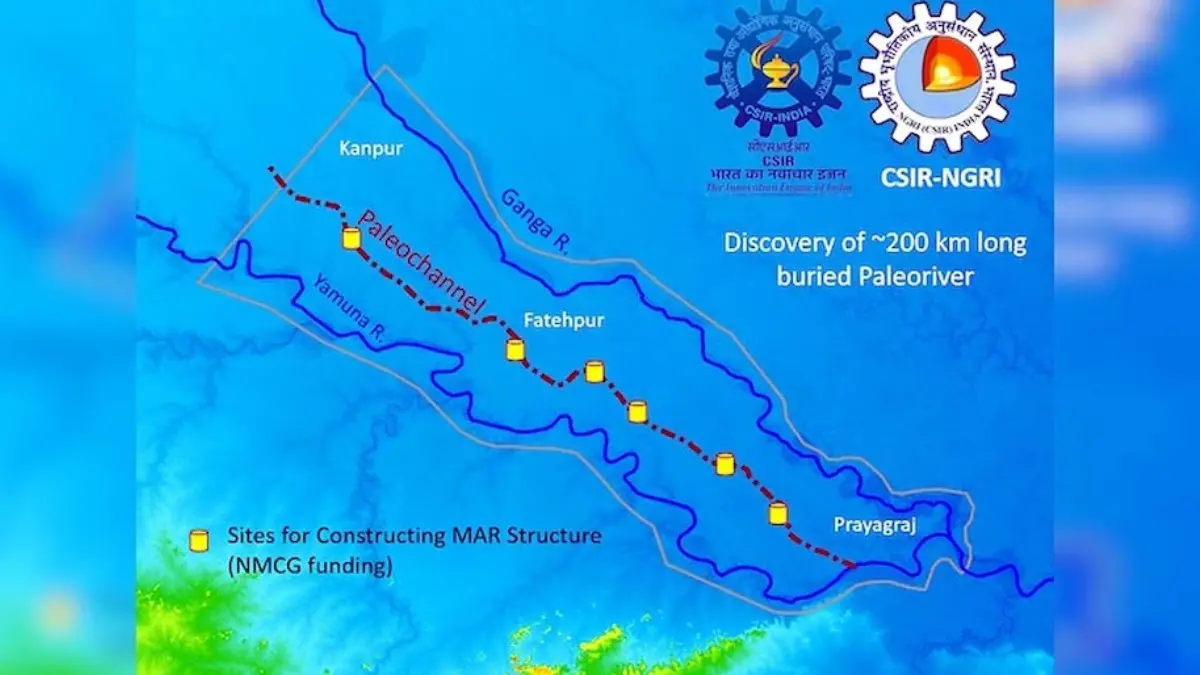
For centuries, the Sangam at Prayagraj has been celebrated as the sacred meeting point of three rivers: the Ganga, the Yamuna, and the mythical, invisible Saraswati. While only two are visible to the naked eye, scientists from one of India’s top research institutes have now uncovered compelling evidence of a massive, buried river channel beneath the surface, giving scientific weight to ancient belief.
Researchers from the CSIR-National Geophysical Research Institute (NGRI) in Hyderabad used advanced airborne geophysical technology and confirmatory drilling to locate a major "palaeo-river" channel. This ancient system flows between the Ganga and Yamuna within the doab region near Prayagraj.
"This has been confirmed and sealed," stated Dr. Subhash Chandra, a scientist at CSIR-NGRI and an expert in palaeo-river channels. "We have done dedicated drilling over the identified paleo channel and the physical existence has been fully confirmed. There is no doubt."
A Giant Hidden Under the Earth
This "ghost river" sits approximately 10 to 15 meters underground, masked entirely by layers of soil and sediment. According to Dr. Chandra, its scale and characteristics suggest it was once a primary waterway rather than a mere offshoot.
Advertisement
"It is a big palaeo river having equal dimensions, the same base level as the Ganga and the Yamuna," Dr. Chandra explained. "Since they have the same depth level, it shows that this is a completely third river, not the same river moving or changing course."
Key findings of the buried river include:
Advertisement
- Scale: Roughly 4 to 5 kilometers wide, matching the size of the Ganga and Yamuna.
- Structure: It displays meandering patterns, suggesting it once flowed alongside the other two rivers for a long period.
- Length: While initial mapping covered 45 kilometers, a later survey supported by the National Mission for Clean Ganga extended this to 200 kilometers, reaching as far as Kanpur.
Scientists believe the channel likely extends even further west toward the Himalayan foothills.
Does it reach the Sangam?
Mapping the final 25 kilometers toward the present-day Sangam has proven difficult. Because the area is now a dense urban landscape, the electromagnetic sensors used in helicopter-borne surveys are hindered by power lines and buildings.
"There are weak channels and minor traces," Dr. Chandra noted. "We could not survey over the city because the electromagnetic sensors used in heli-borne surveys do not work over built-up areas. But we do not rule out that it emerges near the Sangam."
The researchers also point out that river courses naturally shift over thousands of years, meaning the exact point of confluence has likely migrated over time.
A Solution for Modern Water Scarcity?
Beyond the historical intrigue, this discovery offers a potential lifeline for a region struggling with falling water tables. The palaeo-river is partially filled with water and acts as a massive underground reservoir, or aquifer.
There are now discussions about building "recharge structures" to funnel rainwater into this buried channel.
"This will help increase the groundwater level," Dr. Chandra explained. "That enhances the base flow to the river system during the summer season. It will help not only the quantity of water but also the quality, because groundwater recharge is relatively fresh."
By understanding the path of this underground giant, authorities can also better regulate industrial waste to prevent the contamination of these vital deep-water sources.
Is This the Legendary Saraswati?
While the location aligns remarkably well with historical and mythological accounts of the "lost" Saraswati, Dr. Chandra maintains a disciplined scientific stance, avoiding the label "Saraswati" in formal reports. However, the published research acknowledges that the find "adds a new physical dimension" to the traditional belief.
Regardless of the name, the evidence is clear: beneath the soil of Prayagraj lies a third major river, buried by time but still influencing the geography of India’s most famous confluence. The story of the Sangam is no longer just a matter of faith, it is now a matter of data.
Get Current Updates on India News, Entertainment News, Cricket News along with Latest News and Web Stories from India and around the world.