
SC Aravalli Ruling: What's the Future of the Licenses Issued in a Rush After the SC Nov Order?
Following SC's latest order, Republic has raised concerns regarding new mining licenses issued after the initial November ruling. Sources said that over 50 licenses were granted in the Aravalli region between December 2 and December 18, with more than 120 licenses auctioned throughout the month.
- India News
- 4 min read

;'%3e%3cpath%20d='m8,15.99c4.41,0,7.99-3.58,7.99-7.99S12.41,0,8,0,0,3.59,0,8s3.58,7.99,7.99,7.99Z'%20style='stroke:%23fff;%20stroke-miterlimit:10;%20stroke-width:.02px;'/%3e%3cpath%20d='m3.08,3.37l3.82,5.11-3.84,4.15h.87l3.37-3.64,2.72,3.64h2.94l-4.04-5.39,3.58-3.87h-.86l-3.1,3.35-2.5-3.35h-2.94Zm1.27.64h1.35l5.97,7.99h-1.35l-5.97-7.99Z'%20style='fill:%23fff;'/%3e%3c/g%3e%3c/svg%3e)


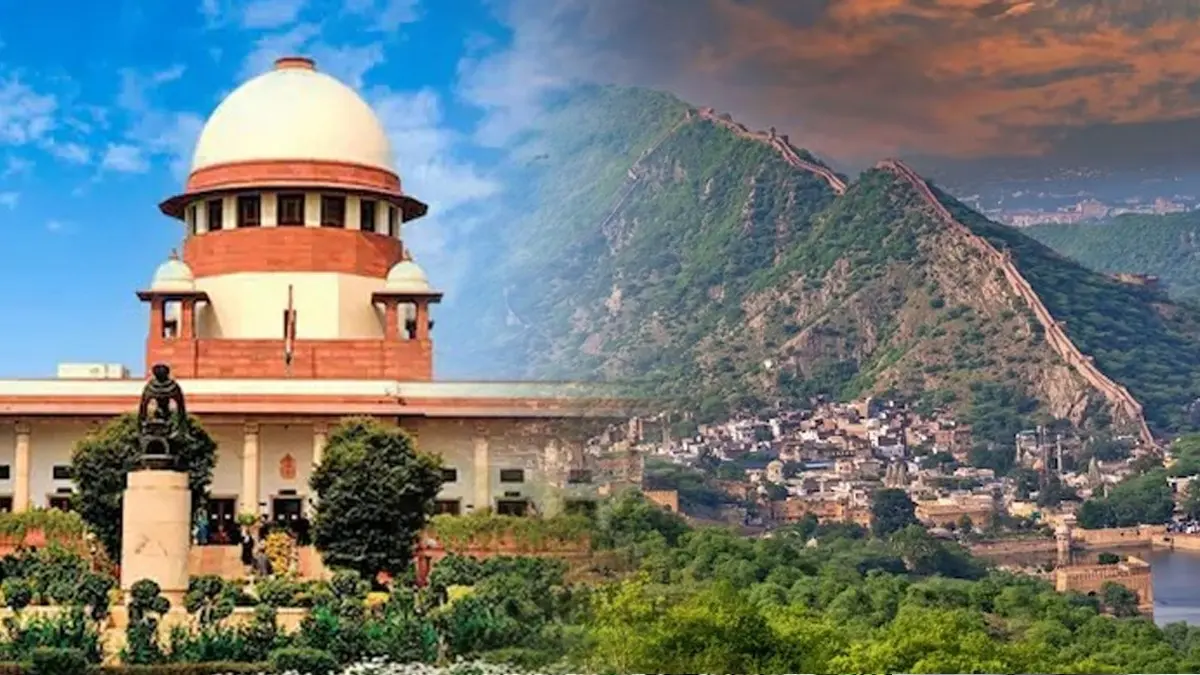
New Delhi: The Supreme Court has "put in abeyance" its November 20 decision to accept the Central Environment Ministry's definition of the Aravalli Hills and Aravalli Range. The stay follows an extensive investigation by Republic, which uncovered critical facts requiring the apex court's immediate attention.
Following the Court’s latest order, Republic has raised concerns regarding new mining licenses issued after the initial November ruling. Sources said that over 50 licenses were granted in the Aravalli region between December 2 and December 18, with more than 120 licenses auctioned throughout the month.
There are now mounting demands for the review and suspension of all licenses issued post-November. Republic seeks to clarify whether the Supreme Court will intervene to order their formal suspension.
"Contempt of Court": Experts Weigh In
MD Sinha, Former Principal Secretary of Haryana, stated that the legal implications are clear. "Any order or license issued after November 20 is void. The Mining Secretary of Rajasthan must cancel these orders; otherwise, he is in contempt of court," Sinha said.
Advertisement
When asked if the cancellation should be automatic, Sinha added, "Yes... this is how government works. If he doesn't cancel them, the court must take cognizance. The court did a commendable job today, largely due to the questions raised by your investigation. They refused to hear defense arguments and rightly noted that the matter must be examined by domain experts—not just civil servants."
Sinha further emphasized that under standing rules, no license in the Aravalli area can be granted without Supreme Court permission.
Advertisement
"There were 360 pending proposals; 163 fell in the Aravalli region and were not recommended. Many of these new licenses likely come from that pool," he said.
The Balance Between Development and Ecology
Addressing the nature of mining, Sinha argued for strict regulation over "sustainability" rhetoric.
"There is no such thing as 'sustainable mining' in this ecosystem—it is inherently destructive. The court used the term 'regulated mining' for a reason. We must protect 90% of the area and restrict mining to the 5–10% that is least ecologically sensitive," he said.
Environmental activist Chetan Agarwal echoed these concerns regarding the Management Plan for Sustainable Mining (MPSM). With the November judgment on hold, Agarwal noted that the MPSM is also suspended.
"The entire judgment has been stayed, so the directions to begin the mining plan process must be kept in abeyance," Agarwal explained.
"Mining should only be allowed in small micro-sections where the wildlife, forest, and groundwater departments are given primacy over the mining department," he opined.
SC Stays Previous Order on Aravalli Definition; Forms New Expect Panel to Examine Issues
The Supreme Court has "put in abeyance" its earlier decision (issued on November 20) to accept the Central Environment Ministry's definition of the Aravalli Hills and Aravalli Range.
The top court's acceptance of the definition in November had exposed most of the Aravalli region to the risk of being used for regulated mining.
A vacation bench of the Chief Justice of India (CJI) Surya Kant and Justices J.K. Maheshwari and A.G Masih has also ordered the formation of a new expert committee to examine issues that required to be examined in terms of the definition of Aravallis.
The Court has also issued notice to the Centre and the four Aravalli States - Rajasthan, Gujarat, Delhi and Haryana, seeking their response to its suo motu case on the issue.
On Saturday, the Supreme Court took suo motu cognisance of concerns surrounding the definition of the Aravalli Range, amid mounting criticism from environmentalists and opposition parties over its potential impact on the fragile mountain ecosystem.
The development follows objections to the Centre's newly notified definition of the Aravalli mountain range, which is based on a 100-metre height criterion.
On December 24, the Union Ministry of Environment, Forest and Climate Change (MoEF&CC) had also issued directions to the States for a complete ban on the Grant of any New Mining Leases in the Aravallis.
This prohibition applies uniformly across the entire Aravalli landscape and is intended to preserve the integrity of the range. The directions are aimed at safeguarding the Aravallis as a continuous geological ridge extending from Gujarat to the National Capital Region and at stopping all unregulated mining activities.
The Aravalli range is a 670-kilometre-long mountain range in northwestern India.
The highest elevation of the range has been recorded at 1,722 metres. The hill starts near Delhi, passes through Haryana, Rajasthan, and ends in Gujarat. The highest peak of the range is known as Guru Shikhar, in Mount Abu, Rajasthan. The Aravalli range is the oldest fold-mountain belt in India, dating back around 2 billion years.
Get Current Updates on India News, Entertainment News, Cricket News along with Latest News and Web Stories from India and around the world.