
‘Sindh Will Always Be Part of India, Borders Can Change’: Rajnath Singh Hints at Future Reunification
Defence Minister Rajnath Singh, addressing a Sindhi convention in Delhi, said Sindh will always remain a part of India civilisationally and hinted that borders can change in the future.
- India News
- 4 min read

;'%3e%3cpath%20d='m8,15.99c4.41,0,7.99-3.58,7.99-7.99S12.41,0,8,0,0,3.59,0,8s3.58,7.99,7.99,7.99Z'%20style='stroke:%23fff;%20stroke-miterlimit:10;%20stroke-width:.02px;'/%3e%3cpath%20d='m3.08,3.37l3.82,5.11-3.84,4.15h.87l3.37-3.64,2.72,3.64h2.94l-4.04-5.39,3.58-3.87h-.86l-3.1,3.35-2.5-3.35h-2.94Zm1.27.64h1.35l5.97,7.99h-1.35l-5.97-7.99Z'%20style='fill:%23fff;'/%3e%3c/g%3e%3c/svg%3e)


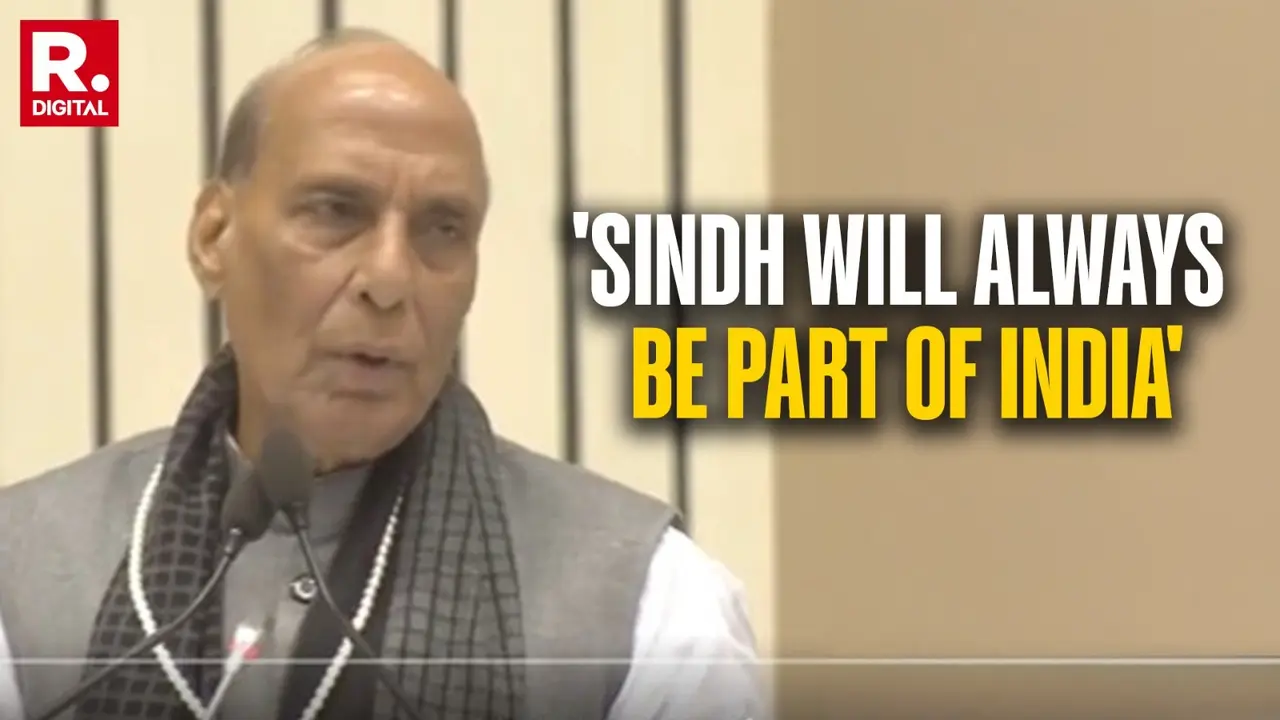
New Delhi: Defence Minister Rajnath Singh stated on Sunday that, while Sindh is not a part of India now, it remains an important component of India's civilizational identity, and that borders may change in the future. Singh emphasised that the emotional and cultural ties to Sindh have never diminished, particularly among Sindhi Hindus who immigrated to India during Partition, while speaking at a Sindhi convention in Delhi.
In 1947, the area surrounding the Indus River, known as Sindh, joined Pakistan. Urdu, Sindhi, and English speakers live in the province, which is the third biggest in Pakistan and has Karachi as its capital. Sindhi Hindus who had lived there relocated to India following Partition, bringing with them rich memories and customs associated with the area.
Singh cited veteran lawmaker Lal Krishna Advani's statement that Sindhi Hindus of his generation still reject Sindh's independence from India in one of his books. Singh added, "I'd also like to mention that Sindhi Hindus, especially those of his generation, still haven't accepted the separation of Sindh from India," according to a book written by Lal Krishna Advani.
Additionally, he emphasised Advani's remarks regarding the Indus River's spiritual significance. “Not just in Sindh, but throughout India, Hindus consider the Indus River sacred. Many Muslims in Sindh also believed that the water of the Indus was no less sacred than the Aab-e-Zamzam of Mecca. This is Advani ji's quote,” he said.
Advertisement
Emphasising India’s civilisational connection with Sindh, Singh added, “Today, the land of Sindh may not be a part of India, but civilisationally, Sindh will always be a part of India. And as far as land is concerned, borders can change. Who knows, tomorrow Sindh may return to India again. Our people of Sindh, who hold the Indus River sacred, will always be our own. No matter where they are, they will always be ours.”
Singh has previously discussed areas that are part of Pakistan-occupied Kashmir (PoK). On September 22, he addressed the Indian community in Morocco and expressed his confidence that PoK will return to India without taking any forceful action, citing the rising dissatisfaction of the local populace. "PoK will be ours by itself. You must have heard sloganeering because demands have begun to be made in PoK, he remarked.
Advertisement
During India's Operation Sindoor, which targeted terrorist infrastructure and the Pakistani forces who assist it, several scholars contended that India ought to have pushed deeper into the PoK and taken control of territory that is legally India's.
How Sindh was separated from India
When India and Pakistan were divided in 1947, the 200,000 square kilometre historic Sindh region, which included the Thar Desert, became a part of Pakistan. Sindh's wealth was transformed into poverty and bloodshed by the partition, which was more than just a change of borders. It also caused widespread migration and instability.
While the indigenous Sindhi Muslims did not entirely welcome the new Indian Muslims, many middle-class Hindus left Sindh for India. They were referred to as "Sindhi Muhajirs," which caused hostilities and bloodshed between Sindhis and Muhajirs that hampered the growth of the area for about 20 years.
Muslims and Hindus battled together for Sindh's distinct identity.
Sindh, Gujarat, and Maharashtra were all a part of Bombay Province until 1936. Muslims and Hindus in Sindh together spearheaded a campaign to establish it as a distinct province. Due to the Marathi and Gujarati populations' prominence, residents of Sindh felt that their rights and customs were being disregarded.
A Hindu by the name of Harchandrai first called for a separate Congress legislature for Sindh in 1913. The political climate in Sindh started to shift when the province gained its independence in 1936. The first call for an independent Pakistan was made from this very territory in 1938. Muhammad Ali Jinnah formally demanded that Muslims have their own nation, Pakistan, during the Muslim League's annual meeting in Karachi.
A resolution supporting Pakistan was passed by the Sindh Assembly in 1942. The people of Sindh were unaware at the time that Partition would lead to their destruction. India was split into two parts in 1947, just five years later. Five years later, in 1947, India was divided into two parts. Hindus in this area were forced to flee their houses and migrate to India, much like in other parts of Pakistan.
Get Current Updates on India News, Entertainment News, Cricket News along with Latest News and Web Stories from India and around the world.