
Steel Guardians: Inside The Nerve Centre Of India's 'Operation Sindoor' Triumph!
India's air defence system shines in Operation Sindoor, intercepting hundreds of drones and missiles fired by Pakistan and securing all Indian military and air bases.
- India News
- 5 min read

;'%3e%3cpath%20d='m8,15.99c4.41,0,7.99-3.58,7.99-7.99S12.41,0,8,0,0,3.59,0,8s3.58,7.99,7.99,7.99Z'%20style='stroke:%23fff;%20stroke-miterlimit:10;%20stroke-width:.02px;'/%3e%3cpath%20d='m3.08,3.37l3.82,5.11-3.84,4.15h.87l3.37-3.64,2.72,3.64h2.94l-4.04-5.39,3.58-3.87h-.86l-3.1,3.35-2.5-3.35h-2.94Zm1.27.64h1.35l5.97,7.99h-1.35l-5.97-7.99Z'%20style='fill:%23fff;'/%3e%3c/g%3e%3c/svg%3e)


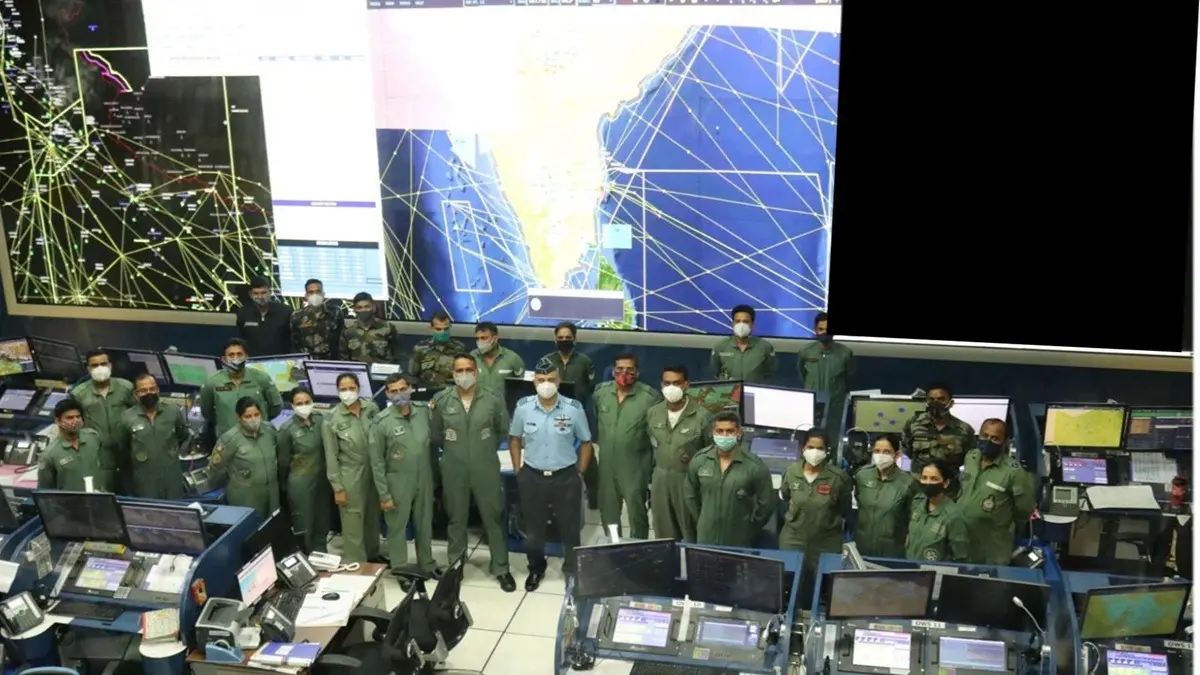
New Delhi: In the archives of modern aerial defence, the extraordinary success of India's ‘Operation Sindoor’ will undoubtedly be etched as a testament to technological prowess and human resolve. Behind the strategic masterstrokes and the unwavering courage displayed, a dedicated cadre of Indian Air Force (IAF) officials and personnel formed the backbone of this monumental achievement. A photograph released on Monday by the Indian Armed Forces, offered a rare glimpse into the high-stakes environment of the Integrated Air Command and Control System (IACCS) – the veritable brain that orchestrated India's impenetrable air defence during the critical operation.
In the photo, the faces of quiet determination, the skilled professionals who, from their advanced control stations, meticulously managed the nation's shield against a formidable onslaught, can be seen. As ‘Operation Sindoor’ progressed, it was reportedly from this sophisticated hub, shown in the picture, that India's response to hundreds of incoming drones and missiles, launched by Pakistan, was coordinated with breathtaking precision.
At the centre, the air crackled with tension, yet within the IACCS, a calm, focused energy prevailed. In the picture, it can be seen that each blip on the screen, each piece of incoming data, was analysed in fractions of a second, leading to decisive actions that neutralised threat after threat.
As per officials, the scale of the challenge was immense. The skies were contested, and the intent of the adversary was clear, to overwhelm and penetrate. Yet, the IAF team, a symphony of well-drilled expertise, rose to the occasion magnificently. Their vigilance was unwavering and their coordination was seamless.
Advertisement
The successful interception and destruction of a vast number of hostile projectiles stand as irrefutable proof of their exceptional capabilities. It wasn't merely about technology, it was about the human element harnessing that technology with unparalleled skill. Every member of the team, from the senior commanders to the technical staff, played an indispensable role in this complex ballet of defence.
The outcome of the whole exercise was a resounding success, which the world acknowledged. It was through this hub that all Indian military installations and vital air bases across the designated operational theatre were kept secure, their integrity unbreached. The comprehensive protection was no accident, it was the direct result of the meticulous planning and flawless execution managed from within the IACCS. The photograph shared captures a moment of profound professional pride, the faces of individuals who understood the gravity of their responsibility and delivered beyond measure. They are the guardians who ensured that India's airspace remained inviolable when it mattered most.
Advertisement
The success of 'Operation Sindoor', particularly the air defence component managed by this exceptional team, sends a strong message. It showcased India's formidable defensive capabilities and the exceptional calibre of the men and women who serve in its air force. Their actions during those critical hours have not only safeguarded national assets but have also strengthened the nation's confidence in its security apparatus.
These personnel, operating at the cutting edge of defence technology, have penned a new chapter in vigilance and operational excellence, their deeds echoing the highest traditions of the Indian Air Force. Their triumph is a shield forged in skill, dedication, and an unshakeable commitment to the nation's sovereignty.
India's Air Defence System
The success of Operation Sindoor is the result of 11 years of systematic upgrades to India's air defence architecture. The major achievements included the Rs 35,000 crore deal for five S-400 Triumf squadrons signed in 2018, with three now operational along the borders with China and Pakistan, capable of engaging threats up to 400 km away. The USD 2.5 billion Barak-8 Medium-Range SAM deal with Israel, signed in 2017, has also strengthened frontline bases like Bhatinda.
The IACCS, along with the Akashteer system, ensured seamless coordination and real-time data sharing between various air defence systems. Developed by Bharat Electronics Limited, Akashteer automates air defence operations, fusing data from multiple sensors and providing a unified air picture to commanders. Its main features include decentralised engagement, real-time airspace visualisation, and built-in redundancy and scalability.
Operation Sindoor showcased India's indigenous military capabilities, with the BrahMos supersonic cruise missile delivering precision strikes against Pakistani airbases. The operation marked the combat debut of indigenously manufactured loitering munitions, which executed simultaneous precision strikes, catching Pakistan's defences off guard. The success of these systems demonstrated India's remarkable progress in indigenous defence technologies.
Operation Sindoor
Operation Sindoor was a coordinated precision assault operation initiated by the Indian Armed Forces in response to the Pahalgam terror attack. The operation was executed from Indian territory through the coordinated efforts of the Army, Navy, and Air Force. India's measured but resolute stance won silent international support, with most world powers recognizing India's right to self-defence.
India's air defence ecosystem, fortified over the past decade, thwarted Pakistan's retaliatory missile and drone strikes. The systems used included:
- S-400 Triumf systems: capable of engaging threats up to 400 km away
- Barak-8 missiles: medium-range SAMs that bolster frontline bases
- Akash Surface-to-Air Missiles (SAMs): indigenous missile batteries that enhance close-range defence
- DRDO's anti-drone technologies: including Man Portable Counter Drone Systems (MPCDS)
- Integrated Counter-Unmanned Aerial System (UAS) grid: detects, jams, and eliminates threats before they breach
Get Current Updates on India News, Entertainment News, Cricket News along with Latest News and Web Stories from India and around the world.