
'Public Safety Above Animal Rights': SC Cracks Down on Stray Dog Menace, Pulls Up States, UTs Over 'Failure' To Tackle Crisis
The Supreme Court of India has declined to modify its November 2025 order directing authorities to remove stray dogs from public institutions, including schools, hospitals, colleges, bus stands and railway stations.
- India News
- 6 min read

;'%3e%3cpath%20d='m8,15.99c4.41,0,7.99-3.58,7.99-7.99S12.41,0,8,0,0,3.59,0,8s3.58,7.99,7.99,7.99Z'%20style='stroke:%23fff;%20stroke-miterlimit:10;%20stroke-width:.02px;'/%3e%3cpath%20d='m3.08,3.37l3.82,5.11-3.84,4.15h.87l3.37-3.64,2.72,3.64h2.94l-4.04-5.39,3.58-3.87h-.86l-3.1,3.35-2.5-3.35h-2.94Zm1.27.64h1.35l5.97,7.99h-1.35l-5.97-7.99Z'%20style='fill:%23fff;'/%3e%3c/g%3e%3c/svg%3e)


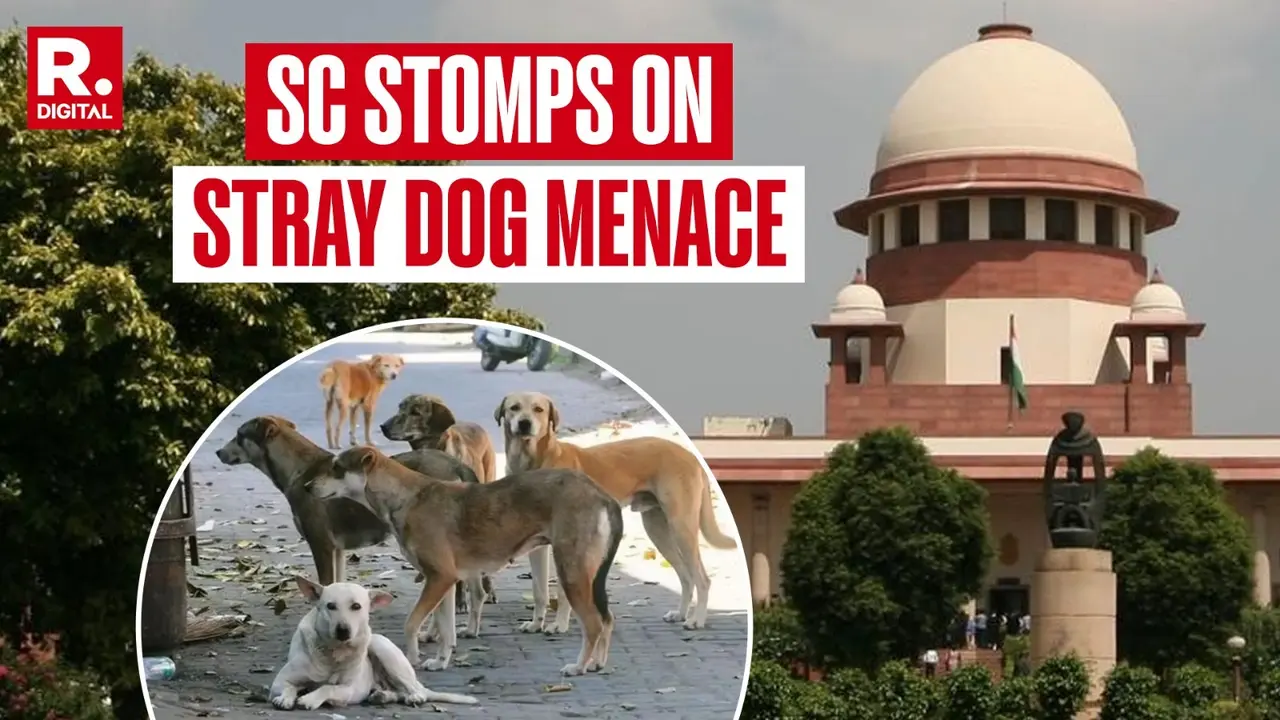
New Delhi: Asserting that the right to life with dignity fundamentally includes the freedom to walk the streets without fear of animal attacks, the Supreme Court of India has delivered a non-negotiable verdict on the country’s escalating stray dog menace.
The apex court ordered the immediate rounding up, sterilisation, and permanent relocation of stray dogs from key public areas, effectively modifying long-standing guidelines mandating their return to their original territories.
Given the growing widespread concern over dog bites, rabies fatalities, and highway accidents caused by stray cattle, the apex court has laid down a strict roadmap for state governments, municipal bodies, and national agencies.
The Court has granted legal immunity to municipal officials implementing these drives and clarified that legally permissible measures, including euthanasia, can be used to neutralise rabid or dangerous animals threatening human life.
Advertisement
Refusing to modify its November 2025 directives, a three-judge bench comprising Justices Vikram Nath, Sandeep Mehta, and N.V. Anjaria made it clear that the state cannot remain a passive spectator while citizens fall victim to an alarming rise in dog bites and rabies-related fatalities.
The Supreme Court's Ultimatum:
1. No bars on removal: Refused to alter the ban on strays in public institutions.
Advertisement
2. No return policy: Dogs captured from public hubs cannot be released back there.
3. Mandatory fencing: Schools, hospitals, and transit stations must be secured.
4. District ABC units: At least one fully functional sterilisation centre per district.
5. Highway clearance: NHAI ordered to deploy vehicles to remove stray cattle.
6. High Court judicial oversight: High courts to monitor compliance via Suo motu cases.
Expanding Safe Public Spaces
The apex court strongly rejected pleas to dilute its stance on the removal of stray dogs from key public areas. Highlighting the ground realities, the bench noted that innocent children, international travellers, and the elderly are increasingly becoming victims of brutal stray dog attacks.
By tying public safety directly to Article 21 (Right to Life), the Court firmly prioritised human safety while establishing a structured mechanism for animal welfare. With public anxiety mounting over aggressive strays in parks, residential areas, and markets, the Supreme Court has pushed for an adaptable, safety-first approach.
The Court ruled that state and local authorities must take informed and reasoned decisions to extend these safety frameworks to various public places, ensuring a secure environment for the public at large. The Supreme Court directed all state healthcare machineries to ensure the continuous and adequate availability of anti-rabies vaccines and medicines across all public health centres.
"No-Return" Policy and Mandatory Fencing
The crux of the Supreme Court's ruling lies in the permanent modification of how local municipal bodies handle stray populations around sensitive public areas. Reinforcing its November 2025 order, the Court directed the total removal of stray dogs from:
- Educational institutions (schools and colleges)
- Hospitals and medical facilities
- Public sports complexes
- Bus stands, depots, and railway stations
Crucially, the Court ordered that these institutions be properly equipped to block any dog's entry. Striking a massive blow to previous protocols that mandated returning animals to their exact locations, the bench ruled that stray dogs captured by these zones must not be released back to the same spot.
The Court observed that permitting their return would completely frustrate the very purpose of securing these premises and addressing urgent public safety concerns. Instead, local government bodies are legally bound to capture these dogs, vaccinate and sterilise them under the Animal Birth Control (ABC) Rules, and permanently shift them to designated dog shelters.
Animal Birth Control Frameworks
The Supreme Court ordered a structural overhaul of the Animal Welfare Board of India (AWBI) framework. States and Union Territories have been directed to take immediate steps to strengthen and implement these rules.
The apex court has mandated the establishment of at least one fully functional ABC centre in every single district across India. State authorities must evaluate local human and canine population densities to actively expand the number of these sterilisation facilities where needed.
Expanding its focus to high-speed road networks, the Supreme Court turned to the National Highways Authority of India (NHAI) to address the deadly hazard of stray cattle causing fatal accidents on expressways.
The NHAI has been directed to formulate a strict monitoring and coordination framework within a defined timeline. To physically clear the roads, the Court authorised the deployment of depreciated transport vehicles repurposed specifically to safely manage and relocate stray cattle away from national transit corridors.
High Courts to Monitor Compliance
The Supreme Court has a rigorous, multi-tiered judicial monitoring system, shifting the active execution ground to regional judiciaries. The apex court has directed all High Courts across India to register suo motu cases under continuing proceedings to monitor local implementation.
State Chief Secretaries and the Union Government must file their first comprehensive compliance affidavits before their respective jurisdictional High Courts by August 7, 2026. Following this, the High Courts are required to submit a consolidated compliance report to the Supreme Court by November 17, 2026.
The apex court indicated that while the core legal matter now stands closed before it, its doors remain strictly open to receive, review, and enforce these compliance reports, putting the entire state machinery on absolute notice.
Get Current Updates on India News, Entertainment News, Cricket News along with Latest News and Web Stories from India and around the world.