
Supreme Court's Big Judgement on Menstrual Hygiene: Declares it Right to Life, Directs Free Sanitary Pads in All Schools
The Supreme Court on Friday delivered the judgment on pan-India implementation of the Centre's policy 'Menstrual Hygiene Policy for School-going Girls' in Government and Government-aided schools. The apex court said that the right to menstrual health is a part of the right to life under Article 21.
- India News
- 3 min read

;'%3e%3cpath%20d='m8,15.99c4.41,0,7.99-3.58,7.99-7.99S12.41,0,8,0,0,3.59,0,8s3.58,7.99,7.99,7.99Z'%20style='stroke:%23fff;%20stroke-miterlimit:10;%20stroke-width:.02px;'/%3e%3cpath%20d='m3.08,3.37l3.82,5.11-3.84,4.15h.87l3.37-3.64,2.72,3.64h2.94l-4.04-5.39,3.58-3.87h-.86l-3.1,3.35-2.5-3.35h-2.94Zm1.27.64h1.35l5.97,7.99h-1.35l-5.97-7.99Z'%20style='fill:%23fff;'/%3e%3c/g%3e%3c/svg%3e)


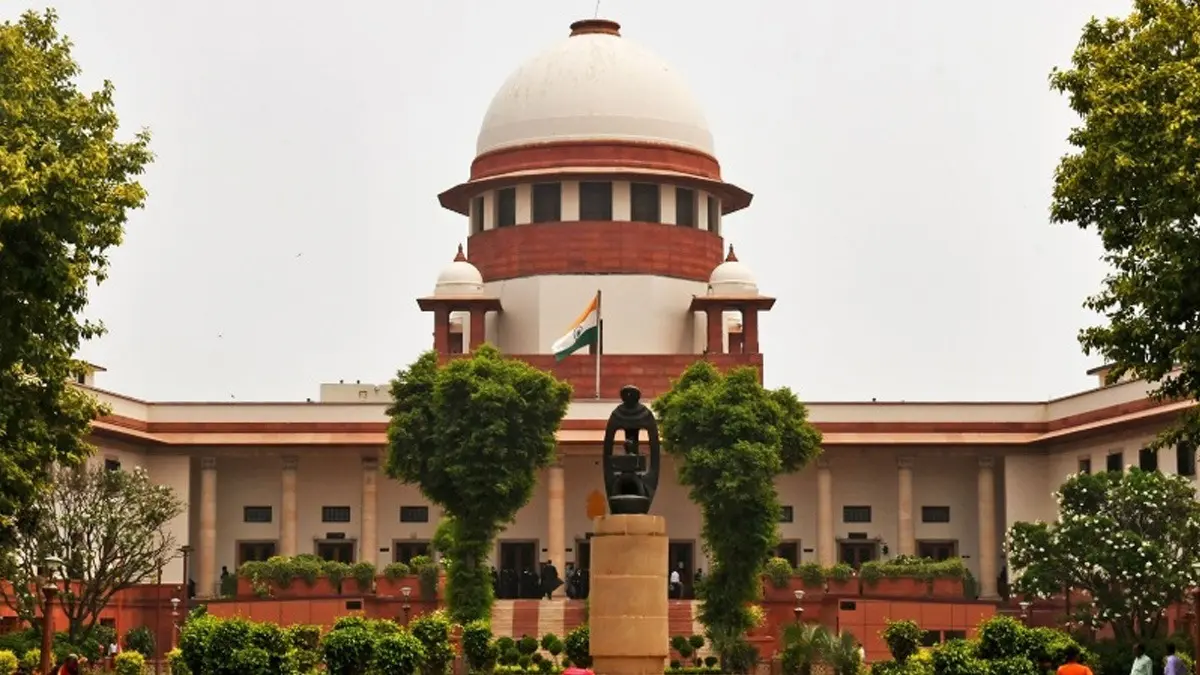
New Delhi: The Supreme Court on Friday delivered the judgment on pan-India implementation of the Centre's policy 'Menstrual Hygiene Policy for School-going Girls' in Government and Government-aided schools.
The apex court said that the right to menstrual health is a part of the right to life under Article 21 of the Indian Constitution. Thus, it has directed that all schools in India, whether private or government, in both urban and rural areas, must provide free of cost biodegradable sanitary napkins of the highest safety and hygienic standards to girls.
A bench led by Justice J.B. Pardiwala has framed key constitutional questions during hearings on a public interest litigation seeking nationwide access to menstrual hygiene resources for adolescent girls in Classes 6–12.
"The right to life under Article 21 of the Constitution includes the right to menstrual health. Access to safe, effective, and affordable menstrual hygiene management measures helps a girl child attain the highest standard of sexual and reproductive health. The right to a healthy reproductive life embraces the right to access education and information about sexual health," Justice Pardiwala said.
Advertisement
"The right to equality is expressed through the right to participate on equal terms. At the same time, equality of opportunity necessitates that everyone has a fair chance to acquire the skills necessary to access benefits," Justice Pardiwala added.
Furthermore, Justice Pardiwala emphasized that the right to equality manifests through equal participation and opportunity. True equality requires ensuring everyone has a fair chance to acquire necessary skills and access benefits, particularly addressing barriers that disproportionately affect girls due to menstrual hygiene challenges, which can lead to absenteeism, health issues, and school dropouts.
Advertisement
"This judgment is not meant only for the stakeholders of the legal system. It is also meant for the classroom, where girls hesitate to ask for help. It is for the teachers who want to help but are restrained due to a lack of resources. It is for the parents who may not realise the impact of their silence, and for society, to establish that progress is measured by how we protect the most vulnerable. We wish to communicate to every girl child who may have become a victim of absenteeism because her body was perceived as a burden, that the fault is not hers. These words must travel beyond the courtroom and law review reports, and reach the everyday conscience of society at large," Justice Pardiwala said.
The policy in question, approved by the Union Health Ministry following earlier Supreme Court directives (including from 2023), aims to mainstream menstrual hygiene in schools through awareness, free or improved access to products, separate facilities, and environmentally sound disposal, though the Court's forthcoming verdict will determine the extent of mandatory pan-India rollout and enforcement in government and aided institutions.
This landmark case highlights menstrual hygiene as integral to dignity, gender equity, and the effective realization of constitutional rights to education and life for India's girl students. The judgment is expected to set binding directives for implementation across the country.
Get Current Updates on India News, Entertainment News, Cricket News along with Latest News and Web Stories from India and around the world.