
Vanishing Springs, Drying Rivers: Is Kashmir On Brink Of Water Disaster?
The Kashmir Valley is grappling with an unprecedented water crisis as major water sources, including lakes, rivers, and springs, witness severe depletion.
- India News
- 4 min read

;'%3e%3cpath%20d='m8,15.99c4.41,0,7.99-3.58,7.99-7.99S12.41,0,8,0,0,3.59,0,8s3.58,7.99,7.99,7.99Z'%20style='stroke:%23fff;%20stroke-miterlimit:10;%20stroke-width:.02px;'/%3e%3cpath%20d='m3.08,3.37l3.82,5.11-3.84,4.15h.87l3.37-3.64,2.72,3.64h2.94l-4.04-5.39,3.58-3.87h-.86l-3.1,3.35-2.5-3.35h-2.94Zm1.27.64h1.35l5.97,7.99h-1.35l-5.97-7.99Z'%20style='fill:%23fff;'/%3e%3c/g%3e%3c/svg%3e)


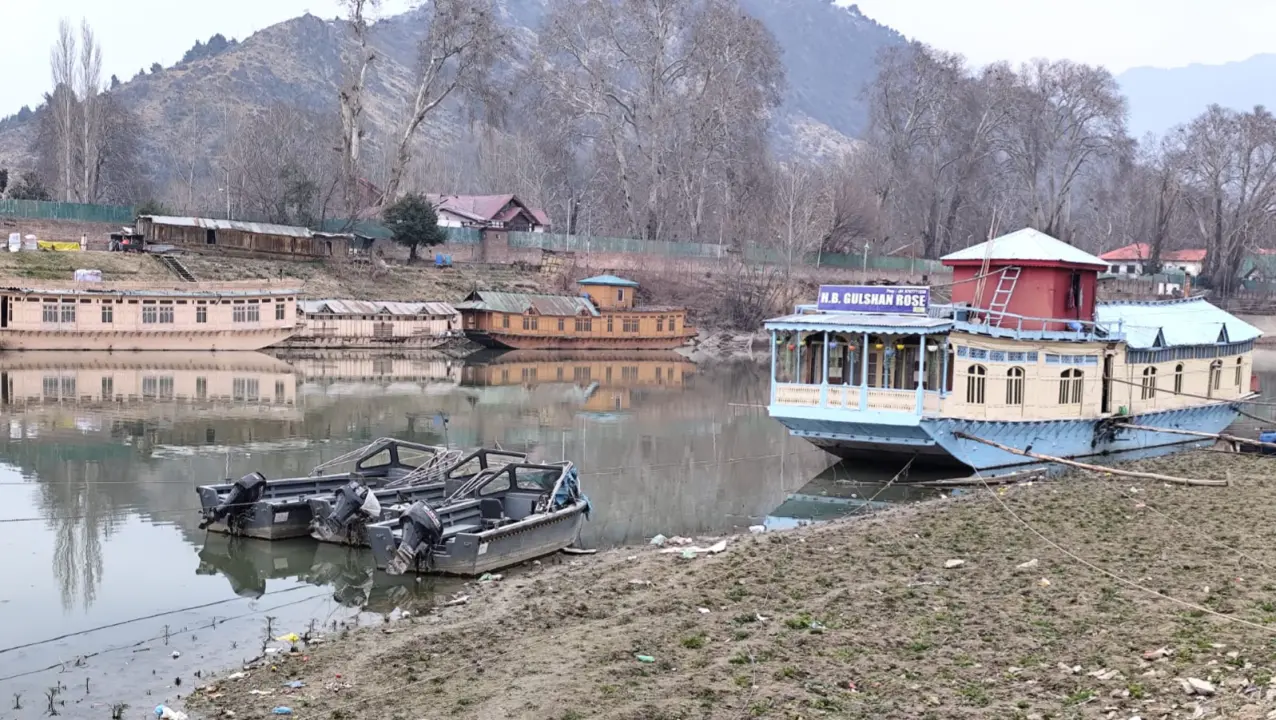
Srinagar: The Kashmir Valley is grappling with an unprecedented water crisis as major water sources, including lakes, rivers, and springs, witness severe depletion. Achabal Springs in South Kashmir have dried up completely, exacerbating concerns of a major drought in the coming summer months. Experts attribute the crisis to an alarming 80% deficit in winter precipitation, warning that if dry conditions persist, the valley could face acute shortages affecting agriculture, horticulture, and drinking water supplies.
According to the Meteorological Department, January recorded a staggering 79% decline in precipitation, with February showing even lower levels. "If this dry spell continues, we are staring at an acute crisis," a Met official warned. "There won't be enough water for drinking or irrigating fields, severely impacting the Valley's agrarian economy."
The crisis has disrupted the region's tourism and sports activities. The lack of snowfall has forced the administration to postpone the fifth edition of the Khelo India Winter Games, originally scheduled to begin on February 22. Ski slopes in Gulmarg remain barren, while higher reaches lack the snow cover required for safe winter sports, dealing a blow to the Valley's winter tourism industry.
The situation is particularly concerning along the Jhelum River, which is flowing more than a meter below its usual level for this time of year. Social media is flooded with images of parched riverbeds, dried-up springs, and dangerously low water bodies.
Advertisement
"The riverbed of Jhelum is visible at several places, particularly upstream in South Kashmir, while downstream levels in North Kashmir are alarmingly low," said an official from the Irrigation and Flood Control Department.
Adding to the crisis, the Executive Engineer of the Water Works Division in Srinagar has announced a 30-hour shutdown of the Sindh Power Canal HEP Old Ganderbal from February 22 to 23 for desilting and repair work. The shutdown is expected to disrupt the raw water supply to treatment plants at Nishat, Alusteng, and Rangil, affecting potable water distribution in major parts of Srinagar and its outskirts.
Advertisement

Environmental experts warn that the crisis is not solely due to a dry winter but also stems from long-term ecological neglect and climate change. "The Himalayas are warming at nearly twice the global average, leading to reduced snowfall and erratic precipitation," said climate scientist Dr Aamir Sultan Wagay.
"What we are witnessing in Kashmir is a direct consequence of global warming, deforestation, and unregulated urban expansion," Dr Wagay added. Unchecked construction along water bodies has further worsened the situation.
"Over the years, people have built houses, shops, and hotels along fragile shorelines, narrowing natural water channels. In some places, lake beds have been filled to create land, reducing water retention capacity," said environmentalist Dr Saima Khan.
She stressed the need for urgent intervention. "Deforestation has severely impacted groundwater recharge. If forests are not preserved, water crises will become an annual phenomenon."
Meanwhile, Chief Minister of J&K, Omar Abdullah acknowledged the severity of the situation, stating that the crisis has been building up for years. "J&K is staring at a water crisis this year. It's not a recent phenomenon; it's been building up for a few years now."
"While the government must adopt a more proactive approach to water management and conservation, it can't be a government-centric effort. All of us in J&K need to change how we take water for granted," Abdullah said in a post on X.
He added that he would be reviewing the Jal Shakti Department's measures and engaging with the public to discuss collective solutions. However, critics argue that government preparedness remains inadequate.
While authorities have suspended water supply to certain areas, no comprehensive rationing plan has been announced to ensure equitable distribution. Leaky supply pipes in rural areas continue to waste precious water, highlighting infrastructure gaps.
Experts urge the administration to revive traditional water conservation methods, such as rainwater harvesting, which was successfully implemented in Kupwara in the 1960s and 70s.
"We need to look at past models where rainwater was stored in reservoirs for irrigation. The government should promote and incentivize such practices in urban and rural areas," said agronomist Dr Asif Bhat.
With worsening climate conditions, experts also recommend exploring alternative water sources, such as desalination plants and wastewater treatment, to reduce dependency on seasonal precipitation.
"The water crisis in Kashmir is no longer a temporary issue—it's a long-term challenge," said climate expert Dr Parvez Wani.
She further added, "A holistic strategy involving conservation, sustainable urban planning, afforestation, and efficient water distribution is the only way forward. If we fail to act now, the summers ahead will be harsher than we can imagine."
Get Current Updates on India News, Entertainment News, Cricket News along with Latest News and Web Stories from India and around the world.