
‘Victory Is in the Mind’: Army Chief Dwivedi Ridicules Pakistan’s Claim of Winning Operation Sindoor, Lauds India’s Narrative Warfare
Army Chief Gen Upendra Dwivedi slams Pakistan’s victory claim, highlights narrative warfare, political will, and major strikes in Operation Sindoor.
- India News
- 5 min read

;'%3e%3cpath%20d='m8,15.99c4.41,0,7.99-3.58,7.99-7.99S12.41,0,8,0,0,3.59,0,8s3.58,7.99,7.99,7.99Z'%20style='stroke:%23fff;%20stroke-miterlimit:10;%20stroke-width:.02px;'/%3e%3cpath%20d='m3.08,3.37l3.82,5.11-3.84,4.15h.87l3.37-3.64,2.72,3.64h2.94l-4.04-5.39,3.58-3.87h-.86l-3.1,3.35-2.5-3.35h-2.94Zm1.27.64h1.35l5.97,7.99h-1.35l-5.97-7.99Z'%20style='fill:%23fff;'/%3e%3c/g%3e%3c/svg%3e)


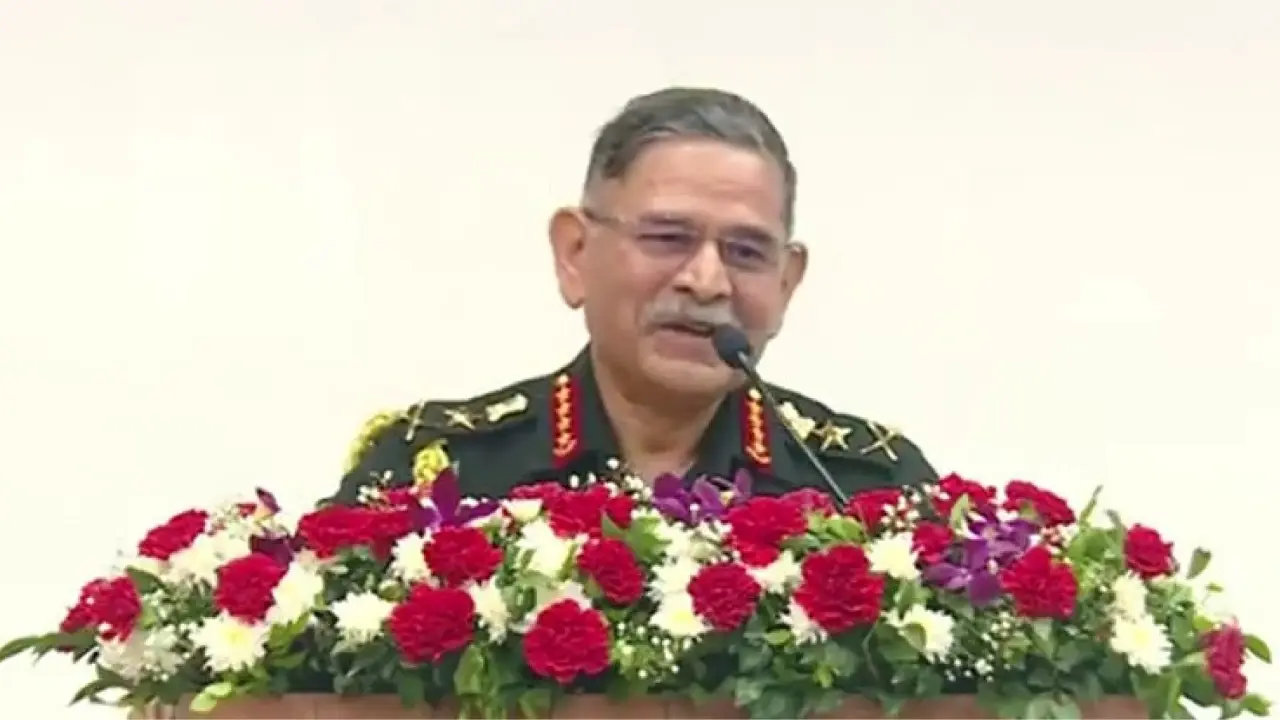
New Delhi: Army chief General Upendra Dwivedi criticized Pakistan's claim of victory over India during the recent conflict, emphasizing the importance of the narrative management system.
Victory is in the mentality, the Army commander added, explaining how Pakistan was able to convince its people that it had won following Operation Sindoor. That is how you impact the domestic, hostile, and neutral populations, Gen Dwivedi addressed an audience at IIT Madras.
"Narrative management system is something which we realise in a big way because victory is in mind. It's always in the mind. If you ask a Pakistani whether you lost or won, he'd say, my chief has become field marshal, we must have won only, that's why he has become field marshal," stated the Chief of Army Staff (COAS), taking a nuanced swing at Pakistan Army chief Asim Munir's promotion to Field Marshal.
“Justice Done”: India’s First Strategic Message Goes Global
The Indian forces countered Pakistan's strategy in their own way - using social media and other platforms to convey their message to the masses. "Strategic messaging was very important, and that's why the first messaging that we did was, justice done. That hit the maximum, I am told, in the world today, the number of hits which we received," he added.
Advertisement
The strategic messaging was "simple" yet spread worldwide, according to the COAS, citing news conferences made by two women officers from the Indian Army and Indian Air Force.
“Narrative Management System Is Important… It Took Time and Effort"
The Army chief said "The logo which you see all over the world was created by a Lieutenant Colonel and an NCO. We prepared all this. When we were going in for these kinds of operations, we were also going for these things (strategic messaging) because the narrative management system is important. It took a lot of time and a lot of effort."
Advertisement
“In Operation Sindoor, We Played Chess… This Is Called Greyzone”
Gen Dwivedi also explained to the IIT-M teachers and students how the intelligence-led operation represented a doctrinal shift. He compared the military operation to a game of chess, in which the opponent's next move could not be predicted.
He said, "In Operation Sindoor, we played chess... We did not know what the enemy's next move was going to be, and what we were going to do. This is called greyzone. Greyzone means that we are not going for conventional operations. What we are doing is just short of a conventional operation... We were making the chess moves, and he (enemy) was also making the chess moves. Somewhere we were giving them the checkmate and somewhere we were going in for the kill at the risk of losing our own but that's life is all about..."
“'Enough Is Enough': Defence Minister’s Words That Galvanised Forces”
He also reiterated his Air Force colleague, Air Chief Marshal AP Singh, on the "political will" that allows the forces to pick their next action. The Army Chief also shared that o n April 23, a day after the attack, Defence Minister Rajnath Singh sat down with the leaders of the Indian armed forces and said "Enough is enough."
Speaking on Operation, Chief of Army Staff (COAS) General Upendra Dwivedi says, “...On 23rd, we all sat down. This is the first time that RM (Defence Minister Rajnath Singh) said, 'enough is enough'. All three chiefs were very clear that something had to be done. The free hand was given, 'you decide what is to be done.' That is the kind of confidence, political direction and political clarity we saw for the first time...”
"What happened on 22 April in Pahalgam shocked the nation. On the 23rd, the next day itself, we all sat down. This is the first time that RM (Defence Minister Rajnath Singh) said, "Enough is enough". All three chiefs were very clear that something had to be done. The free hand was given, 'you decide what is to be done.' That is the kind of confidence, political direction and political clarity we saw for the first time... That is what raises your morale. That is how it helped our army commander-in-chiefs to be on the ground and act as per their wisdom.
On the 25th, we visited the Northern Command, where we thought, planned, conceptualised and executed the seven targets out of the nine that were destroyed, and a lot of terrorists were killed. On April 29, we met the Prime Minister for the first time... It is important how a small name Op Sindoor connects the whole nation... That is something which galvanised the whole nation... That is the reason the whole nation was saying why have you stopped? That question was being asked and it has been amply answered..."
As the country's grief and outrage grew, the troops responded appropriately, attacking nine terrorist targets deep inside Pakistan and Pakistan-Occupied Kashmir. Aerial attacks on these terror facilities killed more than 100 terrorists early on May 7.
During Operation Mahadev last month, the forces tracked down three of the militants responsible in the atrocity.
Get Current Updates on India News, Entertainment News, Cricket News along with Latest News and Web Stories from India and around the world.