
Explained | Viksit Bharat Shiksha Bill 2025: Objectives, Key Features And Why It Matters For Students and Higher Education Institutions
The government, in a bid to address these structural challenges and align with the National Education Policy (NEP) 2020 vision, has introduced the Viksit Bharat Shiksha Adhishthan (VBSA) Bill, 2025. Read what the bill is all about.
- India News
- 4 min read

;'%3e%3cpath%20d='m8,15.99c4.41,0,7.99-3.58,7.99-7.99S12.41,0,8,0,0,3.59,0,8s3.58,7.99,7.99,7.99Z'%20style='stroke:%23fff;%20stroke-miterlimit:10;%20stroke-width:.02px;'/%3e%3cpath%20d='m3.08,3.37l3.82,5.11-3.84,4.15h.87l3.37-3.64,2.72,3.64h2.94l-4.04-5.39,3.58-3.87h-.86l-3.1,3.35-2.5-3.35h-2.94Zm1.27.64h1.35l5.97,7.99h-1.35l-5.97-7.99Z'%20style='fill:%23fff;'/%3e%3c/g%3e%3c/svg%3e)


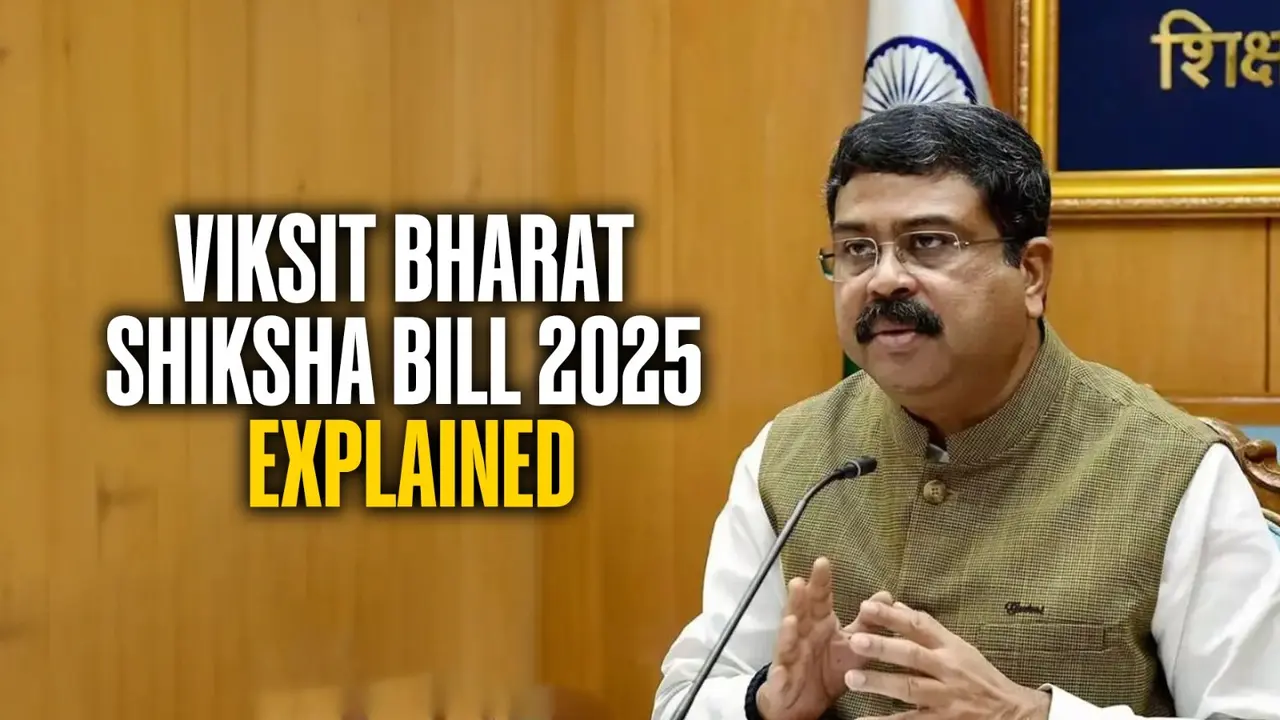
New Delhi: The Union Minister for Education, Dharmendra Pradhan, on Monday ( December 15) introduced the Viksit Bharat Shiksha Adhishthan (VBSA) Bill 2025 in the Lok Sabha, which aims at overhauling India’s higher education regulatory system by replacing the UGC( University Grants Commission), AICTE (All India Council for Technical Education), and NCTE (National Council for Teacher Education) with a new umbrella commission.
The VBSA bill also aims at streamlining regulations, reducing overlapping oversight by multiple authorities, and give institutions greater academic freedom. While Opposition members raised objections to the bill at the introduction stage and accused the Union government of overcentralising education through the proposed legislation, the bill was ultimately sent to a Joint Parliamentary Committee.
Why The Bill Matters
The bill matters as India’s higher education sector has long operated with multiple regulatory bodies, which often led to overlapping mandates, fragmented standards, and inconsistent approval mechanisms. The government, in a bid to address these structural challenges and align with the National Education Policy (NEP) 2020 vision, has introduced the Viksit Bharat Shiksha Adhishthan (VBSA) Bill, 2025.
Main Objective Of The Bill
- Improve academic quality, streamline regulation, and modernise governance in universities and higher educational institutions across India.
- Enable and empower universities to achieve excellence in teaching, learning, research, and innovation.
- The bill will also simplify regulation under a single, unified authority.
- The bill also aims to reduce bureaucratic red tape and duplication.
- VBSA bill will strengthen academic autonomy for universities and colleges.
- It will also align Indian higher education with global quality standards.
Structure Of The Commission
The Apex Umbrella body, the Viksit Bharat Shiksha Adhishthan, will consist of a chairperson and 12 other members, all of whom will be appointed by the President of India. The councils will have 14 members and the president and the members of the councils will also be appointed by the President on the recommendation of a search-cum-selection committee of the Union government.
Advertisement
Key Highlights of the Bill
A. Unified Apex Body
The bill will comprise three independent councils- Standards Council (Viksit Bharat Shiksha Manak Parishad), Regulatory Council (Viksit Bharat Shiksha Viniyaman Parishad) and Accreditation Council (Viksit Bharat Shiksha Gunvatta Parishad). Each council can have up to 14 members and VBSA will include members from the Education Ministry, State higher education institutions, and eminent experts.
Advertisement
B. Higher Education Regulation
With a plan to repeal UGC Act 1956, AICTE Act 1987, and NCTE Act 1993, it will create a single coherent framework for higher education regulation.
C. Single-Window Digital Platform
A faceless, single-window digital platform will oversee the approvals, inspections, and compliance processes
D. Greater Autonomy
Institutions will enjoy greater autonomy, especially high-performing universities.
NEP 2020 ALIGNMENT
The Statement of Objects and Reasons attached to the bill highlights that the National Education Policy (NEP) 2020 calls for a fundamental transformation of the education ecosystem. This includes redesigning regulatory and governance mechanisms to develop a system suited to the demands and ambitions of 21st-century learning.
It explains that the proposed law is rooted in the NEP’s view that the current regulatory framework is outdated and needs a thorough reworking to revitalise the higher education sector and support its long-term growth.
The document further outlines the NEP’s push for a “light but tight” oversight model- one that maintains accountability, transparency and efficient resource use through audits and disclosures, while also promoting innovation by granting institutions greater autonomy, strengthening governance, and encouraging creative approaches.
Institutions Covered
The proposed law applies to all central and state universities, colleges and Higher Educational Institutions (HEIs), institutions of national importance, institutions of eminence, and technical and teacher education institutions.
Professional programmes such as Medicine, Dentistry, Nursing, Law, Pharmacology, and Veterinary Sciences will continue under their respective regulators and thereby be exempted.
If implemented, VBSA Bill will not only streamline regulatory processes, but also ensure uniform academic standards nationwide. Furthermore, it will also reduce fragmentation among regulators and promote transparency in accreditation and governance.
Other Key Outcomes
- The VBSA Bill aims to place students and young learners at the centre of the higher education system by improving access, transparency and learner-oriented processes, with the goal of expanding outreach and boosting enrolment.
- It promotes holistic learning by encouraging critical thinking and creativity.
- Flexible academic frameworks will allow multidisciplinary study and support lifelong learning, including reskilling and upskilling.
- Greater emphasis on research and innovation aims to strengthen problem-solving and creative skills.
- The Bill supports global standards to improve the quality and international credibility of Indian universities.
- Increased autonomy for high-performing institutions is expected to drive innovation and better outcomes.
Get Current Updates on India News, Entertainment News, Cricket News along with Latest News and Web Stories from India and around the world.