
‘Neutralise And Destroy’: Israeli Envoy Details Israel’s Strategic Game Plan For Iran After Khamenei’s Assassination
In an exclusive interview with Arnab Goswami, Israeli Ambassador to India Reuven Azar says Israel is determined to “neutralize and destroy” Iran’s nuclear and ballistic missile programmes, outlines next steps after Khamenei’s death, and warns the operation could continue for weeks.
- India News
- 6 min read

;'%3e%3cpath%20d='m8,15.99c4.41,0,7.99-3.58,7.99-7.99S12.41,0,8,0,0,3.59,0,8s3.58,7.99,7.99,7.99Z'%20style='stroke:%23fff;%20stroke-miterlimit:10;%20stroke-width:.02px;'/%3e%3cpath%20d='m3.08,3.37l3.82,5.11-3.84,4.15h.87l3.37-3.64,2.72,3.64h2.94l-4.04-5.39,3.58-3.87h-.86l-3.1,3.35-2.5-3.35h-2.94Zm1.27.64h1.35l5.97,7.99h-1.35l-5.97-7.99Z'%20style='fill:%23fff;'/%3e%3c/g%3e%3c/svg%3e)


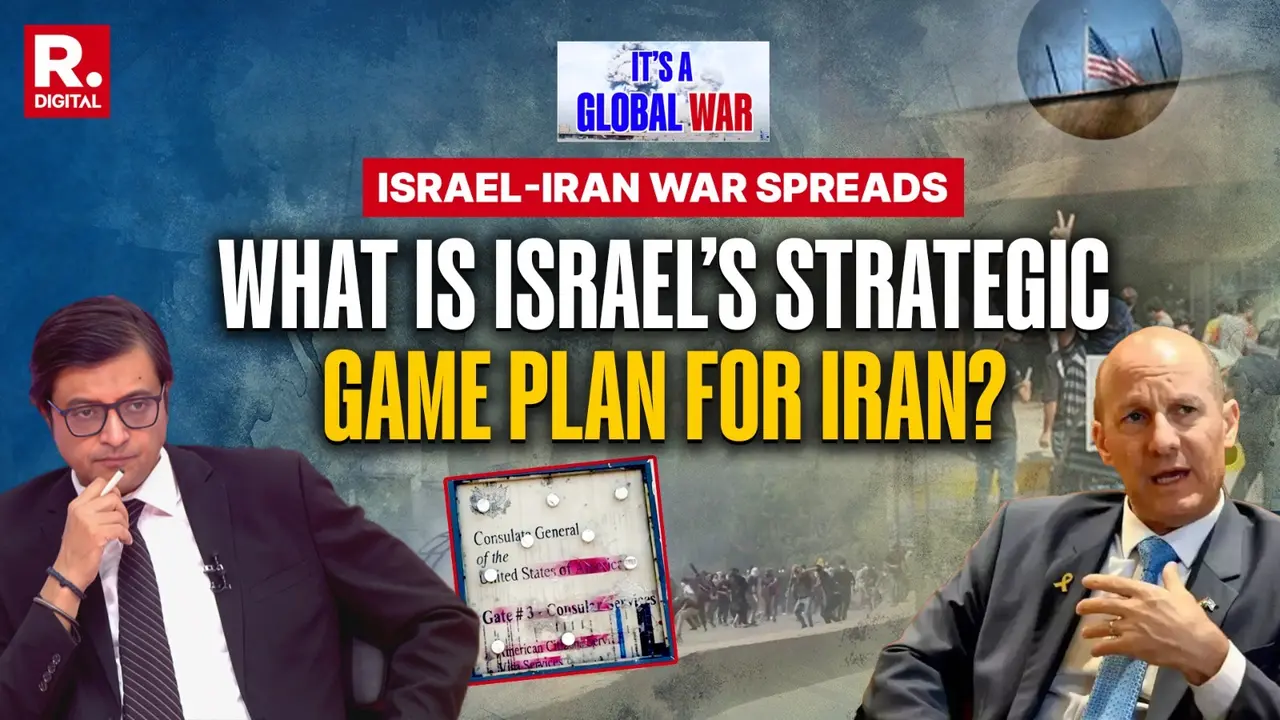
New Delhi: As military tensions escalate in the Middle East following joint US-Israel strikes on Iran, Israeli Ambassador to India Reuven Azar, in an exclusive conversation with Republic TV Editor-in-Chief Arnab Goswami, outlined Israel’s objectives and what lies ahead.
On Saturday, the United States and Israel conducted strikes on Iran, sharply intensifying an already volatile situation. Israel said it had launched pre-emptive attacks, while US President Donald Trump confirmed a “major combat operation.” Explosions were reported across parts of Iran.
Following the death of Iran’s supreme leader Ayatollah Ali Khamenei, Iran’s Revolutionary Guards vowed severe retaliation, promising what they described as their “most-intense offensive operation ever.” Airspaces across parts of the region were shut, oil prices spiked, and protests erupted in several countries.
‘Neutralize And Destroy Both Plans’
Responding to questions about what happens next after Khamenei’s death and whether Israel had planned for a leadership transition in Iran, Reuven Azar said:
Advertisement
“What Israel has in mind is to neutralize and destroy both plans that Iran, the Iranian regime, had to exterminate the State of Israel. The first is the military nuclear program, in which the regime invested tens of billions of dollars and has been deceiving the international community for years. And the second is the ballistic missile program. Both programs, in line also with their effort on the proxies, were directed in order to destroy us.”
He added:
“Now, we've tried negotiation for a long time. And now, we are determined to neutralize those threats.”
Advertisement
On the political future within Iran, Azar said:
“Now, regarding the game plan in Iran, I think it's up to the Iranian people to decide whether they're going to assume this opportunity. We've seen the Basij murdering, massacring tens of thousands of Iranian citizens. We hope the Iranians brace this moment and use it in order to change their country for the better.”
‘If They Stick With The Ayatollahs, The Situation Will Continue’
When asked what happens if the Iranian public does not move against the existing establishment, Azar responded:
“Well, I think that if the people around decide to stick with the Ayatollahs and do not use this moment, the situation will continue.”
Pressed further on whether that would mean a status quo, he said:
“Well, I don't know. I think that we have to see how the dynamics go, because once the regime is debilitated to the degree that it is, we think it's a matter of time until it will collapse. It hasn't brought anything good for the Iranian people, and I think more and more people, even within the ranks of the regime, are getting to that conclusion.”
‘This Operation Can Take Weeks’
On whether further strikes are likely, particularly around the strategically critical Strait of Hormuz, Azar said:
“I think this operation can take weeks. We are going to concentrate in the coming days. Don't forget it's an American-led operation. What Israel is going to do, in coordination with the United States, is to continue striking military targets. And, of course, we are taking also a lot of measures to defend, not only ourselves, but also together with the Americans, to defend the entire region from the attempts of Iran to strike it, where our air force is going after.”
With concerns mounting over oil prices and the possibility of Iran attempting to block the Strait of Hormuz, Azar added:
“Well, I think it will have a challenge to block the Strait of Hormuz because of the balance of power right now, which is overwhelmingly in favour of the American forces. We'll have to wait and see. They'll probably try to do that, but I'm not sure they're going to be able to.”
As uncertainty continues to prevail across the region, the developments mark a significant escalation in the Middle East conflict, with global political and economic implications unfolding rapidly.
Why did the US attack Iran?
Soon after explosions were reported in Tehran on Saturday, President Trump posted on social media accusing Iran of running an "unending campaign of bloodshed and mass murder targeting the United States".
Trump said Iran had refused every chance to give up its nuclear programme. He also claimed Iran was developing long-range missiles that could threaten Europe, US troops stationed abroad, and could even "soon reach the American homeland".
He referred to the 1979 seizure of the US embassy in Tehran, when dozens of Americans were held hostage for 444 days. He also mentioned the 1983 bombing of a US Marine barracks in Beirut by Iran-backed groups, which killed 241 people.
In January, Trump had promised to act if Iranian security forces cracked down on protests linked to the country’s economic crisis.
In June last year, the US bombed three nuclear facilities in Iran. Trump said the US Operation Midnight Hammer had "obliterated" Iran's nuclear programme.
Those US strikes last summer led to a ceasefire in a 12-day conflict between Iran and Israel. During that conflict, Israel had targeted Iranian nuclear, military and infrastructure sites, and Iran responded by firing hundreds of rockets and drones at Israel.
Why is Israel striking Iran?
Prime Minister Benjamin Netanyahu has long considered Iran to be Israel’s biggest threat. After the fall of Bashar al-Assad’s government in Syria, which was a key ally of Iran, and after Israel weakened the Iran-backed Hezbollah group in Lebanon, Israel launched direct attacks on Iran last summer.
Although Israel stopped its earlier campaign after the US struck Iran’s nuclear facilities, many analysts believed Netanyahu might resume military action if the opportunity arose. With elections scheduled in October, some believe the renewed conflict could also strengthen his position at home.
In a video message on Saturday explaining the new strikes, Netanyahu again said that Iran’s Islamic regime must not be allowed to obtain a nuclear weapon.
On Sunday, the Israeli military said the strikes were also linked to the Hamas attacks of October 7, 2023. A military spokesman said Israel “will not forget” the Iran-backed assault. He added, “We will continue to pursue Israel’s enemies, from the architects of the attack to the terrorists who took part in the massacre.”
Get Current Updates on India News, Entertainment News, Cricket News along with Latest News and Web Stories from India and around the world.