
‘We Are Peaceful Till...’: Col Lamba Revisits Operation Sindoor, Recalls War Strategy After One Year of Pahalgam Attack
One year after the Pahalgam terror attack, India faces a tough strategic dilemma, balancing public demand for stronger retaliation with rising risks of escalation. As tensions remain high, the Valley’s fragile peace highlights deeper challenges in 2026.
- India News
- 9 min read

;'%3e%3cpath%20d='m8,15.99c4.41,0,7.99-3.58,7.99-7.99S12.41,0,8,0,0,3.59,0,8s3.58,7.99,7.99,7.99Z'%20style='stroke:%23fff;%20stroke-miterlimit:10;%20stroke-width:.02px;'/%3e%3cpath%20d='m3.08,3.37l3.82,5.11-3.84,4.15h.87l3.37-3.64,2.72,3.64h2.94l-4.04-5.39,3.58-3.87h-.86l-3.1,3.35-2.5-3.35h-2.94Zm1.27.64h1.35l5.97,7.99h-1.35l-5.97-7.99Z'%20style='fill:%23fff;'/%3e%3c/g%3e%3c/svg%3e)


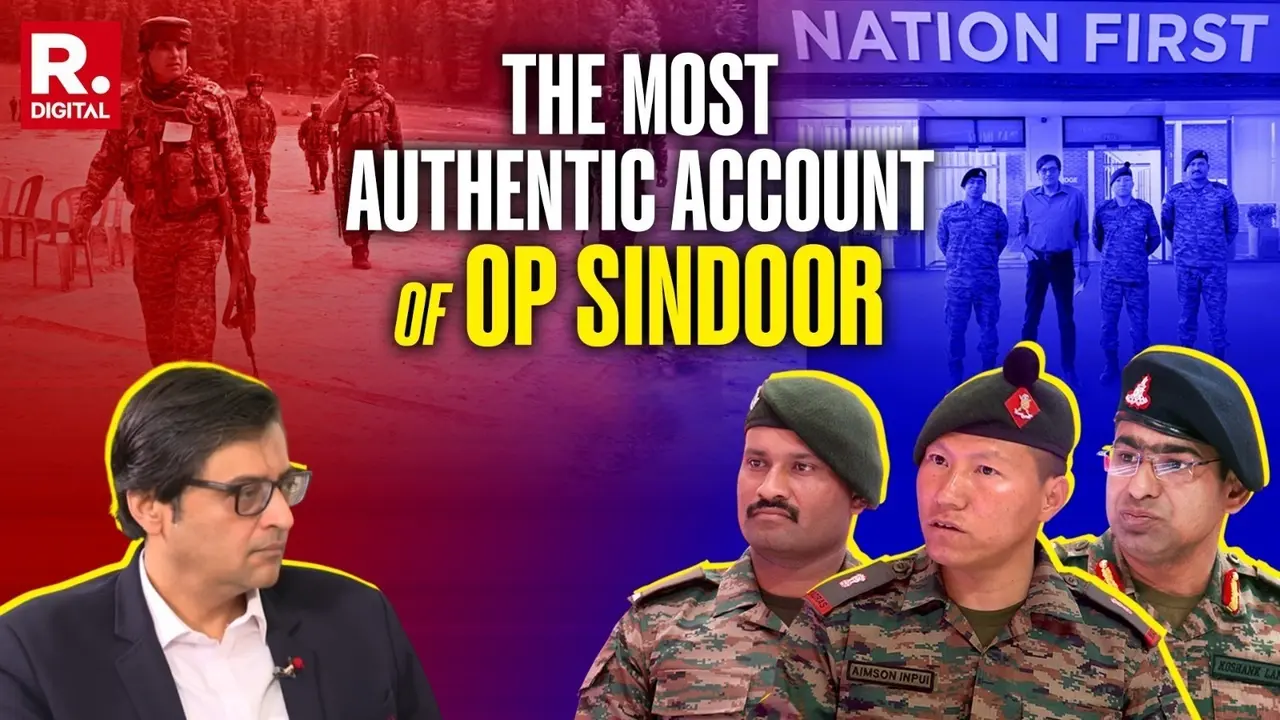
New Delhi: A year after the devastating Pahalgam terror attack of April 22, 2025, the scars remain, etched deeply in the hearts of victims’ families and in the collective memory of the nation. While life in Kashmir has gradually found its rhythm again, the pain, the questions, and the pursuit of justice continue. In a rare and exclusive conversation with Republic Editor-in-Chief Arnab Goswami, Colonel Koshank Lamba, the commanding officer during Operation Sindoor, opened up about the mission, the mindset, and the spirit of the Indian Army.
How Our Army Got Ready for This?
Recalling the immediate aftermath of the Pahalgam attack, Colonel Lamba detailed how preparations began almost instinctively.
“Okay. So, the preparation stage started primarily right after when the terror attack in Pahalgam happened. It's an inherent drill that when something of this nature happens, all the army units start preparing for an eventuality of escalation of operations. So, without any order, we started our preparation and battle procedures towards that. And a couple of days later, we were put on a high alert that we may have to mobilize to any of the undisclosed at that time area of operations and carry out certain operations.”
He emphasized that secrecy was paramount from the very beginning.
Advertisement
“Our battle procedures and drills started. One of the key facets at that time was to maintain secrecy, that since this movement is going to be a very large one, it should not be detected by enemy.”
Inside Operation Sindoor: Planning, Precision, and Execution
As troops moved into Kashmir and began operational planning, the focus sharpened on accuracy and preparedness.
Advertisement
“Thereafter, we moved, we were moved to Kashmir, we went there and we started our process of the analysis of targets, the acquisition of targets, how we would place our guns so that they are not affected by enemy actions. And thereafter, all this combination of actions and battle procedures, we got ready to carry out precision strikes on enemy. And finally, on the night of 6th, 7th, we unleashed precision strikes on enemy terror infra, thereby destroying a number of terror targets.”
The Mood Among Soldiers: ‘Josh and Energy’
Despite the secrecy, there was a shared understanding among the troops that something significant was coming.
“So, while we were preparing, I had to maintain secrecy. So, I had to keep what we are doing a secret from largely anyone in my unit. I was the commanding officer of the unit at that time. So, the information flow was on a need-to-know basis at that time. But people had anticipated, people were aware that something is going to happen and there was a lot of josh. There was a lot of vigor.”
“I did not find anybody having any apprehension or anybody slowing down. People were full of energy, wanting to do something. They had understood the responsibility that was being given to them.”
Precision Without Collateral Damage
One of the most challenging aspects of the operation was ensuring absolute accuracy while avoiding civilian harm.
“Absolutely, you don’t get a second chance. One of the directives given to us was that we have to be precise, very accurate, primarily to hit the target accurately and also to negate any collateral damage. The terror camps we are talking about were deliberately concealed within villages, within inhabited places. So, they were, in a way, using civilians as shields.”
He highlighted the role of advanced technology and intelligence.
“There were a lot of technological advances in play. We had access to live satellite imagery. We had access to very accurate target acquisition means. And we had intelligence infrastructure telling us that wherever we were hitting, there were no civilians and that the targets were indeed terrorist infrastructure.”
“After the higher headquarters amalgamated all this information and technology, what we got were very accurate grid references or coordinates.”
Training Overcomes Fear
Even under immense pressure, training proved to be the backbone of execution.
“Now, we had to engage that. You have to be doubly sure of your equipment and your training. You have to be confident and ensure you are not making a mistake. There is some stress, of course, but with relentless training and rehearsals, we overcome that.”
“The result is in front of you, we did not cause any collateral damage. All strikes were pinpoint accurate.”
Why Enemy Air Defence Couldn’t Stop the Strike?
Explaining the technical edge, Colonel Lamba pointed out the limitations of enemy systems.
“The artillery shell, when it goes, is next to impossible to interdict. By virtue of its size, around 48 to 50 kgs, air defence systems like guns or missiles are not designed to intercept artillery shells. They are designed to intercept aircraft and drones. An artillery shell has a very small radar cross-section, making it extremely difficult to detect and intercept.”
Facing Retaliation: Planning for the Worst
Anticipating enemy retaliation was a critical part of the strategy.
“Absolutely. This is one of the fundamental principles we use while planning operations of this scale. We anticipate what the enemy will do in response. Will they retaliate with artillery? Yes. So, what do I need to do to safeguard myself and also neutralize their artillery? Will they retaliate with drones? Yes. So, we plan to destroy those drones and reduce their capabilities.”
“This is called force preservation. We conceal ourselves, stay alert, anticipate enemy action, and plan how to counter and destroy it.”
A Story of High Moral by Colonel Lamba
Perhaps the most striking part of Colonel Lamba’s account was the spirit of his men under fire.
“This high morale, we feel this high morale with you. So when on the night of 6th and 7th, we opened up, within 15 odd minutes, Pakistani shelling had started coming on us. So our fire mission was finished at that time and we had preserved our equipment. And when we would hear the sound of the shells coming in, we would rush into the bunkers.”
“And when the shelling would stop, we would go out and start doing our duties. At that time I had to literally hold some people that not everyone is required to move out at this time. Some people can go out, do their duties, and again when they hear the sound, can come back.”
“But there were people fighting to get out of the bunker. A normal person would think that if bullets are falling and splinters are flying, I should go into the bunker and protect myself. But I had to literally rein in men.”
What Makes the Indian Army Different?
Colonel Lamba reflected on the deeper values that define the force.
“First is, even today, a very, very large segment of society, people from society who are joining the Indian Army as enlisted men or officers, are doing it for patriotic fervor and not as a job or for money.”
“Secondly, the kind of leadership which Indian Army exercises has a very strong role to play, Everyone is exercising leadership in their domain.”
“Thirdly, the training. I’ve been on a UN mission and I’ve seen how other countries train. I think I’ll agree with Major Jameson, we have a culture of training. There is no day that goes by when training in a battalion or regiment is not happening.”
What is Colonel Lamba’s Message for Young Generation?
While choosing his words carefully, Colonel Lamba made it clear where India stands.
“I’m too junior to give a message to the adversary, but if I have to say something, I would say that the Indian Army always remains prepared.”
“We were prepared to deal with contingencies in Operation Sindhu. We were able to execute it at very short notice and carry it out successfully. We are prepared today as well.”
“We are peaceful till the time we are peaceful. But if a chance is given or if we are tasked to carry out that damage, then we can be very, very violent.”
A Nation’s Pride, A Soldier’s Story
Colonel Lamba’s words are not just a recounting of a military operation, they are a reflection of courage, discipline, and an unshakable sense of duty. One year after Pahalgam, as families continue to heal and the nation continues to seek answers, stories like these remind us of the men who stand silently at the borders, prepared, precise, and unwavering.
WATCH THE FULL INTERVIEW:
Get Current Updates on India News, Entertainment News, Cricket News along with Latest News and Web Stories from India and around the world.