
Explained: What is the Thiruparankundram’s Karthigai Deepam Row?
The Thiruparankundram Hilltop, where a temple and a Muslim shrine (dargah) stand together, has witnessed recurring clashes centred around ritual practices repeatedly in Tamil Nadu.
- India News
- 5 min read

;'%3e%3cpath%20d='m8,15.99c4.41,0,7.99-3.58,7.99-7.99S12.41,0,8,0,0,3.59,0,8s3.58,7.99,7.99,7.99Z'%20style='stroke:%23fff;%20stroke-miterlimit:10;%20stroke-width:.02px;'/%3e%3cpath%20d='m3.08,3.37l3.82,5.11-3.84,4.15h.87l3.37-3.64,2.72,3.64h2.94l-4.04-5.39,3.58-3.87h-.86l-3.1,3.35-2.5-3.35h-2.94Zm1.27.64h1.35l5.97,7.99h-1.35l-5.97-7.99Z'%20style='fill:%23fff;'/%3e%3c/g%3e%3c/svg%3e)


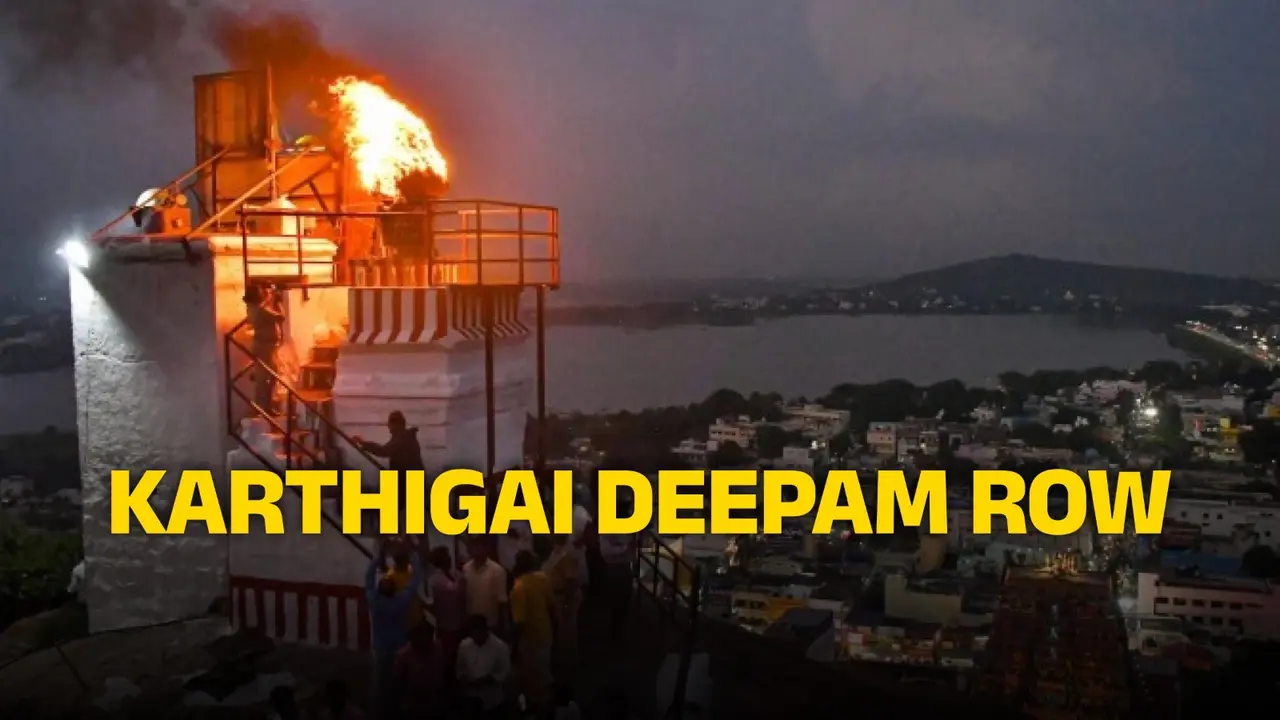
Karthigai Deepam Row: The Thiruparankundram Hill is a shared religious site, home to both a Murugan temple and a centuries-old dargah. For over three decades the hill has witnessed the recurring conflicts over ritual practices, which have repeatedly sparked political tensions in Tamil Nadu.
The origins of the dispute trace back to 1994, when a Hindu rights activist was killed during unrest surrounding the lighting of the Karthigai Deepam lamp. The controversy flared up again in 2014 following allegations of meat being consumed on temple land adjacent to the dargah, an act that provoked significant public anger. The situation was further inflamed when DMK ally Navas Kani performed a goat sacrifice during the Islamic holy month of Ramzan.
In 2023, a separate attempt to rename the location Sikandar Hill sparked protests statewide, leading to a legal ruling that formally reinstated the site's original name, Thiruparankundram.
What Led to the Karthigai Deepam Row?
- The recent conflict started when petitioner Ravi Kumar sought permission to light the Karthigai Deepam at the Deepathoon pillar.
- Devotees say the flame once burnt atop the Deepathoon for more than 1,300 years, but the ritual stopped nearly 80 years ago.
- Since then, the lamp has been lit at a mid-hill Ganesh temple, but demands to restore the original practice have persisted.
Significance of the Karthigai Deepam Ritual
- The Karthigai Deepam ritual, observed on the full moon of the Tamil month Karthigai, dates back to Sangam era traditions around 200 to 300 BCE.
- Tamil communities celebrate it as a symbol of light triumphing over darkness.
- The Thiruparankundram hill is seen as one of the most sacred sites for Tamil Hindus, with its Deepathoon being described as a divine beacon once lit with ghee and camphor.
Madras High Court Ruling and State resistance
- On December 1, Justice G R Swaminathan of the Madras High Court issued an order permitting the lamp to be lit atop the hill on December 3 before 6 pm.
- The state government opposed the move, arguing the ritual had not been practised for eight decades.
- The government filed an appeal and maintained that law and order concerns justified restraint.
December 3: The Breakdown
- As the court’s 6 pm deadline passed, the lamp remained unlit.
- Justice Swaminathan convened an unusual 6 pm video conference demanding answers from the Madurai collector and police commissioner.
- Officials cited the pending appeal and delays from the Department of Hindu Religious and Charitable Endowments of Tamil Nadu.
- The judge then permitted the petitioners to go up with CISF protection and light the lamp himself.
- But Section 144 was already in force on the hill. Police blocked entry, arguing CISF could not override state security deployment.
- Barricades fell, stones were thrown, and several were injured as the unrest unfolded.
- On December 4, the Madurai High Court again heard contempt charges and instructed the collector to personally oversee preparations and the commissioner to ensure the ritual was carried out.
- The lamp still remained unlit.
- Justice Swaminathan sought a detailed report from the CISF commandant on why the order could not be implemented and why prohibitory orders were imposed.
- Meanwhile, the state government approached the Supreme Court, leading to the High Court adjourning the matter.
- The Chief Justice of India directed that the case would be listed only after all documents from the state were filed.
Accusations and Political Escalation
- The BJP accused the DMK government of being “hell-bent” on disobeying the High Court and provoking communal tension.
- BJP leaders alleged the state was using prohibitory orders to evade the court’s directives.
- Protests erupted across Tamil Nadu, including outside the DMK headquarters in Chennai.
- BJP State President Nainar Nagendran was detained. BJP Leader Vinoj Selvam was arrested.
- Countering BJP’s claims, DMK leaders said vested groups were trying to inflame unrest and accused the judiciary of yielding to political pressure.
- Kanimozhi Karunanidhi moved an adjournment motion in Parliament, raising concerns about attempts to create disharmony.
56 Ex-Judges Defend Madras HC Judge After Impeachment Motion Filed by Opposition
Fifty-six retired judges, among them former justices of the Supreme Court, have released a statement backing Justice G.R. Swaminathan of the Madras High Court. Justice Swaminathan, who presided over the Thirupparankundram Subramaniaswamy temple case, is now facing an impeachment motion from opposition parties.
Advertisement
In their statement, the former judges voiced strong disapproval, taking "serious exception" to the impeachment effort.
This move comes after more than 100 parliamentarians from the INDIA bloc, which includes figures like Congress's Priyanka Gandhi Vadra and Samajwadi Party chief Akhilesh Yadav, formally submitted the impeachment motion to Lok Sabha Speaker Om Birla earlier this week.
Advertisement
'Lamp Can Be Lit on Hilltop': In Major Win for Hindus, Madras HC Upholds Ritual
The Madras High Court on Tuesday upheld the right to light the Karthigai Deepam at the Deepathoon stone pillar atop the sacred Thiruparankundram hillock, rejecting fears of law and order issues and strongly pulling up the state and temple authorities for their objection.
Pronouncing the verdict, a Division Bench of Justices G Jayachandran and KK Ramakrishnan said the practice of lighting the Deepam at an elevated place is meant for all Hindu devotees to witness and found no plausible reason for the temple management to deny the request.
The court termed as “ridiculous and hard to believe” the state’s apprehension that lighting the lamp on temple land would disturb public peace. It also criticised the “mischievous submission” that the stone pillar belonged to a dargah, observing that such claims only deepen mistrust between communities.
Get Current Updates on India News, Entertainment News, Cricket News along with Latest News and Web Stories from India and around the world.